

Copyright ⓒ Aju Press All rights reserved.
Related News
-
 Small Business Ombudsman Discusses Expansion of Cosmetics and Pharmaceuticals in Iksan Food Cluster
MycoGenics, which produces health functional foods and mushroom-based functional cosmetics, has received separate factory approval in Eumseong, North Chungcheong Province, to manufacture cosmetic ingredients. While utilizing production facilities in the national food cluster in Iksan, Jeollabuk-do could have reduced expansion burdens, the cluster does not allow the cosmetics industry to establish operations. Sim Bong-kyu, executive director of MycoGenics, stated, "Today's industries are trending towards convergence, but we are dividing permissible industries in a compartmentalized manner," urging for the expansion to allow combined manufacturing of health functional foods and cosmetics.The rigid regulations on resident industries in the national food cluster in Iksan, the only food-specialized national industrial complex in South Korea, are expected to be eased. This comes as the government and the small business ombudsman have agreed to actively pursue institutional improvements in response to the challenges faced by resident companies looking to expand into pharmaceuticals and cosmetics.On November 24, Choi Seung-jae, the small business ombudsman, held a field meeting with resident companies and officials from relevant agencies at the Korea Food Industry Cluster Promotion Agency in Iksan, where they reviewed key location and operational regulations within the industrial complex.During the meeting, companies urgently appealed for the expansion of permissible industries in the national food cluster. Typically, health functional foods, cosmetics, and pharmaceuticals often diversify into these businesses beyond their main operations; however, in this industrial complex, pharmaceuticals are excluded from 'finished pharmaceuticals,' and cosmetics are entirely omitted from permissible industries. As of August this year, the proportion of health functional food manufacturers within the national food cluster reached 14.9% (11.3% of the leased area), but expansion into cosmetics or pharmaceuticals is blocked.Lee Yoon-cheol, production management director at Enterobium, remarked, "Although we are headquartered in Goyang, we moved to Iksan to start health functional food production due to support and location conditions, but we now have to find another external site to produce finished pharmaceuticals," suggesting the need for industry expansion to allow for finished pharmaceutical production.There were also calls to lift the usage restrictions on beverage-only plots. Yoo Young-eop, CEO of the beverage manufacturing company 'Seomuldamda,' stated, "It is difficult to diversify products with the existing beverage plots," urging for the conversion of both leased and unleased beverage plots into 'food and beverage plots.'In response, the government and the ombudsman expressed a willingness to find proactive solutions. Kim Jae-min, head of the National Food Cluster Promotion Team at the Ministry of Agriculture, Food and Rural Affairs, stated, "While maintaining the identity of the cluster, we will actively consult with the Ministry of Trade, Industry and Energy and the Ministry of Land, Infrastructure and Transport to improve the procedures for changing industries," adding that discussions regarding the conversion of beverage plots into food and beverage plots will also be conducted proactively with relevant agencies.Choi Seung-jae emphasized, "As technology and market environments rapidly converge, regulations should not hinder the pace, and the Ministry of Agriculture has expressed a willingness to accept this request, so we will break down the barriers between departments and closely collaborate with the agencies involved to ensure that changes on the ground lead to substantial institutional innovation and job creation."Companies attending the meeting also proposed the establishment of procedures for operating shared factories for health functional foods and allowing instant sales manufacturing and processing business reports for startups using shared kitchens. Park Eun-jin, a small business ombudsman officer, explained, "If the manufacturing quality management (GMP) standards for shared factories are established and implemented next year, we will actively review institutionalization plans for health functional food shared factories based on the results of their operation after safety verification."* This article has been translated by AI.
-
Korean Kolmar Develops AI Technology to Predict Skin Safety of Cosmetics
Korean Kolmar is collaborating with the Korea Research Institute of Chemical Technology to develop technology that predicts the skin safety of cosmetics using artificial intelligence (AI). The plan aims to shorten development time by predicting skin reactions and ingredient absorption rates before product production, while also addressing international cosmetic safety regulations.Korean Kolmar announced on the 18th that it signed a memorandum of understanding (MOU) with the Korea Research Institute of Chemical Technology on the 17th for the development of AI-based skin impact prediction technology. The signing ceremony was attended by Moon Byeong-seok, head of Kolmar Holdings' technology research center, and Shin Seok-min, head of the Korea Research Institute of Chemical Technology.The two organizations will collaborate on joint research of AI-based skin impact prediction technology, technology exchange, validation and performance review of the prediction technology, and demonstration and verification of prediction models using representative ingredients and formulations.Korean Kolmar plans to develop a dedicated AI model for cosmetics that predicts skin reactions and ingredient absorption rates through this collaboration. The focus will be on predicting not only single ingredients but also formulations that combine multiple raw materials.Once the technology development is complete, it will be possible to predict the impact on the skin and the degree of ingredient absorption based on formulation information before prototype production. Formulations that include safety regulation target ingredients such as organic UV filters, preservatives, and surfactants can also be checked during the design phase.The Korea Research Institute of Chemical Technology will be responsible for model development based on its existing AI-based single substance and mixture toxicity prediction technology. Korean Kolmar will validate the commercialization potential of the technology using actual cosmetic ingredient and product information.After the technology development, Korean Kolmar plans to apply the model to its own research and development (R&D) process. The goal is to enhance formulations at the product design stage, reducing development time and costs for client companies and supporting their entry into overseas markets.A representative from Korean Kolmar stated, "Through this agreement, we have established a foundation to confirm skin safety from the early stages of product development," adding, "We will develop K-beauty products that consumers around the world can trust and support our clients' global market entry."Meanwhile, Korean Kolmar recorded double-digit growth rates in both domestic corporate sales and operating profit in the third quarter of this year, thanks to growth in its cosmetics business. Operating profit was provisionally reported at 81.9 billion won (KRW), a 40.5% increase compared to the same period last year. Sales reached 828.2 billion won (KRW), marking the highest figure ever recorded for the third quarter.* This article has been translated by AI.
-
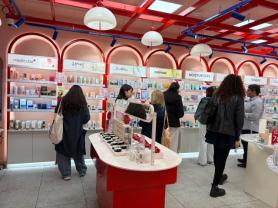 AJP FAQ: How the world falls in love with Korean cosmetics?
Customers browse South Korean beauty products at a store in London on Oct. 9, 2026. Q: Why are South Korean beauty products becoming so popular overseas? A: The global reach of K-pop, South Korean dramas and celebrities has helped boost the popularity of homegrown beauty products around the world. Many people want glowing skin like their favorite South Korean stars, with cosmetics offering affordable, easy-to-use products to help them build their own skincare routines. Q: What is the secret behind South Korean beauty products' global success? A: The Korean Wave may open the door, but product quality helps keep customers coming back. Many South Korean beauty brands offer innovative and endlessly-inventive formulas, lightweight textures and products designed for different skin types and concerns. They are also quick to launch new products in response to fast-changing skincare trends. Some brands also use traditional herbal ingredients such as ginseng, alongside more unusual ones like snail mucin, an ingredient many customers might never expect to find in a skincare bottle. Q: Are South Korean beauty products affordable? A: Many Korean brands offer competitively priced products across different budgets, allowing customers to experiment with new skincare routines without necessarily spending a fortune. Many of them also offer a wide range of products from affordable everyday skincare to premium cosmetics. Combined with competitive prices and perceived quality, this variety makes them attractive to international shoppers. An artificial intelligence (AI)-generated image Q: Is this popularity reflected in export figures? A: Absolutely. South Korea's cosmetics exports reached a record US$11.43 billion in 2025, up 12.3 percent from the previous year, with products shipped to more than 200 countries. With the American market now its largest export destination, South Korea overtook the U.S. to become the world's second-largest cosmetics exporter, although it still lags far behind France, which posted $24.3 billion in exports, more than twice South Korea’s total. Q: Can South Korea's cosmetics boom last? A: That depends on whether brands can keep delivering products that customers like, rather than relying only on viral trends or resting on their laurels. Competition is growing, and international consumers are becoming more demanding and capricious. But the bottom line is that South Korean beauty products' global success is no overnight miracle. It is the result of a mix of Korean cultural influence, product innovation, competitive prices and clever social media marketing. Indeed, the Korean Wave has now made its way onto bathroom shelves around the world.