
If this trend continues, annual exports could surpass $10 billion for the first time, surpassing the previous record of $9.22 billion set in 2021.
The trade surplus also reached an all-time high of $3.97 billion, with imports totaling $850 million.
This achievement coincides with major Korean companies such as Amorepacific, LG Household & Health Care, Kolmar Korea, and Cosmax expanding their global presence with their overseas production facilities.
While China remains the largest market for Korean cosmetics at $1.21 billion, exports to the U.S. grew by 61.1 percent to $870 million, and Japan saw a 21.5 percent increase to $478 million.
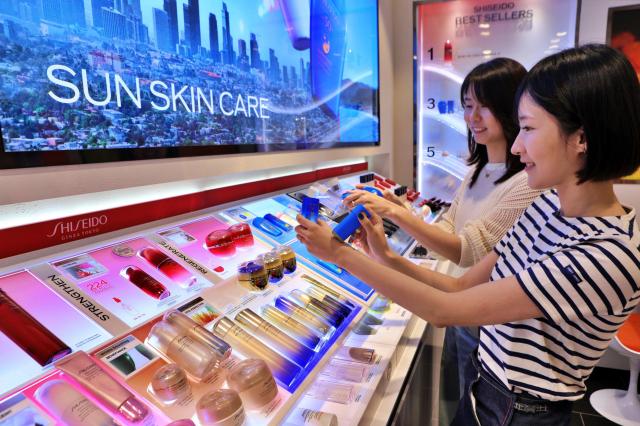
The North American market is showing particularly strong growth, with major companies reporting annual increases of 40-50 percent in recent years. This growth is partly driven by increasing interest in anti-aging and sun protection products.
Meanwhile, France remains the top source of cosmetics imports for South Korea, reflecting the enduring popularity of established global beauty brands.
Korean cosmetics are now exported to 195 countries. The success of “K-beauty” can be largely attributed to the global spread of Korean cultural content, including films, dramas and social media.
The industry is also seeing success with independent indie brands, particularly in the U.S. market, where Korean suncare products are gaining popularity.

Candice Kim
Candice Kim is a dedicated business and technology reporter specializing in the intersection of high-tech innovation and fast-paced consumer trends. Her core beats span the semiconductor, IT, cosmetics, and retail sectors, where she provides in-depth coverage of industry titans including Samsung Electronics, SK hynix, and LG Electronics, alongside leading consumer brands like Olive Young and Musinsa. Whether analyzing complex silicon supply chains or tracking the latest shifts in beauty and fashion retail, Candice is committed to delivering sharp, accurate reporting that keeps readers informed on the forces shaping today's most dynamic markets.
Copyright ⓒ Aju Press All rights reserved.
Related News
-
 Exploring Natural Products Research Institute in Gangneung for New Drugs and Cosmetics
On November 17, I visited the Natural Products Research Institute at the Korea Institute of Science and Technology (KIST) in Gangneung. This institute studies the efficacy of various native natural products in South Korea and develops cutting-edge raw materials for new drugs and cosmetics. Upon entering the institute's 'natural product library,' I was struck by the darkly lit walls filled with square frames.Inside the frames were 1,013 species of plants displayed in their entirety, from roots to leaves. These natural products had completed technology transfer and patent registration and were stored as specimens.A notable natural product was the native plant, astragalus, found in the Nocheonsan area of Gangneung. Park Jin-soo, the head researcher at the Natural Products System Biology Research Center, explained, "Various compounds have been discovered in astragalus, and among them, we found a component with anti-inflammatory effects, for which we have filed a patent application."Natural products have fewer side effects and can be used for extended periods. Their range of applications has been broad, having been used in folk remedies for a long time. However, identifying and extracting the active ingredients can be challenging, requiring lengthy research periods.The results of long-term research can be astonishing. Recently, the institute achieved notable results with 'astragalus.' Typically, astragalus roots are added when making samgyetang (ginseng chicken soup). The institute focused on 'astragalus sprouts.'Park explained, "When we analyzed astragalus sprouts instead of the roots, we found beneficial components for skin beauty and whitening, and the patent has been completed. We expect technology transfer to be finalized within this year," adding that plans are in place to cultivate astragalus sprouts in smart farms for commercialization as cosmetic ingredients next year.In the Hwanggye AI demonstration farm, similar initiatives were observed. The AI demonstration farm introduced 'hops,' known for their use in brewing. With high-value components identified in hops for skin care, the farm plans to mass-produce hops to verify their potential for high value. Currently, hops are not visible due to the cold weather, but they are expected to be seen around May next year.Natural products are extracted and stored in vials under ultra-low temperatures to prevent changes in their composition. The extracted samples are stored in a database (DB) with identifiable information through barcodes. This is to test combinations with various natural products using artificial intelligence (AI) and to find components that maximize efficacy.The institute has been early in adopting AI for research. The NPI Finder is a prime example. The NPI Finder allows researchers to simultaneously search for chemical components, protein targets, and disease information central to natural product research. Coupled with the evolutionary chemical bonding similarity (ECBS) prediction model, it enables rapid exploration of new disease applications for natural products.Park Geun-wan, head researcher at the Natural Products Information Research Center, stated, "In the past, it took a long time to find active natural products and then isolate effective components. With the introduction of AI, we can now predict active ingredients and mechanisms of action first, leading to significant qualitative changes in our research."The ECBS, which quickly explores compounds with similar functions, has gained international recognition. In the CACHE Challenge, an international competition for predicting AI-based new drug candidates, Park Geun-wan achieved joint victory in the third round and sole victory in the fourth round.The Natural Products Research Institute also has an animal laboratory, where experiments are primarily conducted on mice. Mice breed quickly and have a close living radius to humans. Research on 'dry age-related macular degeneration eye drops' conducted by Seo Mun-hyung, head of the Natural Products Efficacy Optimization Research Center, also involved mouse experiments.Age-related macular degeneration is a condition where abnormalities in the macula lead to decreased vision and distorted perception, primarily affecting the elderly. A treatment for the milder 'dry age-related macular degeneration' was first released in 2023 as an injection and is currently the only option available.However, the injection has significant side effects. Seo focused on eye drops, particularly on the toll-like receptor (TLR) inflammatory signaling, identified as a major cause of macular degeneration. TLR protects our bodies through inflammatory responses, but if misregulated, excessive inflammation can occur.Seo searched for substances that inhibit this signaling and developed a final peptide that can regulate it.He verified the effectiveness of the discovered peptide by administering it to the eyes of mice induced with dry age-related macular degeneration over about three weeks, confirming its therapeutic potential. Seo anticipates completing toxicity tests by the first half of 2028, followed by clinical stages, with eye drops expected to be available around 2035.Kim Joo-sun, director of the KIST Gangneung Natural Products Research Institute, commented, "The system of extracting natural products and synthesizing them into new drugs has been established. We expect a global blockbuster drug to be released in the market soon."* This article has been translated by AI.
-
Curly Beauty Festa 2026: Experience Cosmetics and Receive Gifts
“It’s great to see various cosmetics in one place, and with gifts and discounts, I plan to come every year.” A woman in her 30s and her mother in her 60s shared this sentiment on November 12 at the Curly Beauty Festa 2026 held at the Dongdaemun Design Plaza (DDP) in Seoul. They mentioned they had come for a day out together and that this was their second visit after last year. The Curly Beauty Festa, which allows attendees to try and compare cosmetics sold online, kicked off on November 12 and runs until the 15th at the DDP Art Hall. This year marks the third edition of the event, featuring 45 brands including SK-II, Eucerin, Sabon, and Amelie. Before the 10 a.m. opening, a long line formed at the entrance as many visitors arrived early. The venue is organized into four themed zones: morning, day, evening, and night. The Morning Zone showcases cleansers and gentle skincare products, while Dr. For Hair offers scalp diagnostic services. The Day Zone features sun care and makeup products, the Evening Zone highlights hair and body products along with foot care demonstrations, and the Night Zone allows visitors to experience high-performance skincare and beauty devices. In the Curly Zone set up in each area, various events such as scent sampling and games took place. In the Morning Curly Zone, attendees could smell the “1450 Gobulso Breeze Jasmine Toothpaste,” co-developed by Curly and LG Household & Health Care, and receive the product. In the Night Curly Zone, samples of the “Duera 5X Two-Step Facial Film Mask” were provided after examining its formulation. Upon entry, visitors received a welcome bag, and upon leaving, they were given a gift bag filled with beauty products. Throughout the venue, QR codes allowed attendees to check product discounts or request delivery for the items they experienced. This year, a new feature called “Beauty Curly Icon” introduced 48 popular beauty products. Curly reduced the number of participating brands from 60 last year to 45 this year to enhance the quality of experiences rather than quantity. A Curly representative explained, “Visitors found it difficult to explore all booths while participating in events and waiting in line. We organized the layout to allow for focused experiences at each brand.” This year, approximately 14,000 visitors are expected. Curly is investing in offline events to cultivate its beauty business as a new growth driver. In the third quarter of this year, the transaction volume for Beauty Curly increased by 25% compared to the same period last year. The transaction volume for brands participating in last year’s Beauty Festa also saw an average ninefold increase year-over-year. Curly will hold an “November Grand Beauty Curly Festa” online until November 19, offering over 5,600 products at discounts of up to 90%. This strategy aims to connect on-site experiences with online purchases to broaden its customer base. Kim Go-eun, head of Curly's brand marketing group, stated, “We aim to provide customers with intuitive and sensory beauty experiences through curated offerings across four daily time zones.”* This article has been translated by AI.
-
Korean Cosmetics Firm Kolmar Reports 40.5% Increase in Q3 Operating Profit
Korean cosmetics company Kolmar reported significant growth in both sales and operating profit for its domestic subsidiary in the third quarter, driven by the expansion of its cosmetics business.On November 6, Kolmar announced that its consolidated operating profit for the third quarter reached 81.9 billion won, a 40.5% increase compared to the same period last year. Sales rose by 21.3% to 828.2 billion won, marking the highest quarterly figure to date. Net profit for the period increased by 22% to 51.7 billion won.The improvement in performance was led by the domestic cosmetics sector. The standalone sales of Kolmar's domestic subsidiary in the third quarter rose by 34.7% to 433.7 billion won, while operating profit surged by 42% to 62.9 billion won.In terms of product sales distribution, skincare accounted for the largest share at 48%, followed by sun care at 32% and makeup at 15%. The top 10 customers contributed to 57% of total sales.In contrast, the overseas subsidiaries continued to struggle. The companies in China and Canada reported increased losses, while the U.S. subsidiary saw significant sales growth but continued to incur operating losses.The Chinese subsidiary's sales fell by 4.5% year-on-year to 30.4 billion won, with an operating loss of 4.4 billion won. This decline was attributed to weaker-than-expected orders from major color cosmetics clients, leading to higher fixed costs. The Canadian subsidiary's sales decreased by 12% to 8.1 billion won, with an operating loss of 1.6 billion won.Meanwhile, the U.S. subsidiary's sales surged by 122% to 18 billion won, but it still faced an operating loss of 3.8 billion won.Yunwoo, a subsidiary that manufactures cosmetic containers, improved its performance thanks to the growing demand for K-beauty products. In the third quarter, Yunwoo's sales increased by 35.1% year-on-year to 83.5 billion won, and it returned to profitability with an operating profit of 3 billion won.Kolmar anticipates that the growth trend in its domestic cosmetics business will continue into the fourth quarter. The company is operating its major domestic production lines at maximum capacity and has secured production volumes through the end of the year. It plans to focus on increasing production capacity in anticipation of rising demand in the first quarter of next year.* This article has been translated by AI.