
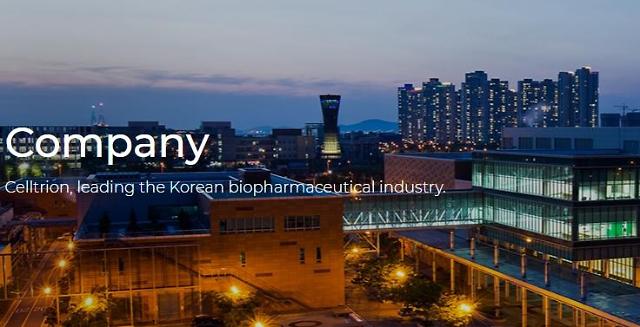
[Courtesy of Celltrion]
SEOUL -- Celltrion, a leading biosimilar manufacturer in South Korea, has signed a joint development agreement with Intract Pharma, a British bio company, to develop oral infliximab in the form of pills. Infliximab is the basic ingredient of Remsima, a copy of Janssen Biotech's Remicade treating rheumatoid arthritis and Crohn's disease.
Celltrion said in a statement it would provide infliximab as a raw material for clinical trials, while Intract is in charge of development and verification based on its oral formulation technology that efficiently delivers protein medicines such as antibodies to the intestines.
Celltrion said it would secure rights to preferred negotiation upon completion of second-stage clinical trials and receive part of sales in royalties when exporting technology. Even if Intract or a third party succeeds in commercializing it, Celltrion will provide infliximab exclusively for the production of commercial materials. Intract is to launch clinical trials next year for patients with inflammatory bowel disease.
Celltrion has unveiled Remsima SC, the subcutaneous injection of Remsima, that can ben injected into the fat layer beneath the skin at home. The company has adopted an aggressive strategy to secure profitability and price penetration in competition with other subcutaneous-type products such as Adalimumab sold under the brand name of Humira, which is on the World Health Organization's list of essential medicines.

Copyright ⓒ Aju Press All rights reserved.
Related News
-
 OPINION: KOSDAQ at 30 needs to grow up
Ticker at KRX lobby. AJP D/B Life begins at 30, so they say. Investors in KOSDAQ are still waiting for the junior stock market to grow into the promise of its birth as Korea’s answer to Nasdaq. The market turned 30 in July. By Thursday, its index stood more than 30 percent below its starting level on today’s scale. In an otherwise rewarding year for many stock markets, including its bigger sibling KOSPI, the KOSDAQ has lost about 22 percent. For two sessions this week, it seemed ready to shake off the gloom. The index gained 10.35 percent despite the Nvidia leadership drama and fears of a sharp U.S. Federal Reserve rate increase. Speculation about fresh government support gave investors something else to trade on. Then came the denial. The KOSDAQ ended Thursday down 1.22 percent at 696.53 after financial authorities dismissed reports that they would announce another support package Friday. It remained 43.34 percent below its April intraday peak of 1,229.42. President Lee Jae Myung on the day called for faster development of the KOSDAQ and reform of the venture capital ecosystem so innovative companies could raise funds as they grow. He urged consistent reforms to improve corporate value and shareholder returns, alongside measures to encourage long-term investment. Earlier in the morning, the Financial Services Commission (FSC), Financial Supervisory Service and Korea Exchange had denied online claims of an imminent package. The rumors included loosening or phasing out the daily 30 percent stock-price limit and measures to encourage retail trading. The FSC warned that spreading groundless rumors could constitute unfair trading. The positions are not formally contradictory. The president called for market development; regulators denied a specific announcement and its supposed contents. They were right to correct false information. But investors were left with another round of presidential encouragement and regulatory rebuttals, without a clearer understanding of when promised reforms would change the market they own. That gap is fertile ground for speculation. Broad pledges sustain expectations of official support. Rumors supply the missing details. Denials send investors scrambling to reassess them. Companies’ earnings and prospects struggle to compete with guesses about the next government announcement. The scoreboard shows why investors are so eager for relief. Source: Financial Supervisory Service. Compiled and edited by AJP. Graphics AI assisted. A longer history chart is more uncomfortable. The KOSDAQ is 30.35 percent below its July 1, 1996 base level of 1,000 on today’s scale. The original base was 100 before a tenfold rebasing in 2004. The comparison excludes dividends, and the companies making up the index have changed. Even with those qualifications, it is a poor anniversary portrait for a market created to finance Korea’s future. Nor is the weakness confined to its smallest companies. The KOSDAQ 150 closed at 1,149.35, down 47.27 percent from its March peak of 2,179.57. The index of its leading stocks has lost nearly half its value. Thirty years on, it remains a junior market whose successful companies have reasons to leave and whose investors repeatedly turn to the government for reassurance. The departures of NHN, now Naver, Kakao and Celltrion for the main board illustrate the problem. A Korea Capital Market Institute study found that the exit of stronger companies weakened KOSDAQ performance and could encourage further transfers. When growing up means moving elsewhere, the market loses the businesses that could demonstrate its own maturity. Some companies nurtured on KOSDAQ have succeeded elsewhere. Korea has produced corporate successes without building an equally successful destination for sustained investment in its growth market. Another weakness lies in the gap between financing innovation and evaluating it. Young technology companies may need years of research before producing meaningful revenue. Conventional earnings screens alone cannot distinguish a promising laboratory from a business surviving on its next capital raising. A November study by the Korea Capital Market Institute found that companies admitted through technology-special listing provisions often continued to report losses while investing in research after going public. Their aggregate five-year stock performance concealed a wide divide between a small number of strong winners and many laggards. Opening the listing gate is only the beginning of the market’s job. Investors need reliable information about what happens afterward. For a biotech company, that means clinical progress, cash requirements and the commercial significance of licensing agreements. For an industrial technology company, it means whether announced partnerships produce customers, revenue and cash flow. Repeated announcements cannot substitute for evidence of progress. External shocks compound these weaknesses. Higher interest rates make distant profits less valuable today, while uncertainty over AI spending can unsettle smaller suppliers. A market with credible disclosures and committed institutional investors is better equipped to assess those risks than one waiting for the next support rumor. The government already has a reform agenda. In March, the FSC outlined market segmentation, faster removal of failing companies and measures to broaden institutional participation. It also noted that the benchmark used in public fund management evaluations had been changed to include a 5 percent KOSDAQ component. Investors should now be able to judge implementation and results. Start with communication. The presidential office and financial authorities should publish a shared timetable identifying what has been approved, what remains under consultation and who is responsible for delivery. Rumor rebuttals should accompany accessible progress reports on actual reforms. A denial should leave investors better informed about policy. Then make remaining on KOSDAQ attractive to successful businesses. A credible upper segment could help if admission rests on sustained disclosure quality, governance and operating performance. It must give investors a useful distinction and companies a reason to stay. Attaching a premium label without changing the investment experience would accomplish little. Long-term capital also needs people equipped to deploy it. Independent research, specialist fund managers and evaluation periods that reflect the time needed to commercialize technology would help. Pension funds should retain investment discretion. Directing them to support an index would transfer the market’s problems to retirement savers without repairing its foundations. Investor protection must become visible in daily practice. Authorities should pursue manipulation and misleading disclosures promptly, scrutinize financing arrangements that dilute existing shareholders and enforce credible exit standards. Genuine research risk deserves patient capital. Concealing setbacks or repeatedly selling implausible promises does not. Reform should be measured by the quality of post-listing disclosures, progress toward commercialization, institutional ownership over time and the retention of strong companies. Listing counts, turnover spikes and a few buoyant sessions reveal far less about whether the market is doing its job. Expanding price limits might change trading behavior. Fresh incentives might bring buyers through the door. Neither gives those buyers a durable reason to remain shareholders. The president is right to emphasize long-term investment. His administration must now make that ambition concrete enough to displace the daily guessing game over stimulus. At 30, KOSDAQ needs investors who stay because companies deliver. Another rumor-driven rally would only postpone growing up. * The writer is managing editor of AJP. ** The views expressed are the writer’s own and do not necessarily reflect those of AJP.
-
 KLPGA Tour Welcomes the Era of Kim Min-sol
Kim Min-sol, born in 2006, has dominated the 2026 season of the Korea Ladies Professional Golf Association (KLPGA) Tour, ushering in the 'Kim Min-sol Era' by sweeping the Player of the Year, prize money leader, and Rookie of the Year awards.On November 8, Kim finished the KLPGA Tour's final event, the Daebo House D Championship, at the Seowon Hills Course in Paju, Gyeonggi Province, with a score of 8-under 208, tying for sixth place.With this performance, Kim added 42 points to her Player of the Year total, bringing her season total to 567 points. Heading into the final event, she trailed Seo Kyo-rim by 38 points but managed to overcome the deficit. Seo finished the final round with a score of 4-over 220, tying for 52nd place and ending the season with 563 points.Earlier, on October 4, Kim secured the Rookie of the Year title at the 26th Hite Jinro Championship. In the prize money category, she accumulated 1.628 billion won, surpassing Seo Kyo-rim's 1.420 billion won to claim the top prize. Kim is the first player in KLPGA history to exceed 1.6 billion won in a single season.It has been 20 years since a rookie has claimed both the Player of the Year and prize money leader titles in the same season, a feat last achieved by Shin Ji-ae in 2006, who also won the lowest stroke average and most titles that year.After the tournament, when asked which award brought her more joy, Kim said, "I tried not to think about the Player of the Year, but I did some calculations yesterday. So today, I valued every stroke. I don't know how it will turn out, but I have no regrets. If I win the Player of the Year, it will be more meaningful because it was harder to achieve."Standing at 178 cm, Kim is known for her long drives and was nicknamed 'Giant Baby' since her amateur days. In 2023, she contributed to the national team's victory at the World Amateur Team Championships and won a silver medal in the women's team event at the Hangzhou Asian Games. She joined the Doosan Construction We've Golf Team as a founding member that year.Her professional debut was not smooth. After becoming a KLPGA member in July 2024, Kim finished 83rd in the regular tour seed ranking event that year, leading her to start in the second-tier Dream Tour last year.However, her resurgence came quickly. Kim won four times on the Dream Tour last year, honing her skills. She then secured her regular tour seed by winning the KLPGA Tour BC Card & Han Kyung Ladies Cup in August, where she led wire-to-wire. She added her second victory at the Dongbu Construction & Korea Land Trust Championship in October.Kim's participation in 15 regular tour events last year did not meet the required number, allowing her to retain her rookie status into this season. Her impressive performance led her peers to name her a strong candidate for Player of the Year during the season-opening media day.With high expectations, Kim started the season strong, winning all three of her titles in the first half of the year. She claimed her first major victory at the 40th Korean Women's Open in June and triumphed at the McCall & Mona Yongpyong Open later that month after a second playoff hole. Although she did not win in the second half of the season, she remained competitive in major tournaments, finishing as runner-up at the BC Card & Han Kyung 48th KLPGA Championship after a playoff against Seo Kyo-rim and tying for second at the Hite Jinro Championship, where she secured her Rookie of the Year title.This season, Kim's most notable achievement has been her consistent performance. She made the cut in all 25 tournaments she entered, finishing in the top 10 11 times, including three victories.Regarding her consistent cuts, Kim stated, "I believed that making the cut was the most important. There were moments when I almost missed the cut, but I tried not to give up and do my best. There were times I made the cut by just one stroke. I focused a lot on the process. When I thought about the results, things often didn't go well."Her long drives and precise iron shots have also drawn attention. Kim ranked second in driving distance with an average of 259.50 yards and led the tour with 11 eagles, surpassing the previous single-season record of nine set by Jang Hana in 2013. She also ranked third in average strokes (70.76) and average birdies per round (3.60), proving her elite status on the tour.Doosan Construction has seen success with Kim's rise, having supported her from her professional transition through her time on the second-tier tour to securing her spot on the regular tour. After signing a sub-sponsorship deal with Shin Ji-ae last year, Kim had the opportunity to learn from the veteran. Last month, she met with Shin to gain insights and advice from her experiences.Kim expressed her gratitude, saying, "This season will be unforgettable for me. I am truly happy and honored to have won my first major title, along with the Player of the Year, prize money leader, and Rookie of the Year awards. I believe this achievement is thanks to Doosan Construction, my teammates, and the fans who supported me at every tournament, known as 'Weber.'"Having made her debut on the international stage at the US Women's Open and AIG Women's Open this year, Kim plans to participate in more overseas tour events next year. She said, "I want to participate in as many major tournaments as possible. This year, my goal was to gain experience and make the cut, but next year, I want to grow and compete at a higher level."However, the KLPGA Tour this season was not solely Kim's domain. Other players also showcased impressive performances in the title race.Seo Kyo-rim, last year's Rookie of the Year, began her season with her first career win at the Celltrion Queens Masters and followed it up with victories at the MediHeal & Korea Ilbo Championship and the major 48th KLPGA Championship, securing four wins and the title of most victories. Despite battling rib pain in the second half of the season, she finished second in Player of the Year points (563) and second in prize money.The lowest stroke average award went to Yoo Hyun-jo, who won the final Daebo House D Championship with a total score of 14-under 202, achieving her third victory of the season. Yoo managed to lower her average score to 70.68 in the final tournament, overtaking Seo Kyo-rim.This season, a record five players surpassed 1 billion won in prize money, including Kim Min-sol, Seo Kyo-rim, and Yoo Hyun-jo (1.185 billion won), along with Lee Ye-won (1.049 billion won) and Kim Min-sun 7 (1.045 billion won), breaking the previous record of four players.Additionally, Park Min-ji set a record for the most career wins (20) with her victory at the Sh Bank MBN Women's Open in May and became the first player to surpass 7 billion won (7.085 billion won) in total prize money at the Hana Financial Group Championship.* This article has been translated by AI.
-
KOSPI Rebounds Over 1% Despite Foreign Selling; Semiconductor Stocks Perform Well
The KOSPI, which started lower, has turned around and risen over 1% as major semiconductor stocks like Samsung Electronics and SK Hynix show strength. Despite foreign investors selling more than 500 billion won, institutional buying is supporting the index's rise. In contrast, the KOSDAQ continues to decline due to weakness in top market capitalization biotech and secondary battery stocks.According to the Korea Exchange, as of 10:42 a.m., the KOSPI is up 69.17 points (1.37%) at 5,128.86. The index opened at 5,034.20, down 25.49 points (0.50%) from the previous session, but quickly reversed course and expanded its gains.In the securities market, institutions have made a net purchase of 399.2 billion won. Meanwhile, individuals and foreigners have sold a net 6.7 billion won and 504.7 billion won, respectively, indicating a selling trend.Most of the top market capitalization stocks are performing well. Samsung Electronics is up 3.02%, SK Hynix is up 4.77%, SK Square is up 2.49%, Samsung Biologics is up 2.51%, KB Financial is up 0.73%, and Celltrion is up 0.95%. Conversely, LG Energy Solution is down 2.52%, Samsung Electro-Mechanics is down 1.15%, and Hyundai Motor is down 0.89%.The KOSDAQ index continues to show weakness. At the same time, the KOSDAQ index is down 1.26 points (0.20%) at 643.01. The index opened at 638.82, down 5.45 points (0.85%) from the previous session. In the KOSDAQ market, individuals and institutions have made net purchases of 148.7 billion won and 19.3 billion won, while foreigners have sold a net 172.7 billion won.Among the top market capitalization stocks, Alteogen is down 17.51%, EcoPro is down 4.38%, EcoPro BM is down 4.69%, Rainbow Robotics is down 3.89%, HLB is down 2.72%, and Samchundang Pharm is down 0.12%. On the other hand, JUSUNG Engineering is up 7.68%, Simtech is up 5.67%, IOTech is up 4.06%, and Rino Industrial is up 0.54%.* This article has been translated by AI.