
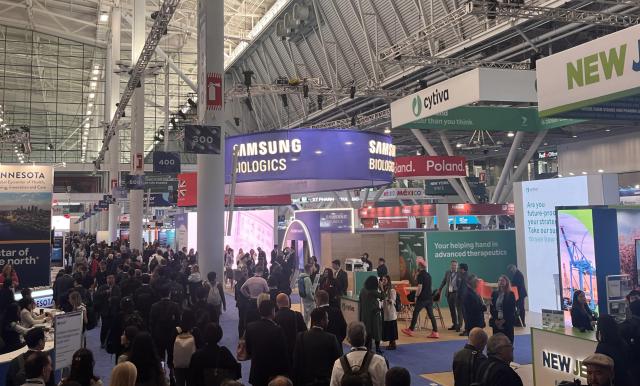
The four-day event, held at the Boston Convention and Exhibition Center, marks the 32nd edition of the world’s largest biotechnology trade show.
“BIO 2025 offers Korean biotech companies an unparalleled global platform to showcase their technologies and establish transformative partnerships,” said Jurie Hwang, director of public and international relations at the Korea Biotechnology Industry Organization (KoreaBio).
The convention takes place against the backdrop of evolving pharmaceutical markets.
With the U.S. under renewed political pressure to curb rising drug prices, South Korean firms are eyeing the American biosimilar market, where several high-profile patents are nearing expiration.
South Korea’s pharmaceutical sector made a notable showing at this year’s gathering.
Samsung Biologics, Celltrion, Lotte Biologics and SK Biopharmaceuticals were among the major companies hosting large-scale booths aimed at securing global partnerships and licensing agreements.
Kim Dong-young
Kim Dong-young is a bilingual journalist at AJU Press (AJP), covering Korean tech, energy, and bio/pharma.
He reports from the field at events like CES and APEC, runs AJP's YouTube channels,
and is pursuing a master's at Sogang's MOT program.
Copyright ⓒ Aju Press All rights reserved.
Related News
-
 Korean biotech firms eye share of expanding gene therapy market
An image of DNA/ Yonhap SEOUL, May 29 (AJP) - South Korean biotechnology companies are stepping up efforts to stake a claim in the burgeoning global gene therapy market, which is projected to swell to approximately $366 billion by 2032, according to a new industry report. The Korea Biotechnology Industry Organization has released an analysis citing data from the market research firm MarketsandMarkets, projecting the sector will grow at a compound annual rate of 19.4 percent — rising from $72 billion in 2023. Gene therapy, which seeks to modify or replace defective genes to treat disease, has gained momentum as medical research deepens and global investment accelerates. Among the various modalities, gene silencing therapies accounted for the largest share of the market last year, generating roughly $34 billion in revenue, or 47.7 percent of the total. Gene augmentation therapies followed with $21 billion, while cell replacement treatments contributed around $15 billion. The report also highlighted the dominance of the neurological segment, which represented 57.4 percent of the market — equivalent to about $41 billion — driven by increasing incidence of chronic diseases and a growing appetite for advanced therapeutic options. “The diversity of approved and commercialized treatments, along with high therapeutic efficacy for major neurological diseases, has driven growth in this sector,” the report noted. North America retained its position as the global leader, with market revenue of approximately $36 billion, underpinned by robust biopharmaceutical manufacturing infrastructure, active drug development pipelines, and significant R&D investment. In South Korea, industry leaders are making strategic moves to align with global trends. Samsung Bioepis, a major biosimilar producer, has identified gene therapy as a central pillar of its future growth strategy. ABL Bio, traditionally focused on antibody treatments, is expanding its pipeline to include gene therapy platforms. Meanwhile, RNA-based biotech firm Rznomics recently entered into a high-profile licensing agreement with Eli Lilly. The deal, valued at more than $19 billion, centers on precision RNA therapies aimed at treating hereditary hearing loss — marking one of the most significant cross-border biotech collaborations to date.
-
 GS charts new course with digital pivot, generational shift
GS E&C headquarters in Jogno, Seoul/ Yonhap Editor's Note: This article is the 19th installment in our series on Asia's top 100 companies, exploring the strategies, challenges, and innovations driving the region's most influential corporations. SEOUL, May 21 (AJP) - As it marks its 20th anniversary this year, GS Group — one of South Korea’s largest conglomerates — is doubling down on digital transformation in a bid to reverse slowing growth and streamline operations in an increasingly volatile economic landscape. The group commemorated the milestone on March 28 with a ceremony at the newly inaugurated GS Art Center, where leaders of its corporate relatives — LG, LIG, and LS — gathered in a rare family reunion of the once-unified LG empire. “GS has consistently pursued growth despite rapidly changing business environments,” said Chairman Huh Tae-soo in a celebratory toast. “We’ve cultivated a world-class petroleum export business in a country without a single drop of oil, built retail networks that enhance daily convenience, and expanded our construction business to improve quality of life.” As the group embarks on its third decade, Huh emphasized a return to the founding ethos of “change and challenge,” positioning innovation as a catalyst for the next phase of growth. Now ranked among South Korea’s top 10 business groups, GS traces its roots to LG Group, co-founded by Koo In-hoe and Huh Man-jung in 1947. Family expansion and growing concerns over succession eventually led to the separation of LG into four corporate branches: LG, LIG, LS, and GS. GS Group officially came into being in 2004 under the leadership of Huh Chang-soo, who established GS Holdings and spun off the group’s construction, oil refining, and logistics arms — forming what are now GS Engineering & Construction (GS E&C), GS Caltex, and GS Retail. GS E&C CEO Huh Yoon-hong during a visit to the firm's construction site in Incheon, May 8, 2025/ Courtesy of GS E&C A worker flies a drone to inspect a GS Caltex factory. Courtesy of GS Caltex During its early years, GS pursued rapid expansion. In 2009, the group acquired trading firm SsangYong for 120 billion won ($84 million), rebranding it as GS Global to capitalize on international networks. In 2014, it executed its largest deal yet: a 564.9 billion won acquisition of STX Energy, which became GS E&R. The group’s assets more than tripled from 18.7 trillion won in 2004 to 58.5 trillion won in 2014, while revenue nearly tripled to 64 trillion won. Although growth has moderated in recent years, the company has focused on consolidating core businesses. But challenges remain. GS Group’s total fair assets fell 1.9 percent over the past year to 79.31 trillion won — bucking the trend of Korea’s major conglomerates, whose combined assets rose 7.4 percent to 3,301.8 trillion won. GS Caltex continues to anchor the group’s performance, accounting for 57 percent of total sales, 30 percent of assets, and 27 percent of EBITDA in 2024, according to Korea Credit Rating. Last year, GS Caltex posted 47.61 trillion won in revenue and 548 billion won in operating profit — down 2 percent and a steep 67.5 percent, respectively, from the previous year. A GS spokesperson cited a slowdown in Chinese demand and uncertainties surrounding U.S. tariff policies as key headwinds for the refining and petrochemical sectors. “The resolution of tariff uncertainties and a rebound in global demand will be crucial for our second-half performance,” the official said. Still, GS Caltex is pressing forward on sustainability. On May 14, the company announced it had led regulatory improvements at the International Maritime Organization (IMO) to promote bio-marine fuels. Amid external pressure and a tightening market, GS Group reported first-quarter revenue of 6.24 trillion won in 2025 — a 0.8 percent decline from the previous year and a 2.6 percent dip from the prior quarter. Operating profit rose 29.5 percent quarter-on-quarter to 800.2 billion won, but still marked a 21.3 percent drop year-on-year. Net profit surged 297.1 percent from the previous quarter to 291.5 billion won, though it remained 38.8 percent lower than the same period last year. In response, the group trimmed its number of affiliates in 2024 to boost operational efficiency. Key moves included GS E&C’s sale of stakes in Zeit O&M and GS Elevator to private equity firm Genesis. Inside the company, a generational shift is also underway. Chairman Huh Tae-soo is overseeing a fourth-generation leadership transition, with younger executives stepping into key roles. Among them is Huh Suh-hong, appointed CEO of GS Retail in 2024. Seen as a departure from GS’s traditionally conservative approach, Huh Suh-hong has pushed for bold moves — including the acquisition of biosimilar company Hugel, signaling a shift toward healthcare and consumer innovation. Now leading the retail arm, he aims to reposition the company amid growing competition from e-commerce players. “We’re laying the groundwork for a new era,” he said recently. To that end, GS Group is investing in artificial intelligence across its petroleum, construction, and retail divisions — part of a broader effort to reignite growth and remain competitive in a fast-evolving global economy. A GS25 convenience store collaborating with FC Seoul/ Courtesy of GS Retail
-
 US biotech firms urge Korea to ease restrictions on modified crops
Getty Images Bank SEOUL, March 19 (AJP) - U.S. biotechnology companies are pressing South Korea to revise its laws governing living modified organisms (LMOs), arguing that the country’s approval process for agricultural imports is overly stringent and lacks transparency. The Biotechnology Innovation Organization (BIO), the world’s largest biotech trade group based in Washington, recently submitted a formal request to the Office of the United States Trade Representative (USTR), describing South Korea’s regulatory framework for LMOs as “non-tariff barriers that have remained unresolved for over a decade.” At the heart of the dispute is South Korea’s multi-agency risk assessment process, which requires approvals from various ministries — including the Ministry of Health and Welfare, the Ministry of Environment, and the Ministry of Oceans and Fisheries — depending on the intended use of the product. “Despite global standards and the Korea-U.S. Free Trade Agreement, South Korea imposes risk assessments for LMO agricultural imports, rendering the approval process unpredictable,” BIO stated in its submission. “Resolving this issue is impossible without amending Korea’s LMO law.” Among the companies affected is J.R. Simplot, an Idaho-based potato producer, which has been awaiting South Korean approval for three LMO potato varieties since 2016. The review process, now in its ninth year, underscores the challenges faced by American agricultural firms seeking access to the South Korean market. The renewed push for regulatory changes comes amid high-level trade discussions between the two nations. Agricultural sanitary and phytosanitary measures were reportedly a focal point in a March 14 meeting between South Korea’s trade minister, Cheong In-kyo, and USTR Representative Jamieson Greer. South Korean officials have acknowledged industry concerns but remain cautious. “If an official request regarding amendments to the LMO law is received, we will review the possibility of improvements after gathering opinions from relevant ministries,” a government official said.