
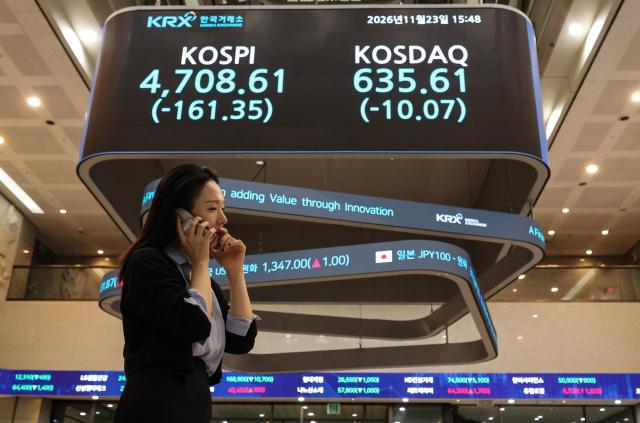
The AI payback has been harsh. Wall Street has entered a correction, Taiwan has suffered its worst weekly rout on record and Korea’s KOSPI has hurtled back to January levels.
The benchmark closed Monday down 3.31 percent at 4,708.54, its lowest since Jan. 13 and nearly half below its June intraday peak.
Finance Minister Lee Hyoung-il said Monday that South Korea had contingency measures ready beyond its stock market stabilization fund, but gave no timetable or size for deploying it.
Financial authorities agreed Sunday to prepare the 10.76 trillion won ($8.1 billion) fund for possible activation. Plans announced in 2020 and 2022 did not lead to stock purchases; deployment now would mark its first use since the 2008 global financial crisis.
Lee ruled out Taiwan-style short-selling curbs, saying Korea’s rules were already stricter than those of other advanced economies. Authorities will instead conduct a three-month crackdown on illegal short selling.
The Financial Services Commission (FSC) also approved a three-month relaxation of daily share-buyback limits, effective Tuesday through Feb. 23.
Listed companies will be allowed to buy all the shares covered by their buyback filings in a single day. The existing daily ceiling is the larger of 10 percent of the planned purchase or 25 percent of the preceding month’s average daily trading volume, capped at 1 percent of outstanding shares.
Buybacks through trusts will be permitted up to the total value of trust assets, replacing the daily limit of 1 percent of outstanding shares. All buybacks remain subject to the Commercial Act’s distributable-profit limit.
Investors had braced for a Black Monday after the Nasdaq Composite lost 10.02 percent in the week through Nov. 20, its steepest weekly decline since March 2020. Taiwan’s TAIEX plunged 17.5 percent, Japan’s Nikkei 225 shed 7.7 percent and the KOSPI lost 7.95 percent.
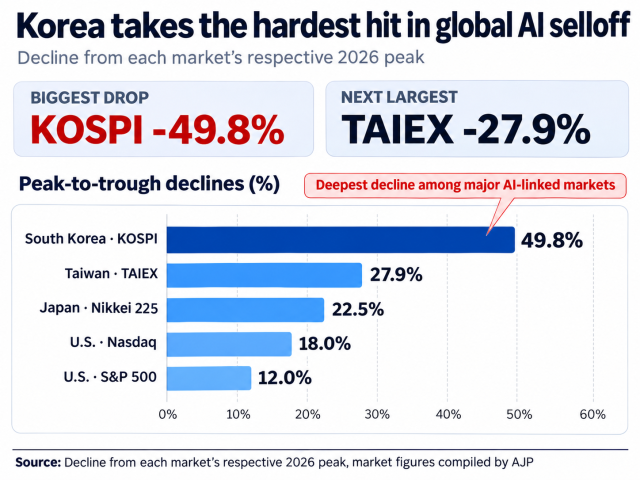
The losses run deeper from this year’s peaks.
By Friday, the KOSPI had fallen 48.1 percent from its June 19 intraday high of 9,385.59. Taiwan’s TAIEX was down 27.9 percent from its October high and Japan’s Nikkei had lost 22.5 percent from its June peak.
The Nasdaq was about 18 percent below its October record, while the S&P 500 had lost roughly 12 percent. A decline of 10 percent from a recent high conventionally marks a correction and 20 percent a bear market, putting all three Asian benchmarks in bear territory.
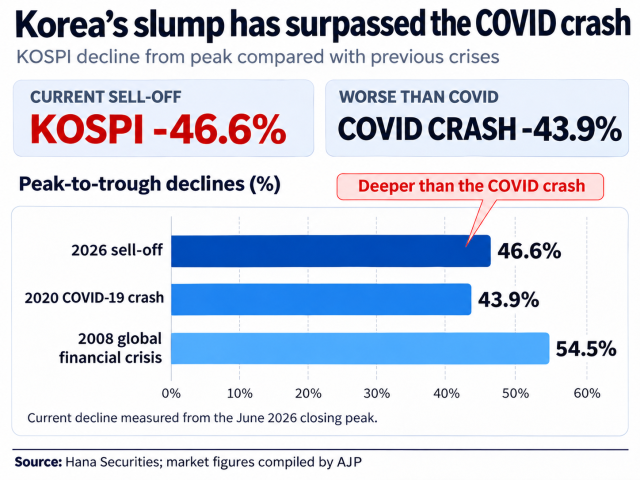
Measured from its June closing peak, the KOSPI had fallen 46.6 percent by Friday. That exceeded the 43.9 percent decline from its 2018 high to the COVID-19 crash in 2020, though it remained short of the 54.5 percent plunge during the 2008 financial crisis.
According to Hana Securities, 81 percent of KOSPI 200 companies have lost at least 40 percent from their highs this year, including 61 percent that have fallen by half or more.
The selling has swept through smaller companies as well. The KOSDAQ was down 0.50 percent at 642.43 in Monday afternoon trading, following a 7.72 percent loss last week.
Samsung Electronics and SK hynix, which powered much of Korea’s earlier rally, sit at the center of the downturn.
Taiwan faces similar pressure. Its TAIEX fell 6.23 percent to 36,033.29 on Friday, capping its worst week on record. The island’s Taiwan Semiconductor Manufacturing Co. (TSMC), the world’s largest contract chipmaker, produces Nvidia’s advanced AI processors and has benefited from the same U.S. investment boom that lifted Korean memory makers.
Yang Jun-sok, an economics professor at the Catholic University of Korea, attributes Korea’s sharper decline partly to the scale of its earlier rally and its concentration in memory chips.
“Korea and Taiwan are in similar situations, but Korea has fallen further partly because its stocks rose much more,” Yang told AJP. “Korea has bet heavily on high-bandwidth memory. If the AI boom stalls, it will be among the hardest hit.”
“TSMC has more flexibility. Even if the AI boom slows, it can shift toward other types of chips,” he said. “Korea, by contrast, is much more dependent on one part of the market, and investors are pricing in that risk.”
“Outside semiconductors, Korea’s economy has already been slowing,” Yang added. “We would be fortunate if the downturn in Korea stops here.”
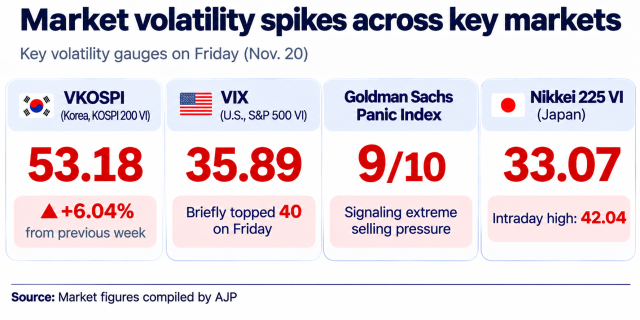
Volatility gauges reflect the anxiety. Korea’s VKOSPI stood at 53.18 on Friday, up 6.04 percent over the week. Wall Street’s Cboe Volatility Index briefly topped 40 before closing at 35.89, while Goldman Sachs’ proprietary Panic Index reached 9 out of 10.
Japan’s Nikkei 225 Volatility Index hit 42.04 during Friday’s session before closing at 33.07.
Behind the panic is a loss of confidence in the AI trade, compounded by political and regulatory uncertainty.
Nvidia plunged 14.01 percent Friday, bringing its decline from its October peak to roughly 48 percent. Founder Jensen Huang’s departure, uncertainty over U.S. restrictions on chip exports to China and a Securities and Exchange Commission investigation into its accounting practices have rattled investors.
Yang sees limited immediate damage to the company’s business.
“There is practically no alternative to Nvidia,” he said. “It has already secured two to three years’ worth of chip orders, so Huang’s departure is unlikely to dent earnings in the near term.”
Whether Nvidia can maintain its technological lead without its founder is a longer-term question.
Even Anthropic’s blockbuster stock market debut offered little relief. Shares in the developer of the Claude AI chatbot rose on their first trading day Thursday but fell the following session.
U.S. spending on AI infrastructure has fueled demand for advanced chips from Korea and Taiwan. Some export earnings have flowed back into American financial markets, reinforcing an investment cycle sometimes called the “technodollar.”
That leaves Asian suppliers exposed if American investment slows.
“Korea isn’t building the AI data centers,” Yang said. “Fundamentally, this depends on whether American AI companies continue investing. If U.S. customers stop buying, there is very little Korea can do.”
A Yuanta Securities analyst offered a different assessment, attributing the selloff to foreign selling, high U.S. interest rates and reduced exposure to AI stocks rather than deteriorating corporate earnings.
“With no buyers to cushion the blow, the index has largely moved in step with foreign selling,” the analyst said.
Earnings forecasts remained intact, he said, making an easing of foreign selling crucial to a recovery.
Leverage has added to the pressure. Outstanding margin loans stood at about 26.1 trillion won on Nov. 19, according to the Korea Financial Investment Association.
Forced sales linked to unsettled stock purchases surged to 63.04 billion won on Nov. 10 before easing to 12.01 billion won on Nov. 19. Those figures have yet to capture the fallout from Friday’s decline.
Further losses could trigger more forced selling, complicating efforts to stabilize the market.
Yang questioned whether the stabilization fund would provide a durable buffer.
“If it actually starts buying, some might think, ‘There’s money in the market now, so I’d better sell while I can.’ That could fuel even more panic,” he said.
Taiwan offers a cautionary example. Authorities activated its NT$500 billion ($15.2 billion) National Financial Stabilization Fund on Nov. 6. Stocks initially rebounded but resumed their decline, leaving the benchmark below its level before the intervention was announced.
Still, some analysts see valuations approaching a floor.
Hana Securities said the KOSPI had fallen to valuation levels comparable with previous financial crises. BNK Investment & Securities identified 4,500–4,700 as a possible bottom if current risks were fully priced in.
Hana’s more bearish scenario puts the index near 4,300 if its price-to-book ratio returns to levels preceding the semiconductor rally.
U.S. Treasury yields have eased as investors seek safety, with the benchmark 10-year yield hovering around 4.9 percent. Borrowing costs nevertheless remain elevated, leaving markets vulnerable to further Federal Reserve tightening.
The turmoil has revived comparisons with the dot-com bust of 2000, when the collapse of internet-stock speculation sent technology shares into a prolonged decline.
For Seoul investors, the next cue will again come from overnight trading on Wall Street.
“What worries me most is what happens in the U.S. market tonight,” Yang said. “If Wall Street plunges again tonight, the fallout could really get out of control.”

Ryu Yuna
Yuna Ryu covers finance, capital markets and Southeast Asian affairs.
She is drawn to the questions that numbers raise and the stories that data alone cannot answer.
Prior to journalism, she worked at Hyundai Motor Company and the Singapore Chamber of Commerce, focusing on business strategy and international affairs. She has also hosted diplomatic receptions and international conferences as an MC.
Ryu holds a master's degree in Media and Communication from Korea University, where her research focused on neuroscience-based studies of media effects.
Copyright ⓒ Aju Press All rights reserved.
Related News
-
 Sidecar kicks in as KOSPI slides more than 5%
SEOUL, November 23 (AJP) -A five-minute “sidecar” halt to program selling kicked in Monday as South Korea’s stock rout deepened. Retail investors joined foreigners in dumping AI shares, sending chip bellwethers SK hynix and Samsung Electronics down nearly 6 percent. The KOSPI sank 5.86 percent to 4,586.75 as of 11:23 a.m., extending Friday’s 5.21-percent slide. The last time KOSPI closed under 4,600 was on Jan. 9. Losers overwhelmed gainers 878 to 21 to underscore the depressed sentiment. Foreigners selling a net 181.3 billion won and retailers 44.4 billion won. Tags: KOSPI, sidecar, SK hynix, Samsung Electronics, foreign selling, retail investors
-
KOSPI Plummets 4.88%, Threatening 4600 Level Amid Selling Pressure
The KOSPI index expanded its losses to nearly 5% on the 23rd, falling to the early 4600 level. The sell-off in artificial intelligence (AI) and semiconductor stocks triggered by the U.S. stock market has spread to the domestic market, causing major stocks, including Samsung Electronics and SK Hynix, to plummet. Foreign investors, who initially engaged in net buying at the start of the session, have also shifted to net selling, increasing downward pressure on the index. According to the Korea Exchange, as of 11:31 a.m. on the 23rd, the KOSPI was trading at 4632.42, down 237.54 points (4.88%) from the previous trading day. The index, which had dropped to the 4700 level early in the session, has continued to widen its losses, now threatening the 4600 level. The shock from the sell-off of AI-related technology and semiconductor stocks in the U.S. stock market on the 20th is believed to have carried over to the domestic market. In particular, large-cap semiconductor stocks that have led the domestic market are experiencing significant declines, driving the index lower. The supply and demand situation is also deteriorating. In the securities market, individuals and foreign investors are net selling 169.9 billion won (KRW) and 158.1 billion won (KRW), respectively. In contrast, institutions are net buying 191.8 billion won (KRW), absorbing the sell-off. Foreign investors, who had net bought over 120 billion won (KRW) early in the session, have turned to net selling, exacerbating supply and demand instability. Major stocks by market capitalization are all showing declines. Samsung Electronics has dropped 5.41%, while SK Hynix is down 4.94%. Samsung Electronics preferred shares (-4.30%), SK Square (-3.25%), and LG Energy Solution (-4.01%) are also showing weakness. Samsung Biologics (-5.76%) and Celltrion (-5.87%) have fallen nearly 6%, while KB Financial (-4.72%) and Hyundai Motor (-4.71%) are also experiencing significant declines. Samsung Electro-Mechanics (-2.33%) is also in a downward trend. The sell-off is spreading across major sectors, including semiconductors, biotechnology, automotive, and finance. The KOSDAQ market is also widening its losses. At the same time, the KOSDAQ index recorded 624.15, down 21.53 points (3.33%) from the previous trading day. In the KOSDAQ market, individuals and foreign investors are net selling 82.1 billion won (KRW) and 13.3 billion won (KRW), respectively, while institutions are net buying 95 billion won (KRW). Among the top KOSDAQ stocks, Alteogen (-4.87%), EcoPro BM (-4.59%), and EcoPro (-4.91%) are down around 5%. JUSUNG Engineering (-4.20%), Rino Industry (-3.97%), Rainbow Robotics (-2.57%), and HLB (-1.85%) are also showing weakness. In contrast, Roboteers is up 3.64%, demonstrating strength even in a declining market.* This article has been translated by AI.
-
Yuanta Securities Lowers KOSPI Forecast to 4,000 Amid Foreign Selling Pressure
Yuanta Securities has significantly lowered its KOSPI forecast for next year. The expected range has been adjusted from the previous 6,000 to 10,000 to a new range of 4,000 to 7,300, indicating that in extreme cases, the KOSPI could drop to the 4,000 level. Analysts suggest that aggressive foreign selling and weakened domestic supply conditions could further drive down the stock market.Kim Yong-gu, a researcher at Yuanta Securities, explained in a report titled 'Revised KOSPI Outlook and Survival Strategy for 2027' on the 23rd, that this adjustment is based on changes in the irrational investment sentiment environment, rather than changes in future performance fundamentals. Compared to the forecast presented on October 13, the upper limit has been lowered by 2,700 points (27%), and the lower limit by 2,000 points (33.3%).Among the reasons for the recent decline in stock prices, Kim pointed to the aggressive selling positions of foreign investors. He noted that the domestic stock market has free market access and ample liquidity, making it favorable for foreigners to establish aggressive short positions using individual stock futures and options.For next year, the stock market is expected to follow a 'lower first half, higher second half' trend. The KOSPI is projected to move between 4,000 and 5,500 in the first quarter, 5,000 and 6,000 in the second quarter, 5,500 and 6,400 in the third quarter, and 6,000 and 7,300 in the fourth quarter. It is anticipated that volatility will continue until early next year, followed by a gradual recovery trend that raises the lows. However, Kim stated, "In the KOSPI range below 5,000 points, holding and buying are more advantageous than panic selling or waiting."Conditions for a market rebound include resolving uncertainties related to high inflation, tight monetary policy, and high interest rates, as well as easing risks from U.S. AI regulations and export controls to China, stabilizing the successor structure of NVIDIA, and activating market stabilization funds and short-selling regulations. In the short term, the aftermath of Jensen Huang's House hearing on December 1 and the easing of additional tightening concerns after the December Federal Open Market Committee (FOMC) meeting could serve as catalysts for a rebound.During a rebound phase, it is important to focus on sectors with significant performance momentum despite large declines. Semiconductors, IT hardware, displays, and machinery were highlighted as representative sectors.In terms of individual stocks, Samsung Electro-Mechanics, SK Hynix, PSK, LS ELECTRIC, Daeduck Electronics, Samsung Electronics, EO Technics, and ISU Petasys were identified as stocks that have both excessive declines and potential for performance improvement. In particular, companies with conservative profit forecasts for next year that exceed this year's optimistic projections were prioritized.Kim emphasized that below the KOSPI 5,000 level, "holding is still more advantageous than panic selling, and buying is better than waiting," and stressed the need to secure bottom prices and multiples of current market and major strategic alternatives while engaging in a time battle.* This article has been translated by AI.