

Journalist

Ryu Yuna류윤아
Julia37@ajupress.com
ReporterFinancial Supervisory Service (FSS) & finance, capital markets, Southeast Asian affairs
Yuna Ryu covers finance, capital markets and Southeast Asian affairs.
She is drawn to the questions that numbers raise and the stories that data alone cannot answer.
Prior to journalism, she worked at Hyundai Motor Company and the Singapore Chamber of Commerce, focusing on business strategy and international affairs. She has also hosted diplomatic receptions and international conferences as an MC.
Ryu holds a master's degree in Media and Communication from Korea University, where her research focused on neuroscience-based studies of media effects. "Beyond every statistic is a human story waiting to be heard."
She is drawn to the questions that numbers raise and the stories that data alone cannot answer.
Prior to journalism, she worked at Hyundai Motor Company and the Singapore Chamber of Commerce, focusing on business strategy and international affairs. She has also hosted diplomatic receptions and international conferences as an MC.
Ryu holds a master's degree in Media and Communication from Korea University, where her research focused on neuroscience-based studies of media effects. "Beyond every statistic is a human story waiting to be heard."
Latest by Ryu Yuna
-
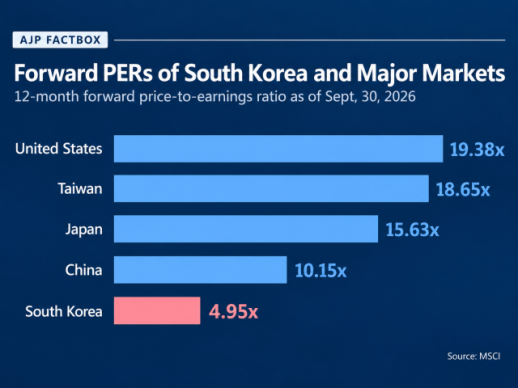 AJP Factbox: What PERs say of Korean stock value South Korean equities traded at a 12-month forward price-to-earnings ratio (PER) of 4.95 times as of Sept. 30, roughly a quarter of the U.S. multiple of 19.38 times, according to global index provider MSCI. MSCI. Samsung Electronics and SK hynix traded at just 3.54 times and 3.18 times forward earnings, respectively, compared with 17.06 times for Taiwan's TSMC and 5.18 times for U.S. chipmaker Micron Technology. 2026-10-23 17:21:31
 -
 Korean stocks look cheap, but are they a good buy? SEOUL, October 23 (AJP) — South Korean stocks have moved back to the bargain corner after dominating the top shelf in the first half, but investors remain unconvinced they offer good value. The October crash has prompted the president to complain that Korean equities are too undervalued Korean equities. Investors, however, remain wary of how much the country’s chip earnings will be worth if global AI spending subsides. South Korea’s 12-month forward price-to-earnings ratio (PER) stood at 4.95 times as of Sept. 30, according to global index provider MSCI. Comparable ratios were 19.38 times for the United States, 18.65 times for Taiwan, 15.63 times for Japan and 10.15 times for China. The measure compares stock prices with expected earnings over the next 12 months. Seoul's figure does not capture the October rout. The KOSPI has lost 19 percent this month through Friday, while the junior KOSDAQ has fallen 12 percent. The KOSPI is nearly 40 percent below its June 22 peak. The KOSPI’s forward PER has fallen to 4.41 times from 5.43 earlier this month, according to financial data provider FnGuide — below the roughly 7 to 8 times recorded during the 2008 global financial crisis and the COVID-19 market turmoil in 2020. Yet analysts caution against treating low earnings multiples as an automatic buying signal. “By that logic, even if the KOSPI reached 11,000, it could still be considered undervalued,” said an analyst at Yuanta Securities. The unusually low ratio reflects both falling share prices and soaring earnings expectations for the country’s dominant chipmakers. Hanwha Investment & Securities raised its 2027 operating profit forecast for Samsung Electronics by 8 percent to 606 trillion won ($458.3 billion) on Oct. 6, citing higher prices and shipments of next-generation high-bandwidth memory, or HBM4. Such upgrades lower forward PERs even when share prices do not fall. When prices also retreat, the apparent discount becomes more striking. Samsung Electronics and SK hynix traded at 3.54 times and 3.18 times forward earnings, respectively, as of Thursday, according to financial data platform Stock Analysis. Taiwan Semiconductor Manufacturing Co. (TSMC) traded at 17.06 times, while U.S. memory-chip maker Micron Technology traded at 5.18 times. The gap extends beyond chips, though it is less pronounced. Hyundai Motor traded at 8.64 times forward earnings, compared with 11.03 times for Japan’s Toyota Motor. But the Yuanta analyst cautioned that different markets command different multiples. “The S&P 500 generally trades at a higher earnings multiple than the KOSPI, so you cannot simply compare SK hynix with Micron.” Even securities representing ownership in the same company can trade at different valuations. SK hynix’s American depositary receipts traded at a premium of about 43 percent to its Seoul-listed shares as of Thursday. “The valuation standards are different for companies listed in Korea and those listed in the United States,” the analyst said. “You cannot simply compare the absolute numbers.” The headline KOSPI multiple also conceals a less dramatic picture across the rest of the market. Excluding chipmakers, the index’s forward PER stands at 10.3 times, down from this year’s peak of 14.5 but close to its 20-year average of 10.4, according to Kiwoom Securities. Much of the apparent bargain therefore rests on the earnings forecasts of a handful of semiconductor companies. “The question is no longer whether the chipmakers will deliver strong earnings, but whether those profits can be sustained,” the Yuanta analyst said. Another measure offers a potentially stronger argument for undervaluation. Samsung Electronics and SK hynix both had 24-month forward price-to-book ratios (PBRs) below one, according to Yuanta. That means their current market values were below their projected net assets two years ahead. But those projections, too, depend on the profits the companies are expected to accumulate. The valuation debate ultimately returns to the durability of AI demand. Large technology companies and specialized AI infrastructure providers have poured money into data centers, servers and computing capacity. As some rely increasingly on debt, investors are questioning whether the eventual returns will justify the spending. “Companies can borrow money to invest, but eventually they have to generate enough profit to recover that investment,” the analyst said. “The question is whether that can be sustained.” Those concerns are weighing on CoreWeave, which rents out computing power for AI applications and has accumulated about $50 billion in debt. Yields on some of its bonds climbed to around 15 to 16 percent in mid-October as investors grew wary of its borrowing. The pressure extends to larger technology companies. Meta Platforms on Wednesday raised the lower end of its 2026 capital spending forecast to $135 billion from $130 billion, leaving the upper end at $145 billion. It reported negative free cash flow of $2.12 billion in the third quarter despite a 26 percent rise in revenue. For Korean chipmakers, the risk is that financing pressures eventually slow the infrastructure spending driving demand for their products. Strong current earnings are already proving insufficient to reassure investors elsewhere in the semiconductor industry. U.S. equipment maker Lam Research reported quarterly revenue and earnings above market expectations on Wednesday, yet its shares fell about 6 percent in after-hours trading as investors weighed supply-chain constraints and a weaker outlook for sales to China. Samsung Electronics and SK hynix face a similar test: record profits may do little for their valuations if investors see them as a cyclical peak. Foreign investors sold a net 11.24 trillion won ($8.4 billion) of KOSPI shares during the week of Oct. 12–16, including 8.85 trillion won in the two chipmakers, according to Koscom CHECK data. Selling continued on Friday despite a modest market rebound. Foreign investors sold a net 982.6 billion won, while institutions bought 937.7 billion won and retail investors purchased 44.9 billion won. Korea’s longstanding corporate governance concerns provide another reason to demand a discount. “In the United States, shareholders are treated as the owners of the company, and companies return value to them,” the Yuanta analyst said. In Korea, he said, decisions favoring controlling shareholders, corporate restructuring and subsidiary listings can leave investors uncertain whether rising profits will benefit them. Those concerns surfaced in the debate over a proposed U.S. listing of Solidigm, SK hynix’s NAND flash memory subsidiary. The plan drew scrutiny over the potential dilution of shareholder value through a separate listing. SK hynix said Friday it had stopped reviewing the listing, citing market conditions and share price movements. Despite the selloff, some brokerages see substantial room for recovery. Hanwha has set a 2027 KOSPI target of 8,500 within a projected range of 6,000 to 9,300. Its target implies upside of about 53 percent from Friday’s close of 5,550.30. The forecast rests on the gap between corporate profitability and share prices. The KOSPI’s projected return on equity (ROE), which measures profits relative to shareholders’ capital, stands at 25.5 percent for the next 12 months, near a record high. Yet its forward PBR was just 1.08 times as of Oct. 16. Based on historical relationships, Hanwha estimates that such profitability could justify a PBR of around two times. Current prices instead imply an ROE of about 11 percent, below the 16 percent recorded over the past year. The brokerage found that since 2005, similar periods when market-implied ROE fell below actual ROE were followed by an average KOSPI gain of 28 percent over the next year. Returns were positive in 84 percent of cases. Its 8,500 target assumes a more modest valuation recovery, with forward PBR rising to 1.32 times. Hanwha expects an initial rebound toward 7,600 by year-end, followed by more gradual gains in 2027. The Yuanta analyst said the index could eventually surpass even Hanwha’s upper projection of 9,300. But it could fall further first, making a market bottom difficult to call. The next clues will come from SK hynix’s earnings announcement on Oct. 28 and Samsung Electronics’ earnings call on Oct. 29. Investors will scrutinize their outlooks for 2027 and 2028 and any new shareholder return plans. The U.S. midterm elections on Nov. 3 could also influence expectations for fiscal policy and long-term interest rates. At home, the scope for policy to deliver a lasting valuation recovery remains contested. “Perhaps doing nothing would be more helpful,” the Yuanta analyst said, questioning the effectiveness of measures introduced this year. Governance and shareholder rights problems would take time to resolve, he added. Monetary policy offers little immediate relief. The Bank of Korea held its benchmark rate at 3.00 percent on Thursday and left the door open to further increases as inflation remains elevated. Korean stocks may look cheap against the profits analysts expect. To become a convincing bargain, investors need confidence that those profits will endure — and that shareholders will receive their share. 2026-10-23 17:09:33
 -
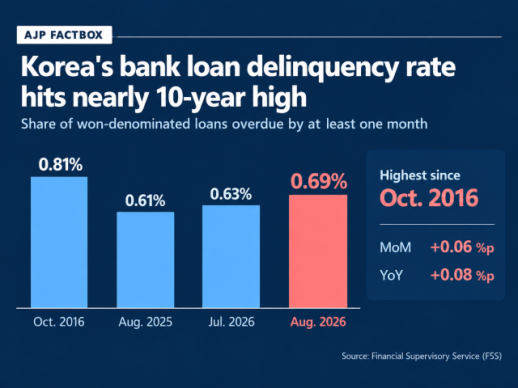 AJP Factbox: Korea's bank loan delinquency rate at near 10-year high South Korean banks' loan delinquency rate rose to 0.69 percent in August, its highest level since October 2016, amid rising corporate delinquencies and prolonged high borrowing costs, according to the Financial Supervisory Service (FSS). The rate increased from 0.63 percent in July and 0.61 percent a year earlier. Corporate loan delinquency rose to 0.86 percent, with the rate for small and midsized corporations reaching 1.10 percent and that for self-employed borrowers standing at 0.86 percent. 2026-10-23 12:48:41
 -
 Korea's bank loan delinquency rate hits nearly 10-year high SEOUL, October 23 (AJP)— South Korean banks' loan delinquency rate edged up to a fresh high in nearly a decade in August, as corporate delinquencies and persistently high interest rates added to repayment pressures, regulatory data showed Friday. The delinquency rate on won-denominated loans stood at 0.69 percent at the end of August, up from 0.63 percent a month earlier and 0.61 percent a year earlier, according to the Financial Supervisory Service (FSS). The reading was the highest since October 2016, when the rate stood at 0.81 percent. The measure covers loans with principal or interest payments overdue by at least one month. The regulator attributed the increase partly to corporate delinquencies involving JoongAng Group affiliates that sought corporate rehabilitation or debt workouts in July, along with mounting repayment pressures amid persistently high interest rates. Newly overdue loans totaled 3 trillion won ($2.27 billion) in August, down 200 billion won from July. Banks resolved 1.5 trillion won in delinquent debt through write-offs and sales, up 100 billion won from the previous month. The new delinquency rate, which measures loans that became overdue during the month against total lending outstanding at the end of the previous month, remained unchanged at 0.12 percent. Corporate loans showed further deterioration. Their delinquency rate rose to 0.86 percent in August from 0.78 percent in July. The rate for loans to large companies climbed to 0.39 percent from 0.36 percent a month earlier. The figure was more than double the 0.15 percent recorded a year earlier. Small and midsized businesses also faced greater repayment pressure. Their delinquency rate rose to 1.00 percent from 0.91 percent in July, matching the level recorded in May. The rate for small and midsized corporations increased to 1.10 percent from 1.00 percent, while that for self-employed borrowers rose to 0.86 percent from 0.77 percent. Household loans showed a smaller increase, with their delinquency rate ticking up to 0.45 percent from 0.42 percent in July. The mortgage delinquency rate rose to 0.31 percent from 0.29 percent. The rate for other household borrowing, including unsecured credit loans, increased to 0.91 percent from 0.84 percent, its highest level since August 2025. Despite the increase, the FSS said the overall delinquency rate remained below the pre-pandemic 10-year average of 0.78 percent and was still manageable over the medium to long term. The regulator said it would monitor banks' compliance with regulations governing the sale and collection of overdue loans, while encouraging debt restructuring to ease repayment burdens on financially vulnerable borrowers. Meanwhile, the Bank of Korea kept its benchmark interest rate unchanged at 3.00 percent on Thursday. 2026-10-23 12:47:25
 -
 KOSPI sinks below 5,400 as Meta's AI spending fuels tech selloff SEOUL, October 23 (AJP) — South Korean stocks fell sharply at Friday's open, sending the benchmark KOSPI below 5,400 as concerns over the mounting costs of artificial intelligence (AI) investments triggered another selloff in semiconductor shares. The KOSPI stood at 5,353.48 as of 9:40 a.m., down 3.26 percent from previous close of 5,533.77. The index opened 2.36 percent lower at 5,403.17 before extending its decline. The junior KOSDAQ dropped 3.45 percent to 737.76, extending losses across both markets. Foreign investors sold a net 256.5 billion won ($193.6 million) of KOSPI shares, while institutions bought a net 291.6 billion won ($220.0 million). Retail investors sold a net 9.9 billion won ($7.5 million). The selling was concentrated in technology shares. Samsung Electronics fell 2.91 percent to 208,250 won, while SK hynix declined 1.47 percent to 1,205,000 won. Samsung Electro-Mechanics tumbled 6.38 percent to 1,072,000 won, while Samsung Electronics' preferred shares lost 2.57 percent to 162,800 won. Shares of SK hynix fell despite announcing before Friday's market open that it had dropped plans for a potential initial public offering (IPO) of its U.S. subsidiary Solidigm, which could ease concerns over shareholder value dilution. Other technology and battery stocks also weakened. Samsung SDI dropped 4.20 percent to 490,500 won, LG Energy Solution fell 2.95 percent to 378,500 won and SK Square slipped 1.86 percent to 737,000 won. Bucking the decline, Samsung E&A jumped 7.40 percent to 59,500 won. The downturn followed a sharp selloff on Wall Street overnight as investors questioned whether massive AI infrastructure spending would generate sufficient returns. The Nasdaq Composite plunged 2.60 percent, its steepest daily decline since June, while the S&P 500 lost 1.21 percent. The Dow Jones Industrial Average edged up 0.02 percent. Semiconductor stocks were among the hardest hit. The Philadelphia Semiconductor Index sank 6.72 percent, with Nvidia falling 4.40 percent, Micron Technology losing 6.26 percent and Intel sliding 8.04 percent. Concerns over AI spending intensified after Meta Platforms reported a $2.12 billion free cash flow deficit in the third quarter, despite a 26 percent increase in revenue. The company also raised the lower end of its 2026 capital spending forecast to $135 billion from $130 billion, while keeping the upper end at $145 billion, adding to concerns over the rising cost of AI infrastructure. Adding to the pressure, Brent crude futures surged 4.00 percent to $113.17 a barrel overnight, their highest level since May. The Korean won meanwhile weakened to 1,325.20 per U.S. dollar from the previous session's 1,324.20. 2026-10-23 10:00:30
 -
 Korea's chip boom draws Hong Kong investors into the bust SEOUL, October 22 (AJP) - South Korean chip stocks have brought joy and now grief to thousands of retail investors, and many in Hong Kong would sympathize. Hong Kong ranked as the second-largest source of foreign net buying in Korean listed stocks in the first eight months of 2026, behind France, with net purchases of 6.45 trillion won ($4.83 billion), according to the Financial Supervisory Service (FSS). It ranked sixth for the whole of 2025. U.S. and British investors, meanwhile, were net sellers during January-August. Easier access helped bring Hong Kong investors into a market riding an extraordinary semiconductor rally. The KOSPI gained 76 percent in 2025 and climbed another 110 percent to its June peak, driven largely by expectations of higher earnings from artificial intelligence demand. The reversal has been punishing. The KOSPI rebounded 3.29 percent to 5,735.66 on Wednesday but remained about 37 percent below its June 22 record close of 9,114.55, according to Korea Exchange data. It finished Thursday 3.5 percent lower. For Korean brokerages courting Hong Kong clients, the challenge is now to turn an appetite for two chipmakers into an investment relationship that can outlast their rally. About 3,500 Hong Kong retail investors have entered the Korean market through an account service launched by Hana Securities and its local partners in October 2025, according to the brokerage. Initially used mainly by wealthy clients, the service has since attracted ordinary retail investors. More than 90 percent of those clients’ Korean equity holdings are concentrated in Samsung Electronics and SK hynix. The two chipmakers account for roughly half of the KOSPI’s market capitalization, leaving both the benchmark and investors heavily exposed to shifts in the outlook for AI spending. An easier route into Seoul The value of Korean listed shares held by Hong Kong investors reached 44.89 trillion won at the end of August, up more than 90 percent from the end of 2025, FSS data showed. That increase reflects both new purchases and changes in the value of existing holdings. Kim Dae-jong, a professor of business administration at Sejong University, attributed the growing interest primarily to improving semiconductor earnings and expectations of further growth in AI demand. “Unlike U.S. and British investors who have been taking profits or rebalancing their portfolios, Hong Kong investors appear to be focusing on the relatively attractive valuations and growth potential of Korean semiconductor stocks,” Kim said. He cited rising memory-chip prices and demand for high-bandwidth memory, a key component in advanced AI processors, as factors supporting earnings expectations for Samsung Electronics and SK hynix. Access has also become simpler. Foreign investors once had to register with South Korean regulators and complete lengthy paperwork before opening local brokerage accounts. South Korea abolished the registration requirement in December 2023, although direct investment still required an account with a domestic brokerage. Foreign omnibus accounts allow overseas clients to trade Korean shares through their existing brokerages, removing the need for separate local accounts. Hana Securities became the first Korean brokerage to offer the service through a partnership with Hong Kong’s Emperor Securities in October 2025. It extended the service to Futu Securities, a major Hong Kong online brokerage, in July 2026. Samsung Securities also provides access through U.S.-based Interactive Brokers, which operates in Hong Kong. Mirae Asset Securities launched its MAPS stock-trading platform in June, allowing Hong Kong individuals to trade Korean equities. Shinhan Securities is preparing a similar omnibus account service with CICC International, the Hong Kong-based international arm of China International Capital Corporation. Chief Executive Lee Sun-hoon visited Hong Kong in September to discuss the partnership. “Foreign omnibus accounts have helped attract overseas capital by simplifying account-opening and trading procedures,” Kim said. He cautioned, however, that easier access alone could not explain the buying. Expectations of stronger chip earnings and further share-price gains also played an important role. Hana is now seeking to broaden its clients’ exposure to other AI-related sectors, including energy and construction. Leveraged bets amplify the swings Hong Kong’s appetite for Korean chips has extended beyond shares to products that multiply their daily returns. SK hynix shares surged about 1,600 percent from the start of 2025 to their June 2026 peak. A leveraged exchange-traded product targeting twice the stock’s daily return, managed by Hong Kong-based CSOP Asset Management, became the city’s largest ETF by assets in June. The product held more than $16.8 billion as of June 22, surpassing the $16.2 billion held by the Tracker Fund of Hong Kong, which tracks the Hang Seng Index, according to data compiled by Bloomberg. The growth has drawn scrutiny from the Bank of Korea (BOK). In its Sept. 10 monetary and credit policy report, the central bank said the combined market value of Hong Kong-listed leveraged ETFs linked to Samsung Electronics and SK hynix had increased more than twentyfold in the first half of 2026. Although the products trade in Hong Kong, their effects can reach Seoul. Financial institutions buy and sell Korean stocks or futures to manage their exposure, and adjustments to maintain targeted daily returns can add to market pressure. Kim said such rebalancing could reinforce market movements, generating additional buying as prices rise and selling as they fall. “When investment is concentrated in Samsung Electronics and SK hynix, growing leveraged bets can significantly affect short-term trading in both stocks,” he said. “Share prices can move excessively because of short-term capital flows, regardless of corporate earnings,” Kim added. “Investors and financial regulators need to watch market volatility closely.” The impact depends on the size of the funds and how financial institutions hedge their exposure, he said. Authorities in both markets have moved to contain the risks. South Korea’s Financial Services Commission raised the minimum cash deposit for retail investors in single-stock leveraged products from 10 million won to 30 million won, effective July 31. It also suspended new listings of single-stock products and tightened investor protection measures. Following regulatory guidance in Hong Kong, CSOP adopted a flexible leverage structure on Aug. 3, allowing its Korean chip-linked products to adjust exposure between 1.1 and two times daily returns instead of maintaining a fixed twofold target. The BOK has called for closer monitoring of leveraged investment and overseas products linked to Korean stocks, warning that trading abroad can create risks at home. Reasons to stay beyond chips Despite the surge in buying, Hong Kong accounted for only about 2 percent of foreign-held Korean listed equities at the end of August, up from 1.7 percent at the end of 2025, according to the FSS. A broader range of investment products is emerging. CSOP launched a KOSPI 200 ETF on June 18 and a KOSPI 200 covered-call active ETF on July 31, extending its offerings beyond individual chipmakers. But a wider menu alone may not be enough to keep investors interested as the market struggles to recover. Kim said automobiles, shipbuilding, defense, biotechnology and finance could attract more foreign capital if companies demonstrate sustainable growth and profitability. “Korean companies need to improve shareholder returns and corporate governance, while providing stable dividends and predictable management policies,” he said. Better access to corporate information would also help investors look beyond a handful of familiar names. “It is particularly important to improve transparency so global investors can easily compare Korean companies’ earnings and shareholder-return policies,” Kim said. “Financial authorities should also expand English-language disclosures and improve foreign investors’ access to information on dividends, taxes and corporate performance,” he added, calling for further improvements to omnibus account services. The chip boom brought Hong Kong investors to Seoul. Whether they stay through the bust may depend on what Korea can offer beyond its two semiconductor giants. 2026-10-22 17:39:08
 -
 Regenerative medicine firm soars above IPO price on KOSDAQ debut SEOUL, October 22 (AJP) - Regenerative medicine firm MS Bio more than doubled from its initial public offering (IPO) price on its KOSDAQ debut Thursday before paring gains later in the day. The stock climbed as high as 19,650 won (US$14.81), about 2.5 times its IPO price of 7,800 won. It was trading at 12,920 won as of around 5 p.m. in after-hours trading, up 65.64 percent from the offering price. The firm priced its shares at the top of its proposed range of 6,800 won to 7,800 won after institutional investors submitted bids exceeding the shares available by 1,096.56 times. The IPO drew 2,269 institutional investors during the book-building process. Retail demand was also strong, with subscriptions oversubscribed 1,538.51 times and investors placing approximately 6.02 trillion won in deposits for share allocations. KB Securities served as the lead underwriter for the 31.2 billion won offering. Founded in 2015, MS Bio develops and manufactures medical products using donated human tissue and biomaterials to help repair and regenerate damaged skin, bone and other tissues. It posted revenue of 23.79 billion won and operating profit of 8.56 billion won in 2025. The firm plans to use proceeds from its IPO to build a new manufacturing facility in Ochang, North Chungcheong Province, increase production capacity and expand into overseas markets including Viet Nam and the U.S. 2026-10-22 17:32:14
 -
 AJP Factbox: Slim job market keeps Koreans at school More than three in four South Korean university students who postponed graduation cited employment uncertainty, according to a 15-year study by the National Youth Policy Institute (NYPI). Of the 1,139 respondents surveyed in 2025, 88.8 percent had attended university, while 7.4 percent of university attendees had delayed graduation. Among those who postponed graduation, 76 percent cited the need for more time to prepare for employment or fears of struggling to find a job after graduating. The study also found disparities in early employment. More than half of university attendees had taken a leave of absence, mainly for military service or career preparation. At their first jobs, respondents worked an average of 40.16 hours per week and earned 2.54 million won ($1,900) a month. 2026-10-22 10:50:11
 -
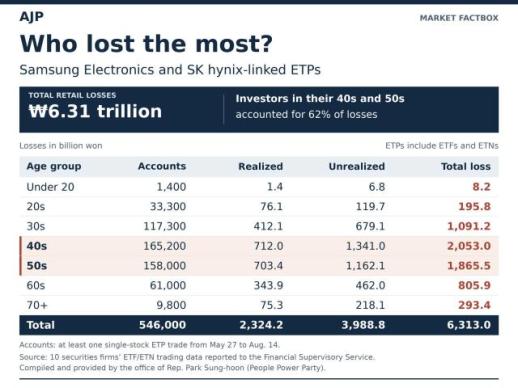 AJP Factbox: : Burned by ETPs even before September's rout South Korean retail investors accumulated more than 6.3 trillion won ($4.76 billion) in realized and unrealized losses on leveraged and inverse products tied individually to Samsung Electronics and SK hynix within two and a half months of their launch. Their misfortunes may have deepened over the last two months as Samsung Electronics shares have fallen 15 percent and SK hynix shares 23 percent as of Oct. 21 since September. 2026-10-21 15:20:21
 -
 Korean retailers lose nearly $5B on single-stock ETPs even before rout SEOUL, October 21 (AJP) -South Korean retail investors accumulated more than 6.3 trillion won ($4.9 billion) in realized and unrealized losses on leveraged and inverse products tied each to Samsung Electronics and SK hynix within two and a half months of their launch. Their misfortunes likely have deepened over the last two months as Samsung Electronics shares have fallen 15 percent and SK hynix shares 23 percent since September. Investors in their 40s and 50s accounted for nearly 4 trillion won of the losses, according to data released Wednesday by Rep. Park Sung-hoon of the People Power Party (PPP), a member of the National Assembly’s National Policy Committee. The figures cover trading from the products sold by 10 brokerages from May 27 to Aug. 14 and excludes the July-October crash. Single-stock exchange-traded products, or ETPs, allow investors to magnify exposure to an individual stock or bet on its decline and were introduced to follow the top two chipmakers during the peak of AI chip rally. Of the total, 2.3242 trillion won represented losses crystallized through trading. Another 3.9888 trillion won, or 63.2 percent, consisted of unrealized losses on holdings. Realized losses rose rapidly in early August, increasing by 360.4 billion won from the end of July through Aug. 14. Unrealized losses narrowed by 50.7 billion won over the same period, leaving combined losses 309.7 billion won higher. Investors in their 40s suffered the largest losses by age group: 2.053 trillion won across 165,200 accounts. Those in their 50s lost 1.8655 trillion won across 158,000 accounts, followed by investors in their 30s with 1.0912 trillion won in losses. Together, investors in their 40s and 50s accounted for about 62 percent of total losses. Older investors sustained the heaviest losses per account. Those aged 70 and above lost an average of about 29.94 million won across 9,800 accounts, roughly 2.6 times the overall average of 11.56 million won across 546,000 accounts. Investors in their 60s lost an average of 13.21 million won per account. Authorities tightened access to single-stock leveraged products as concerns over investor risk mounted. On July 31, they raised the minimum deposit requirement for ordinary retail investors from 10 million won to 30 million won. Mandatory simulated trading followed on Aug. 19. Questions over the approval process sharpened after FSS Governor Lee Chan-jin acknowledged during an Oct. 19 parliamentary audit that parts of the review had been accelerated to meet a timetable. He also acknowledged that the FSS had unusually begun reviewing securities registration statements before the Korea Exchange completed its preliminary listing review. FSS labor union on Wednesday blamed a supervisory structure subordinate to government financial policy and called for oversight of the watchdog to be transferred from the Financial Services Commission (FSC) to the National Assembly. “Even when financial policies pursued by the administration have side effects or problems, there are structural constraints that make it difficult to voice an independent opinion for fear of institutional disadvantages, including budgetary penalties,” the union said in a statement. It said the watchdog lacks the authority to make or amend supervisory regulations or formally place items on the FSC’s agenda, limiting its ability to respond when problems emerge. When consumers suffer losses, the union argued, the FSS bears responsibility for supervisory failures, which in turn invites tighter control over the agency. The union called for the FSC’s powers to oversee the FSS and approve its budget to be transferred to the National Assembly. It also sought parliamentary confirmation hearings for nominees to lead the watchdog. 2026-10-21 15:16:28