

Journalist

Ryu Yuna류윤아
Julia37@ajupress.com
ReporterFinancial Supervisory Service (FSS) & finance, capital markets, Southeast Asian affairs
Yuna Ryu covers finance, capital markets and Southeast Asian affairs.
She is drawn to the questions that numbers raise and the stories that data alone cannot answer.
Prior to journalism, she worked at Hyundai Motor Company and the Singapore Chamber of Commerce, focusing on business strategy and international affairs. She has also hosted diplomatic receptions and international conferences as an MC.
Ryu holds a master's degree in Media and Communication from Korea University, where her research focused on neuroscience-based studies of media effects. "Beyond every statistic is a human story waiting to be heard."
She is drawn to the questions that numbers raise and the stories that data alone cannot answer.
Prior to journalism, she worked at Hyundai Motor Company and the Singapore Chamber of Commerce, focusing on business strategy and international affairs. She has also hosted diplomatic receptions and international conferences as an MC.
Ryu holds a master's degree in Media and Communication from Korea University, where her research focused on neuroscience-based studies of media effects. "Beyond every statistic is a human story waiting to be heard."
Latest by Ryu Yuna
-
 Seoul to mandate cybersecurity disclosures SEOUL, October 20 (AJP)— South Korea will require all companies listed on the KOSPI and KOSDAQ to publicly disclose their cybersecurity spending, staffing and related activities from 2027, regardless of their revenue. The Ministry of Science and ICT (MSIT) said Tuesday that the Cabinet approved revisions to the Enforcement Decree of the Act on the Promotion of Information Security Industry, expanding mandatory information security disclosures to companies and public institutions previously exempt from the requirements. The changes will take effect on Jan. 1, 2027. Under the revised rules, the government will eliminate the existing requirement that listed companies have annual revenue of at least 300 billion won to fall under the disclosure mandate. All KOSPI- and KOSDAQ-listed companies, except special purpose acquisition companies (SPACs), will be covered regardless of revenue. Organizations required to obtain Information Security Management System (ISMS) certification, which verifies whether companies have adequate cybersecurity management practices in place will also be subject to the disclosure requirements. The revised rules will remove existing exemptions for public institutions, financial companies, electronic financial service providers and small businesses. Small businesses will be given an additional two years to prepare, with the requirements taking effect on Jan. 1, 2029. South Korea made cybersecurity reporting mandatory in 2022 for businesses meeting certain criteria based on industry, revenue or user numbers. The system requires companies to disclose their cybersecurity investments, dedicated security personnel and information about certifications, assessments, inspections and other security-related activities. The latest revision follows a series of cyberattacks and forms part of a government-wide information security plan announced in October 2025. It aims to close gaps in corporate disclosure requirements, improve public access to information about cybersecurity preparedness and encourage businesses to treat security spending as a long-term investment rather than simply a cost. The government will also revise how user numbers are calculated to determine which companies must disclose their cybersecurity information. Instead of averaging daily users over the final three months of the previous year, the new rules will use the average daily number of users for the entire previous year. To help newly covered organizations comply, MSIT plans to provide updated disclosure guidelines and consulting services, along with year-round online consultations, training programs and regional educational sessions. 2026-10-20 17:37:55
 -
 Retail investors fight a losing battle as outflows from Seoul deepen SEOUL, October 20 (AJP) - What goes up comes down, and the higher the climb, the steeper the descent. But for those swept up in the tailwind, that pedestrian observation can land hard. "When stocks rise sharply, a correction is inevitable," President Lee Jae Myung told reporters at the Chunchugwan press center of Cheong Wa Dae on Monday. "Unlike in the past, it is difficult for the government to intervene directly in financial and securities markets. Nor is it desirable." The KOSPI went from the best performer in the first half (nearly 100 percent from the beginning of the year) to the worst performer this month. It has lost nearly 20 percent so far this month. It is still around 32 percent higher from the 2025 year-end, but lost almost 70 percent of its first-half gains. Policymakers have limited power to arrest a correction. Intervention may numb the pain, but the relief can be brief and the aftereffects bitter. "If the government could control the market, things would be much easier," a trader said on condition of anonymity. "I wouldn't read too much into the remarks. They sounded more like a general statement." Another analyst, however, questioned whether the scale of the retreat could be dismissed as a routine correction, given the earnings strength behind the rally. "I do agree that corrections are inevitable, but much of the rally was driven by strong semiconductor earnings, and the market has become heavily dependent on the sector," he said. "Still, I would not consider a decline to this level a normal correction." The chipmakers that powered the market's ascent are now bearing the brunt of foreign selling as investors reassess the spending boom behind their profits. Lee nevertheless remained upbeat about valuations. "South Korea's stock market remains significantly undervalued," he said. He identified lingering distrust in corporate governance as a central reason for the discount. "What remains is a lack of trust in the market," Lee said. "I don't think concerns over corporate governance have been fully resolved. Respect for shareholders and the abuse of management control remain issues that need to be addressed." The government's response, he suggested, would focus on restoring that confidence. "We are continuing to review what needs to be done through policy to normalize the stock market," Lee said. "We will soon receive a comprehensive report and take the necessary measures." Foreigners retreat as retail investors raise the stakes For now, foreign and retail investors are taking sharply different positions on the selloff. Foreign investors sold a net 8.85 trillion won ($6.64 billion) of Samsung Electronics and SK hynix shares during the week of Oct. 12 to 16, according to data released Monday by Koscom CHECK, a financial information service. They offloaded 5.36 trillion won of SK hynix and 3.49 trillion won of Samsung Electronics, accounting for the bulk of their 11.24 trillion won in net selling across the main KOSPI market. Samsung Electronics lost 17.75 percent that week, while SK hynix plunged 24.33 percent. Retail investors are the lone buyers in a market deserted by foreigners and domestic institutions. Foreign investors did buy a net 440.2 billion won of ETFs listed on the main market, including 162.8 billion won of KODEX 200, 69.5 billion won of TIGER 200 and 48.7 billion won of KODEX Leverage. But a market researcher cautioned against treating those purchases as a vote of confidence when far larger sums were leaving individual stocks. "What matters is that foreigners are selling," the researcher said. Earlier in the year, domestic liquidity had absorbed foreign selling and kept the rally alive. That support has since weakened, the researcher said. "Before June, foreign selling was actually not a decisive factor because domestic liquidity absorbed it and the market continued to perform well," he said. "Now without foreign buying, it is a tough environment for the market." Retail investors are nevertheless raising the stakes on a rebound. Individuals bought a net 773.3 billion won of KODEX Leverage during the same week, making it their most heavily purchased ETF, according to Koscom ETF CHECK data. The fund seeks to deliver twice the daily return of the KOSPI 200 Index. It accounted for nearly a quarter of their 3.26 trillion won in total net ETF purchases. Buying also extended to leveraged funds tracking the KOSDAQ 150 and semiconductor stocks. The appetite for amplified returns reached overseas. South Korean investors bought a net $2.58 billion of Direxion Daily Semiconductor Bull 3X Shares, known by its ticker SOXL, according to the Korea Securities Depository. The fund targets three times the daily performance of a U.S. semiconductor index. The losses have been amplified, too. KODEX Leverage fell 30.6 percent during the week, underscoring the cost of getting the timing wrong. Retail investors are betting on a recovery even as the foreign buying that could help sustain one remains elusive. Governance reforms face a global test Lee's assurances build on a series of measures aimed at narrowing the "Korea discount," the persistently lower valuations of Korean stocks relative to their global peers. A July 2025 amendment to the Commercial Act required company directors to consider the collective interests of shareholders alongside those of the company and to treat shareholders fairly. A second amendment, enacted in September 2025 and effective from September 2026, gave minority shareholders greater influence over board elections and strengthened management oversight. A third, effective from March 2026, generally required companies to cancel newly acquired treasury shares within a year, subject to exceptions, with an 18-month transition period for previously held shares. The government also introduced tax breaks on dividends from qualifying high-dividend companies in 2026, while financial regulators stepped up efforts against stock manipulation and other unfair trading practices. As shares plunged last week, the Financial Services Commission convened an emergency meeting on Oct. 15, chaired by Lee Eog-weon, to assess market conditions and foreign selling. Authorities pledged closer monitoring, action against illegal trading and preparations for contingency measures. Those efforts address longstanding weaknesses in governance and market confidence. The latest selloff also poses a question that domestic reforms alone cannot answer: whether the global AI spending boom will earn enough to justify its mounting cost. Kwon Nam-hoon, an economics professor at Konkuk University, said that uncertainty would help determine the direction of Korean equities. "There is enormous uncertainty. The fundamental issue globally is the AI boom, and opinions differ over whether AI investment will translate into future profitability," Kwon said. Large cloud and technology companies, often called hyperscalers, are expanding their investment in data centers and computing infrastructure, increasingly drawing on outside financing. "Until now, hyperscalers have largely funded AI investments with their own money," Kwon said. "But as investment costs continue to rise, they are increasingly turning to external financing. Investors differ on how much profit these investments will generate and how quickly those returns will materialize." The International Monetary Fund highlighted similar concerns in its October 2026 Global Financial Stability Report. It identified 14 publicly disclosed AI-related financing deals since 2023 involving about $300 billion in equity investments, $650 billion in related debt and $1.4 trillion in commitments to purchase future services and chips. The IMF warned that those interconnected arrangements could spread risks across companies and lenders if AI investments failed to generate expected revenues. S&P Global raised similar concerns Monday, warning that major technology companies could face greater AI-related financial obligations than currently known, potentially straining their credit ratings if profits fell short. For South Korea, the stakes are especially high. The semiconductor giants delivering the AI windfall are also the market's main exposure to doubts about its durability. Kwon said even small changes in expectations could produce outsized swings. "Even a slightly negative signal can send markets sharply lower, while a positive one can push them higher," he said. "This pattern is likely to persist for some time." 2026-10-20 16:48:55
 -
 KOSPI plunges nearly 4% as foreign selling shatters fragile recovery SEOUL, October 20 (AJP) - South Korean stocks plunged nearly 4 percent on Tuesday, exposing the fragility of the recent recovery as the benchmark KOSPI sank below 5,600. Heavy selling by foreign and institutional investors weighed on semiconductor shares, amid lingering concerns over returns on artificial intelligence (AI)-related investment and rising U.S. Treasury yields. The KOSPI closed at 5,552.74, down 3.73 percent from the previous session's 5,768.01 after it opened at 5,733.57 before sliding as much as 4.76 percent to an intraday low of 5,493.24. It later recovered some of its losses but failed to reclaim the 5,600 level. The junior KOSDAQ also fell sharply, closing at 781.97, down 3.33 percent from the previous close. Foreign investors sold a net 530.0 billion won (US$399 million) of KOSPI shares and institutions unloaded 1.00 trillion won ($756 million). Retail investors bought a net 898.1 billion won ($676 million), absorbing part of the selling pressure. Decliners overwhelmed advancers on the main board, with 773 stocks falling and 118 rising. On the KOSDAQ, 1,348 shares declined, compared with 310 gainers. The latest selloff erased a two-session rebound that had lifted the KOSPI from 5,554.22 on Thursday to 5,768.01 on Monday, following seven consecutive sessions of losses. The recovery proved short-lived as concerns over the profitability of massive AI infrastructure investment continued to weigh on semiconductor valuations. Global uncertainty added to the pressure. Violent protests in France heightened concerns over European political and fiscal stability, driving French government bond yields sharply higher and sending European stocks lower the previous day. The U.S. 10-year Treasury yield also rose to around 5.15 percent. Wall Street, however, moved in the opposite direction, with the Nasdaq Composite gaining 1.11 percent as AI-related stocks rebounded. Yet South Korean stocks failed to follow that recovery, weighed down by persistent concerns over AI investment returns and heavy foreign selling. Major chipmakers led the retreat. Samsung Electronics fell 2.98 percent to close at 211,500 won, while SK hynix dropped 4.23 percent to 1,223,000 won, extending pressure on the two stocks at the center of the market's recent volatility. Samsung Electronics' preferred shares also lost 2.93 percent to 165,900 won and SK Square, the investment holding company and major shareholder of SK hynix, declined 5.00 percent to 741,000 won. Losses extended beyond semiconductors. Battery maker LG Energy Solution fell 4.17 percent to 414,000 won, while Samsung SDI slipped 1.28 percent to 1,155,000 won. Samsung Biologics, a major contract drug manufacturer, declined 2.52 percent to 1,391,000 won. Automaker Hyundai Motor dropped 4.91 percent to 310,000 won. Financial shares also weakened. KB Financial Group fell 1.11 percent to 160,900 won and Samsung Life Insurance lost 3.07 percent to 237,000 won. The weakness also spread across the secondary market, where selling was concentrated in biotechnology, battery materials, semiconductor equipment and robotics shares. Biotechnology firm Alteogen declined 3.35 percent to 231,000 won, while battery materials group EcoPro lost 7.74 percent to 83,400 won. Its subsidiary EcoPro BM, a producer of cathode materials for electric vehicle batteries, plunged 9.15 percent to 105,200 won, making it one of the steepest decliners among major KOSDAQ stocks. Semiconductor equipment maker Jusung Engineering fell 5.44 percent to 198,100 won, while Rainbow Robotics, a developer of humanoid and industrial robots, slipped 1.72 percent to 371,500 won. Biotechnology and pharmaceutical company HLB was the only gainer among the major leading KOSDAQ stocks shown in the market data. It edged up 0.12 percent to 43,000 won. The South Korean won, meanwhile, strengthened to 1,327.50 per U.S. dollar, compared with 1,331.40 in the previous session. Tuesday's sharp selloff came just a day after President Lee Jae Myung sought to reassure investors about the outlook for South Korea's stock market amid its recent market volatility. Speaking to reporters at Cheong Wa Dae on Monday, Lee admitted that market fluctuations would be inevitable after steep gains but maintained that South Korean equities remained significantly undervalued. He pledged to pursue policies aimed at restoring market confidence, even as Tuesday's selloff underscored the continuing pressure on investor sentiment. Across the region, major Asian markets mostly declined amid similar concerns over AI investment returns and rising bond yields. Japan's Nikkei 225 fell 1.30 percent to 64,075.42, while Hong Kong's Hang Seng Index dropped 1.12 percent to 23,916.36. Mainland China's Shanghai Composite bucked the trend, edging up 0.12 percent to 3,735.37. 2026-10-20 16:48:13
 -
 South Korea's sovereign wealth fund returns 6.31% on stock gains SEOUL, October 20 (AJP) — South Korea's sovereign wealth fund posted a 6.31 percent return in the first eight months of 2026, adding $14.6 billion to its portfolio as strong equity gains helped to offset losses in bonds. The Korea Investment Corporation (KIC), which manages government assets invested overseas, saw its assets under management grow from $232 billion at the end of 2025 to $246.6 billion as of August, according to data submitted to Rep. Lee Jong-wook of the opposition People Power Party and released Tuesday. The gains were largely driven by traditional investments, including stocks and bonds, which returned 6.87 percent over the period. Equities delivered a 12.76 percent return, while bonds posted a 0.18 percent loss. Alternative investments meanwhile generated 4.35 percent return, led by hedge funds with an 8.33 percent gain. Infrastructure investments returned 6.05 percent, followed by private equity at 4.81 percent. Real estate posted the weakest return at just 0.39 percent. Over the longer term, however, alternative investments performed better. Over the 10 years from September 2016 through August 2026, KIC recorded an annualized return of 7.14 percent across its total portfolio. Alternative investments generated an annualized return of 8.63 percent, outperforming traditional assets, which returned 6.90 percent annually. Looking ahead, KIC plans to improve its asset allocation strategy by managing investments as a unified portfolio rather than treating each asset class separately. “We will work to deliver stable investment returns by strengthening our focus on absolute returns through initiatives such as the Total Portfolio Approach (TPA),” KIC said. 2026-10-20 12:53:40
 -
 Indonesia's rout revives Asia's crisis ghosts, but risks diverge SEOUL, October 19 (AJP) — Indonesia’s stock market rout has reawakened the spectre of Asia’s 1997 financial crisis, but the diverging fortunes of neighboring markets suggest the turmoil has yet to become contagious. Indonesia is confronting a crisis of market credibility. South Korea is reckoning with the price of its AI boom. Both face the pull of higher U.S. bond yields, but economists caution against mistaking simultaneous market stress for a repeat of the financial contagion that swept Asia nearly three decades ago. The distinction offers some reassurance. The scale of foreign selling offers less. The Jakarta Composite Index plunged 11.57 percent to 5,185.11 on Friday, its sharpest one-day decline since January 1998, after global index provider MSCI proposed stripping Indonesia of its emerging-market status. The selloff triggered a temporary trading halt and left the benchmark down about 40 percent this year. It fell a further 4 percent Monday, while the rupiah weakened to around 18,070 per dollar, near a record low. “This is not a collapse of Indonesia’s economic fundamentals, but a crisis of market governance and investor trust,” said Kim Dae-jong, an economics professor at Sejong University. Yang Jun-sok, an economics professor at the Catholic University of Korea, said the market’s weaknesses predated the latest shock. “These problems have been building for at least a year, if not longer,” Yang said. “The rupiah had already been weakening, and MSCI’s latest warning only made matters worse.” Indonesia’s benchmark had climbed above 9,100 to a record in January, buoyed by the appeal of a large consumer market, abundant natural resources and ambitions to expand manufacturing. The rally masked longstanding concerns over who owned listed shares, how freely those shares traded and whether prices could be trusted. MSCI brought those concerns into focus in late January, questioning the transparency of share ownership and the amount of stock genuinely available for public trading. It also flagged coordinated trading that could distort prices. Regulatory investigations have underscored the problem. In March, Indonesia’s Financial Services Authority announced a probe into suspected manipulation of PT Berkah Beton Sadaya shares between 2020 and 2022. Investigators said transactions involving affiliated companies and shareholders acting for others may have helped drive the stock up about 7,150 percent. The regulator said in February that it had fined 151 parties a combined 240.65 billion rupiah for stock manipulation between 2022 and January 2026. Another 32 suspected cases involving artificial trading and pre-arranged transactions were under investigation. MSCI did not identify individual cases. Its concerns centered on opaque ownership, suspected coordinated trading and weak enforcement. In June, it retained Indonesia’s emerging-market classification but warned that insufficient reform by November could prompt a reassessment. Four months later, it proposed moving the country directly to standalone status, bypassing the frontier-market category. MSCI said reforms had yet to produce lasting improvements in transparency and enforcement. Consultation runs until April 30, 2027, with a final decision expected by the end of June. The stakes extend beyond the label. Funds that replicate MSCI indexes could have to sell Indonesian shares regardless of the underlying companies’ earnings or prospects. Goldman Sachs estimates potential selling by passive funds alone at about $5.6 billion. “The prospect of a direct downgrade to standalone status has raised fears that passive funds could be forced to sell large amounts of Indonesian stocks,” Kim said. Doubts over economic policy have compounded the loss of confidence. Moody’s and Fitch revised Indonesia’s sovereign credit outlooks to negative from stable in February and March, respectively, citing growing policy uncertainty. Both retained their investment-grade ratings. Investors have questioned the fiscal cost of President Prabowo Subianto’s free meals program for students and pregnant women, launched in January 2025. Higher oil prices and U.S. interest rates have meanwhile pressured the rupiah, narrowing the central bank’s room to cut rates without encouraging further capital flight. Bank Indonesia has sought to support the currency and attract foreign investment. The government has pledged to keep the budget deficit within the legal ceiling of 3 percent of gross domestic product. Across Asia, the retreat of foreign money began well before Indonesia’s latest collapse. Overseas investors sold a net $8.21 billion of bonds in India, Indonesia, Malaysia, South Korea and Thailand in September, the largest monthly withdrawal since March 2020. They also sold about $23.49 billion of regional equities, according to regulatory and market data. South Korea accounted for $6.3 billion of the bond outflows, the largest among the five markets. The common pressure came from U.S. Treasuries. The 10-year yield rose 53.5 basis points in September to 5.3645 percent, its highest in nearly 25 years, raising the return investors could earn without taking on the additional risks of Asian markets. Yet regional stocks have not moved in lockstep. As Jakarta plunged Friday, South Korea’s KOSPI rebounded 2.05 percent. Singapore and Philippine shares also advanced. Kim described the divergence as selective rebalancing. “Investors are reducing their exposure to markets with weak governance or high valuations,” he said. Some money leaving Indonesia could find its way into other Asian markets, he added. That does not make Seoul a haven from the selling. The KOSPI lost about a fifth of its value over seven consecutive declining sessions through Oct. 15, capped by a 7.57 percent plunge to 5,554.22. Even after Friday’s rebound, it was down 17.1 percent for the month. The vulnerability lies in what drove the earlier rally: expectations that AI spending would keep delivering exceptional profits for Korean chipmakers. Stronger U.S. inflation and the prospect of faster monetary tightening have sharpened concerns over the cost of debt-financed AI investment. A slowdown in data-center construction would threaten the demand on which much of Korea’s manufacturing windfall rests. “Indonesia faces problems with stock market transparency, while South Korea is grappling with concerns over AI profitability and semiconductor valuations. China, meanwhile, is struggling with weak domestic demand and a prolonged property downturn,” Kim said. Yang likewise distinguished Korea’s earnings and valuation risks from Indonesia’s loss of market credibility. “Samsung Electronics and SK hynix are still expected to perform well for the time being,” he said. “I don’t expect foreign capital to leave Korea for the same reasons it is leaving Indonesia.” The distinction from 1997 is also structural. That crisis began when Thailand abandoned its defense of the baht after speculative pressure depleted its foreign exchange reserves. Investors then questioned whether other fast-growing Asian economies could repay their overseas debts. Pressure spread through Indonesia, Malaysia and the Philippines before reaching South Korea, where banks and companies struggled to refinance short-term foreign borrowings. Seoul sought emergency assistance from the International Monetary Fund in November 1997. “In 1997, countries struggled to defend fixed exchange rates as foreign reserves ran low,” Kim said. “Today, more flexible exchange rates, larger foreign exchange reserves and stronger banks help economies withstand external shocks.” Indonesia held $146.3 billion in foreign exchange reserves at the end of September, sufficient to cover 5.3 months of imports, according to Bank Indonesia. South Korea held $440.56 billion. Those defenses give policymakers more room to absorb market shocks. They do not remove the danger that distrust could spread. “If allegations of market manipulation, insider dealing or corruption emerge in Thailand or Malaysia, investors will start looking much more closely,” Yang warned. For now, Indonesia’s crisis of confidence and Korea’s AI-driven correction remain distinct. But both face pressure from higher U.S. yields drawing foreign money out of Asian markets and the urgency to win back foreign confidence. 2026-10-19 17:33:24
 -
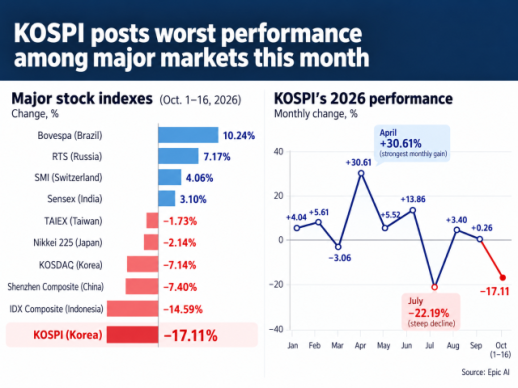 AJP Factbox: KOSPI amongst the worst performers in October 2026 2026-10-19 17:00:14
 -
 FSS chief says Solidigm IPO conflicts with double-listing rules SEOUL, October 19 — South Korea's top financial regulator said Monday that SK hynix's plan to list its U.S. subsidiary Solidigm could violate the country's restrictions on double listings, raising questions over whether the proposed initial public offering (IPO) can proceed under Korean regulations. Financial Supervisory Service (FSS) Governor Lee Chan-jin told a parliamentary audit that both the FSS and the Financial Services Commission (FSC) believe the proposed listing falls under Korea's double-listing restrictions. "The proposed listing conflicts with the rules on double listings," Lee said in response to a question from Rep. Park Sung-hoon of the opposition People Power Party. However, Lee said authorities were still waiting for an official interpretation from the FSC on whether Solidigm's proposed U.S. listing would require a securities registration filing in South Korea. "We are waiting for an official interpretation on whether the listing is subject to domestic securities filing requirements," he said. "We will review the matter carefully and take whatever appropriate measures are available." South Korea introduced stricter double-listing rules in 2026 to protect existing shareholders when a listed company seeks to list a subsidiary separately. Such listings are generally restricted unless they meet specified conditions, including safeguards for shareholders of the parent company. A double listing can raise concerns that separating a subsidiary from its publicly traded parent could weaken the value of existing shareholders' investments. However, because Solidigm is considering a U.S. listing, it does not fall directly under the Korea Exchange's domestic listing review. During Monday's parliamentary audit of the FSS, Park questioned whether SK hynix had adequately informed domestic shareholders about the potential impact of Solidigm's U.S. listing. He said the company had detailed potential risks to its share price in filings with the U.S. Securities and Exchange Commission (SEC) but had not provided similar information to domestic investors. Solidigm was established after SK hynix acquired Intel's NAND flash memory and solid-state drive (SSD) business in 2021. The U.S.-based company specializes in data storage products and has been considering a potential Nasdaq listing. The proposed IPO has drawn attention because a separate listing could give Solidigm access to capital while raising questions over how the value of its business would be reflected in SK hynix shares. Lee said the FSS would continue examining the matter and consider ways to convey shareholder concerns to SK hynix. No final regulatory decision on the proposed U.S. listing has been announced. 2026-10-19 14:56:02
 -
 LS ELECTRIC shares fall despite major deal for US data center project SEOUL, October 19 (AJP) - Shares of South Korean power equipment maker LS ELECTRIC fell more than 4 percent in early trading on Monday amid broader concerns over a potential artificial intelligence (AI)-related investment bust, despite securing a 168.9 billion won (US$125.2 million) contract to supply electrical equipment for a U.S. data center project in 2027. The stock fell as low as 150,000 won before recovering to 158,800 won as of around 9:50 a.m. LS ELECTRIC will supply switchgear to its U.S. subsidiary, which secured a contract to supply power equipment for a hyperscale data center project in the U.S. The deal is equivalent to 3.40 percent of the company's 4.97 trillion won ($3.69 billion) in consolidated revenue in 2025, according to the Korea Exchange (KRX). Switchgear helps control and distribute electricity safely across large facilities, including data centers that require substantial power to operate. The contract runs from Oct. 16, 2026, through the end of next year. The latest deal follows a $114.97 million order secured in April for equipment deliveries in 2026 under the same project. With the new contract covering deliveries in 2027, the two deals are worth a combined $240.2 million. The deal also adds to LS ELECTRIC's business in the North American data center market, where growing demand for AI computing has increased the need for reliable power infrastructure. The company makes transformers, switchgear and power distribution systems used to deliver electricity to industrial facilities and data centers. However, questions remain over whether massive investments in AI infrastructure will generate sufficient returns. Rising borrowing costs have added to those concerns, putting pressure on companies financing large-scale data center projects. Those concerns have weighed on technology and AI-related shares in South Korea and overseas. The benchmark KOSPI plunged 7.57 percent last Thursday, as selling pressure intensified. Global chip stocks also came under pressure last week as investors reassessed the outlook for AI spending. South Korean stocks showed signs of recovery Monday morning, with the benchmark KOSPI rising 0.31 percent or 17.75 points to 5,685.80 as of around 10:20 a.m. from last Friday's close. LS ELECTRIC, founded in 1974, manufactures power distribution systems, transformers and industrial automation equipment. Its North American business has become an important focus as investment in data centers and electricity infrastructure increases. 2026-10-19 10:44:53
 -
 AJP Factbox: October 2026 KOSDAQ IPO calendar Three companies had listed on the KOSDAQ as of Friday, with seven more tentatively scheduled to debut later in the month, according to Korea Exchange (KRX) data and IPO information website Kokstock. 2026-10-16 17:44:32
 -
 Korea's battered ants broaden their bets but keep chips on the table SEOUL, October 16 (AJP) — The adage goes, “If you’re going through hell, keep going" and South Korea’s mom-and-pop investors are not ready to chicken out. Some are, however, broadening their radar beyond chips and their strategies beyond a quick bet on a rebound. Playing smarter and safer is gaining appeal, even as leveraged wagers remain hard to resist. In the first half, as the KOSPI cleared one milestone after another to double by the end of June, investors were swept up in a crowd-driven frenzy with shades of “Squid Game.” After a bruising reversal that erased roughly half of the benchmark’s earlier gains, Korea’s “ants” — the local nickname for individual investors — have reason to become more studious, pickier and less hotheaded. They stayed in the game as the KOSPI plunged 7.57 percent Thursday, hunting for bargains while also looking beyond the familiar chip names. Their search extended to Wall Street. Korean investors bought a net $3.54 billion of U.S. shares from Oct. 1 through Thursday, more than three times the roughly $1 billion purchased during all of September, according to the latest available data from the Korea Securities Depository (KSD). Semiconductor funds still dominated the buying, although investors took opposing positions on where chip stocks were headed. Direxion Daily Semiconductor Bull 3X Shares, or SOXL, which seeks to deliver three times the daily performance of a U.S. semiconductor index, attracted $2.27 billion in net purchases. The fund accounted for about 64 percent of total net U.S. stock purchases over the period. Its inverse counterpart, Direxion Daily Semiconductor Bear 3X Shares, or SOXS, ranked second with $186.47 million. The fund seeks to deliver three times the opposite of the index’s daily return — a leveraged bet that semiconductor stocks will fall. Buying stretched to other technology stocks. Quantum-computing company IonQ drew $117.29 million, while AI data-center operator IREN attracted $93.11 million. Alongside those aggressive bets, investors bought bond, dividend-focused and broad stock-index exchange-traded funds. The iShares 0-3 Month Treasury Bond ETF, or SGOV, which invests in short-term U.S. Treasury bills, ranked fourth with $105.61 million in net purchases. The Schwab U.S. Dividend Equity ETF, or SCHD, drew $81.66 million. The Vanguard S&P 500 ETF, or VOO, attracted $75.08 million, while the Invesco Nasdaq 100 ETF, or QQQM, received $60.26 million. The figures reveal a market divided between investors chasing a semiconductor rebound and those seeking steadier income or broader exposure. They do not necessarily show that the same investors are balancing both. “Investors are pursuing aggressive returns while also trying to protect their assets,” said Kim Dae-jong, an economics professor at Sejong University. “They are betting on the semiconductor industry’s long-term growth potential while preparing for short-term market declines and interest rate fluctuations.” With demand for high-risk leveraged products still strong, however, Kim said it was too early to conclude that diversification had become common among retail investors. Bonds gain ground at home The search for a cushion is also visible in South Korea’s bond market. Retail investors bought a net 10.40 trillion won ($7.75 billion) of bonds through over-the-counter transactions in the third quarter, up 28.6 percent from 8.09 trillion won in the previous quarter, according to the Korea Financial Investment Association. Individuals meanwhile sold a net 5.59 trillion won of shares on the main KOSPI market during the same period, Korea Exchange data showed. Government bonds, bank bonds and special bonds — a category that includes debt issued by public institutions — accounted for about 75 percent of their net bond purchases, pointing to a preference for relatively low credit risk. Kim said shorter-term bonds were particularly appealing during uncertain periods because they are generally less sensitive to interest rate changes. “With stock markets becoming more volatile and economic uncertainty growing, investors are increasingly seeking to protect their capital and secure predictable interest income,” he said. “Government bonds, bank bonds and special bonds generally carry lower credit risk and can help cushion investors against stock market volatility.” Debt clouds the AI trade Behind the investment choices lies a broader question about the AI boom: whether companies can sustain the enormous spending needed to keep it growing. CoreWeave, a U.S. AI cloud company that provides computing power using advanced chips, offers one example. The company has accumulated about $50 billion in debt as it rapidly expands its data centers. Yields on some of its bonds have surged above 16 percent, raising concerns about the cost of financing further growth. Even if demand for AI remains strong, heavily indebted companies may struggle to maintain their spending pace. A slowdown could eventually feed through to orders for AI chips. Investors are therefore caught between confidence in the semiconductor industry’s long-term growth and unease over how much of that promise can support today’s spending and valuations. Leveraged bets feel the pain For Korean investors betting on a semiconductor recovery, the immediate risk is already evident. The Philadelphia Semiconductor Index fell for a seventh consecutive session Thursday, losing about 12.4 percent from its Oct. 6 close. SOXL plunged about 34.7 percent over the same period to close at $107.35. Korean investors held $5.68 billion worth of SOXL as of Oct. 13, making it their fourth-largest U.S. stock holding by value after Tesla, Nvidia and Alphabet, according to KSD data. Kim warned that holding such products through volatile markets could expose investors to greater losses. “Diversification can help limit losses from individual investments, but it still cannot protect investors when the broader market falls,” he said. “Investors need to limit their exposure to high-risk products and maintain an appropriate balance among stocks, bonds and cash-like assets,” Kim added. For now, Korea’s ants are broadening their search without abandoning their biggest bet. They may be looking for a safer way through the market’s hell, but chips still account for much of the risk they carry. 2026-10-16 17:09:25