

Journalist

Ryu Yuna류윤아
Julia37@ajupress.com
ReporterFinancial Supervisory Service (FSS) & finance, capital markets, Southeast Asian affairs
Yuna Ryu covers finance, capital markets and Southeast Asian affairs.
She is drawn to the questions that numbers raise and the stories that data alone cannot answer.
Prior to journalism, she worked at Hyundai Motor Company and the Singapore Chamber of Commerce, focusing on business strategy and international affairs. She has also hosted diplomatic receptions and international conferences as an MC.
Ryu holds a master's degree in Media and Communication from Korea University, where her research focused on neuroscience-based studies of media effects. "Beyond every statistic is a human story waiting to be heard."
She is drawn to the questions that numbers raise and the stories that data alone cannot answer.
Prior to journalism, she worked at Hyundai Motor Company and the Singapore Chamber of Commerce, focusing on business strategy and international affairs. She has also hosted diplomatic receptions and international conferences as an MC.
Ryu holds a master's degree in Media and Communication from Korea University, where her research focused on neuroscience-based studies of media effects. "Beyond every statistic is a human story waiting to be heard."
Latest by Ryu Yuna
-
 Four firms win preliminary approval for KOSDAQ listings SEOUL, October 16 (AJP) — Four South Korean companies have cleared preliminary reviews for listings on the KOSDAQ, moving closer to initial public offerings (IPOs) on the country's junior stock market. The Korea Exchange (KRX) approved listing applications on Thursday from four companies across financial technology, pharmaceuticals, battery materials and manufacturing artificial intelligence (AI). They include E9pay, an international money transfer company, and Innovo Therapeutics, a drug developer. CIS Chemical produces battery materials, while INTERX provides manufacturing AI solutions. The companies can now proceed with institutional bookbuilding, final pricing and retail subscriptions before their shares begin trading. E9pay, founded in 2007, provides overseas remittance and payment services. The company specializes in low-cost international money transfers for individuals and businesses, with services covering more than 100 countries. It reported revenue of 64.71 billion won ($48.0 million) last year, with operating profit of 23.73 billion won and net profit of 19.59 billion won. Innovo Therapeutics, established in 2019, develops treatments for ulcerative colitis and scarring. Its pipeline includes INV-001, a treatment for abnormal scarring that has advanced to Phase three clinical trials in South Korea. The company also uses artificial intelligence to identify new drug candidates. The drug developer recorded revenue of 209 million won last year, alongside an operating loss of 11.05 billion won and a net loss of 5.43 billion won. CIS Chemical, founded in 2012, produces materials used in rechargeable batteries. Its products include recycled lithium carbonate, mixed hydroxide precipitate (MHP), high-purity alumina and cathode additives. The company focuses on refining and recycling battery materials, including nickel, cobalt and lithium compounds, for use in battery production. It posted revenue of 15.99 billion won last year, with an operating loss of 10.26 billion won and a net loss of 11.44 billion won. INTERX, established in 2020, provides artificial intelligence transformation (AX) solutions and consulting services for manufacturers. The company uses AI and digital twin technology to monitor factory operations, predict equipment failures and improve production efficiency. The company generated revenue of 8.65 billion won last year, while recording an operating loss of 8.28 billion won and a net loss of 20.27 billion won. Korea Investment & Securities is the lead underwriter for E9pay, Innovo Therapeutics and INTERX, while KB Securities is handling CIS Chemical's listing. The four companies have yet to announce their final offering prices or listing dates. 2026-10-16 17:00:54
 -
 KOSPI rebounds nearly 3% after seven-day rout SEOUL, October 16 (AJP) — After an epic 20-percent slide in just seven trading sessions, Seoul shares finally reversed direction as local players turned to the two chip majors for bargain hunting. The benchmark KOSPI stood at 5,704.91 as of 10 a.m., up 2.71 percent from Thursday’s close of 5,554.22. It opened 1.80 percent higher at 5,653.99 and extended its gains. The rebound offered some relief after seven consecutive sessions of losses that wiped about 20 percent off the benchmark. The index plunged 7.57 percent Thursday alone as selling intensified across technology stocks. Retail and institutional investors stepped in to buy the dip Friday, purchasing a net 81.9 billion won ($60.9 million) and 169.8 billion won of KOSPI shares, respectively. Foreign investors remained net sellers, offloading 335.8 billion won. Advancers outnumbered decliners 757 to 123. Samsung Electronics rose 2.50 percent to 215,250 won, while SK hynix gained 3.01 percent to 1,300,000 won. Samsung’s preferred shares advanced 4.49 percent to 166,250 won. The chipmakers recovered some of their recent losses after concerns over returns on artificial intelligence investment, high U.S. interest rates and intensifying memory-chip competition weighed on their shares. Overnight gains on Wall Street provided further support, although technology shares barely advanced. The Dow Jones Industrial Average rose 1.08 percent Thursday, while the S&P 500 gained 0.33 percent and the Nasdaq Composite edged up 0.08 percent. U.S. Treasury yields fell despite a higher-than-expected 1.3 percent monthly rise in September producer prices. The 10-year yield declined to 5.086 percent as investors sought the safety of government bonds. In Seoul, gains extended beyond the two chipmakers. SK Square, the investment holding company and largest shareholder of SK hynix, rose 0.78 percent to 771,000 won. Electronic components maker Samsung Electro-Mechanics gained 2.06 percent to 1,187,000 won. Hyundai Motor climbed 2.88 percent to 304,000 won, while KB Financial Group jumped 4.59 percent to 163,900 won. LG Energy Solution rose 0.50 percent to 404,500 won and Samsung Biologics gained 0.40 percent to 1,252,000 won. The junior KOSDAQ also rebounded after a steep correction. It stood at 772.32 as of 9:18 a.m., up 1.51 percent from Thursday’s close of 760.82. The index had fallen 7.65 percent Thursday and lost about 17.3 percent over the seven sessions beginning Oct. 6. Foreign investors sold a net 93.0 billion won of KOSDAQ shares, while retail investors bought 91.5 billion won and institutions purchased 2.0 billion won. Advancers outnumbered decliners 1,122 to 514. Among biotechnology shares, Alteogen jumped 3.98 percent to 222,000 won, while cancer-drug developer HLB fell 0.61 percent to 40,500 won. Semiconductor equipment makers were broadly higher. Jusung Engineering rose 3.42 percent to 211,500 won and laser-processing equipment maker EO Technics gained 3.19 percent to 436,500 won. Chip-testing component maker Leeno Industrial advanced 2.53 percent to 68,900 won. Rainbow Robotics rose 1.59 percent to 351,000 won. Battery-material stocks were mixed, with EcoPro gaining 0.37 percent to 81,100 won while cathode-material producer EcoPro BM slipped 0.19 percent to 105,700 won. In currency trading, the won strengthened to 1,344.0 per dollar from the previous close of 1,344.6. Elsewhere in the region, Japan’s Nikkei 225 rebounded 1.11 percent to 65,143.36 in morning trading after Thursday’s 4.90 percent plunge. Bargain hunting in technology and semiconductor shares, Wall Street gains and lower U.S. Treasury yields supported sentiment. Continued foreign selling on both Korean markets, however, left the durability of the rebound in question. 2026-10-16 10:13:57
 -
 Seoul fails to fully sell second tax-friendly public stock fund SEOUL, October 16 (AJP) —In contrast to overwhelming demand for the inaugural offering in May, South Korea failed to fully sell the second batch of its tax-deductible public equity fund, according to the Financial Services Commission on Thursday. The latest offering raised 519.8 billion won ($387.5 million), or 86.6 percent of its 600 billion won target, over 10 trading days from Sept. 30 to Oct. 15, the FSC said. The first offering in May was fully subscribed within six trading days. The benchmark KOSPI had been gliding toward 8,000 when the fund launched on May 22. By Thursday, the main index had fallen nearly 30 percent from that level to 5,554.22. The market’s decline was especially pronounced on the final day of subscriptions, when the KOSPI plunged 7.57 percent to a six-month low. The junior KOSDAQ index fell 7.65 percent to 760.82. The latest round attracted just 44 billion won on its final day, leaving 80.2 billion won of the target unraised. Brokerages accounted for 66 percent of sales, compared with 34 percent through banks. Lower-income investors, defined as those with annual employment income of 50 million won or less, accounted for 26.5 percent of sales. Their share stood at 28.6 percent at banks and 25.4 percent at brokerages. Despite the overall shortfall, several major brokerages sold out their initially allocated shares before the subscription deadline. They included Mirae Asset Securities, Samsung Securities, Korea Investment & Securities and Kiwoom Securities, as well as NH Investment & Securities and KB Securities. As sales through banks lagged, a total of 146.9 billion won was reallocated from banks to brokerages in two rounds. SeInitially, banks had been assigned 339 billion won of the offering, compared with 261 billion won for securities firms. The adjustments drew criticism that financial authorities were pressuring securities companies to sell the remaining shares of the offering. In response, the FSC said in a statement Thursday that the reallocations were made by the three fund managers based on sales performance and demand among the 24 participating distributors. "The FSC has never instructed securities firms to 'sell quickly,'" the regulator said, rejecting claims that the transfers amounted to forcing unsold allocations onto brokerages. It also said the second offering was intended for investors who missed the first round in May. "It is inappropriate to compare the sales rates and pace of the first and second funds on the same basis," the FSC said. The commission added that a measured pace of sales was preferable for a high-risk investment product that does not allow early redemptions. The retail investment fund is part of the country’s broader National Growth Fund initiative, which channels public and private capital into strategic industries, including artificial intelligence (AI), semiconductors and biotechnology. Eligible investors can deduct up to 40 percent of their investment from taxable income, depending on the amount invested, and pay a preferential 9.9 percent tax on dividend income, including local taxes. The five-year fund does not allow early redemptions. To cushion potential losses, government-backed capital and other subordinated investments are structured to absorb the first 18.8 to 23.3 percent of losses, although investors could still lose part or all of their principal. Following the end of subscriptions, three master funds were scheduled to be established Friday. Investments through 10 sub-funds were set to begin on Oct. 19. 2026-10-16 09:29:35
 -
 Miss Gee Collection brings a vintage glow to timeless elegance SEOUL, October 15 (AJP) — The Seoul Arts Center added color offstage as Miss Gee Collection brought a softly faded vision of spring to its autumn grounds, reaffirming the enduring appeal of one of South Korea’s longest-running designer labels. For spring/summer 2027, founder Gee Chun-hee stayed close to the classical, feminine grace that has defined her work. The freshness came through color, texture and movement — familiar silhouettes seen in a gentler light. Pastels carried the subdued warmth of an old photograph. Textured fabrics gave the clothes depth, while structured jackets played against loose skirts and fluid dresses. As clouds passed across the afternoon sun, the collection seemed to shift with the light. At the outdoor Music Plaza near the World Music Fountain, the breeze supplied its own finishing touch, lifting hems and letting the softer shapes billow against the precise lines of the tailoring. The effect was deliberate, even if the wind was not. “It’s like taking a beautiful image and giving it a vintage-film filter,” co-CEO Gee Jin-hee told AJP, describing the muted, slightly yellowed cast that guided the choice of colors and fabrics. The collection began with a feeling rather than a conventional arrangement of reference images. Gee Jin-hee likened the process to the Harry Potter films, in which thoughts and memories can be drawn from the mind and made visible. “We don’t use mood boards. It’s like pulling thoughts out of someone’s mind in Harry Potter,” she said. That abstract starting point gradually acquired substance through fabrics, colors and silhouettes. “The colors are softer and more muted than in previous collections, allowing them to blend together more naturally,” she said. Richly textured jacquards brought depth and volume. Sharply defined shapes gave way to looser lines, creating a balance between clothes that held their form and those that moved freely around the body. It was an evolution of the house’s vocabulary. The previous fall/winter collection, “Beyond the Classic,” had explored traditional tailoring through sculptural forms, layering and relaxed proportions. Spring softened that approach without losing its composure. For a label now in its 47th year, continuity is part of the design brief. Gee Chun-hee belongs to a dwindling generation of pioneering Korean designers who still present regular collections, maintaining a place for homegrown luxury womenswear in a market dominated by international names. She founded Miss Gee Collection in Seoul’s Myeong-dong fashion district in 1979. Refined tailoring and feminine silhouettes became its signatures, reaching a wider audience through actresses including Shim Eun-ha and Lee Young-ae. Shim’s wardrobe in the 1999 television drama “Trap of Youth” helped popularize the “Cheongdam-dong daughter-in-law look” — polished, discreetly affluent dressing associated with women in one of Seoul’s wealthiest neighborhoods. The appeal was an assurance of elegance rather than an insistence on novelty. Preserving that assurance while responding to changing tastes remains central to the business. “It takes constant effort. We could not have come this far without it,” Gee Jin-hee said. “The economy goes up and down, and trends come and go. But there is a constant thread that runs through everything we do at Miss Gee,” she said. “That is our core, and we work hard to preserve it.” The question of what customers will continue to value has become more pressing across luxury fashion. LVMH, whose houses include Louis Vuitton and Dior, reported a 5 percent year-on-year decline in third-quarter organic sales at its fashion and leather goods division, with revenue of 8.25 billion euros ($9.2 billion). Miss Gee’s own reach has broadened beyond designer boutiques. In 2018, Gee Chun-hee launched G Studio through home-shopping retailer CJ O Shopping, bringing her aesthetic to a wider consumer market. The main collection retains the occasion and ceremony of a luxury presentation. Longtime partner BMW supplied 10 vehicles for VIP transport, including the flagship X7 SUV, and displayed its high-performance XM at the venue. The spring/summer pieces are scheduled to reach Miss Gee Collection stores and its official website following the show. On the runway, however, the most persuasive expression of the house was a simpler one: a firmly tailored jacket, a skirt caught by the breeze and familiar elegance allowed to move. 2026-10-15 18:02:30
 -
 To sell or not to sell, that is the question in Seoul SEOUL, October 15 (AJP) — South Korean retail investors are caught between a market tailspin and faint hopes of a repeat of the first-half rally as mounting losses make it increasingly costly and painful to unwind stock positions financed by more than 34 trillion won ($25.22 billion) in borrowed money. The 7.6-percent crash on Thursday extended the KOSPI’s losses to over 20 percent across seven consecutive sessions, leaving investors who borrowed to chase the rally facing pressure to put up more collateral or sell. For Jang, a company employee in his 30s working in Seoul’s Seongsu-dong district, can't find words to describe his state of mind. The SK hynix shares he bought at 2.5 million won apiece were trading at roughly half that price. "I’ve deleted the trading app,” he said. “If I look on, I think I'll get a heart attack." The KOSPI, once the envy of global markets after doubling from the start of the year to approach 10,000 in June, ended at 5,554.22 — little more than half its June level. The KOSDAQ also tumbled 7.65 percent to 760.82. Both markets triggered sell-side “sidecars,” temporarily suspending program sell orders. Semiconductor heavyweights led the decline. SK hynix plunged more than 11 percent and Samsung Electronics lost 9.5 percent as higher-than-expected U.S. inflation and doubts over returns on artificial intelligence investment weighed on technology shares. The anxiety spilled into online stock forums. “Can’t the Korean stock market just take a week off?” one user wrote on Naver’s stock discussion board. “Down 53 percent? Is this real? I’ve lost half of my life savings,” another lamented. “It feels like another IMF crisis is coming,” a user wrote on Samsung Electronics’ discussion board, referring to South Korea’s 1997 financial crisis and subsequent International Monetary Fund bailout. The KOSPI 200 Volatility Index, or VKOSPI, jumped 18.26 percent to 53.11, reflecting sharply higher expectations of market turbulence. Analysts have pointed to intensifying memory-chip competition, uncertain returns on AI investment and foreign investors cutting their exposure to Korean semiconductor stocks. With support from share buybacks weakening, a sustained rebound may depend on foreign buying returning to the two chipmakers. The stock defeat forcing leveraged stock traders to cough out their holdings is feeding the downward spiral. Forced sales tied to unsettled stock purchases reached 59.35 billion won on Tuesday, according to the latest available Korea Financial Investment Association data. That was the highest since July 31, when they totaled 122.01 billion won. The proportion of outstanding unsettled purchases ending in forced liquidation rose to 5.6 percent from 2.7 percent a day earlier. These sales occur when brokerages liquidate shares to recover unpaid purchase balances. They are distinct from forced sales of stocks bought with margin loans, which can be triggered when investors fail to meet collateral requirements as share prices fall. Still margin borrowing has barely retreated as bargain hunters stepped in as soon as someone threw in the towel. Outstanding margin loans stood at 33.7 trillion won on Oct. 14, down 1.6 percent from the previous session. The balance remained 772 billion won, or 2.3 percent, above its Oct. 1 level. Borrowing on the KOSPI alone had increased by 582 billion won over that period. Investor deposits — cash held in brokerage accounts for stock purchases — slipped under 100 trillion won for the first time since Sept. 21. Shares that were forced to yield were quickly snapped by those gambling on a repeat of the first-half rally. Retail investors purchased a net 1.3 trillion won and local institutions 1.69 trillion of KOSPI shares, versus foreign selling of 3.6 trillion won. “There are still investors looking to buy the dip,” said Yang Jun-sok, an economics professor at the Catholic University of Korea. He warned that some investors might not fully appreciate the risks of leveraged trading until they suffered forced sales. “In the end, investors may have to experience forced liquidation themselves before they fully understand the risks,” he said. The downturn also comes against a less forgiving global backdrop. U.S. consumer prices rose 3.7 percent in September, exceeding the 3.6 percent forecast, while core inflation reached 2.6 percent against expectations of 2.5 percent. The figures fueled concerns over further U.S. interest-rate increases, adding pressure on technology stocks. As South Korea’s chip-heavy market heads south, persistent foreign selling and forced liquidation of leveraged positions threaten to reinforce each other. 2026-10-15 14:25:45
 -
 KOSPI retreats to April levels under 5,600 SEOUL, October 15 (AJP) -The rout in Seoul deepened Thursday as the KOSPI and smaller KOSDAQ both lost more than 7 percent intraday, sliding back to April levels amid relentless foreign selling. The mood was grim, with declining stocks overwhelming gainers 840 to 64 on the main board. As of 11:20 a.m., the KOSPI had clawed back to 5,605.10, down 6.75 percent after retreating to 5,534.24 earlier in the session. Chip bellwethers buckled under the selling pressure. SK hynix tumbled about 10 percent and Samsung Electronics fell roughly 8 percent. Foreign investors had already sold a net 2.45 trillion won in main-board shares. The sharp declines triggered temporary curbs on program selling in both markets. A sell-side “sidecar” was activated on the main board for the second time in three sessions, following Tuesday’s intraday plunge of more than 7 percent. The mechanism suspends program sell orders for five minutes when KOSPI 200 futures fall at least 5 percent and remain at that level for one minute. The KOSDAQ followed at 9:12 a.m., when its futures and underlying index breached their respective thresholds. KOSDAQ 150 futures were down 6.25 percent and the cash index had fallen 6.52 percent at the time. The KOSDAQ sidecar is triggered when futures fall at least 6 percent and the underlying index drops at least 3 percent simultaneously for one minute. The renewed selloff also sent South Korea’s market “fear gauge” above 50. The VKOSPI stood at 53.84 as of 10:49 a.m., up 8.93 points, or 19.88 percent, from Wednesday’s close. It touched 55.64 earlier, its highest intraday reading since Aug. 26. The index measures expected volatility over the next 30 days based on KOSPI 200 options prices. Its level was more than double its long-term average of around 20 since 2010. The gauge had climbed from 36.81 on Oct. 8 to 48.53 on Tuesday before easing to 44.91 on Wednesday. Thursday’s renewed surge erased that brief respite. 2026-10-15 11:29:01
 -
 KOSPI plunges 5% on US inflation, AI selloff SEOUL, October 15 (AJP) — South Korean stocks plunged more than 5 percent at the open Thursday as heavy foreign selling battered semiconductor shares, following stronger-than-expected U.S. inflation data. A sharp overnight selloff in artificial intelligence (AI)-related stocks also weighed on sentiment. The benchmark KOSPI stood at 5,687.84, down 5.34 percent, while the KOSDAQ dropped 5.48 percent to 778.72 as of 9:12 a.m. Foreign investors sold a net 355.6 billion won ($265 million) of KOSPI shares, while retail investors unloaded 124.8 billion won ($93 million). Institutions bought a net 459.8 billion won ($343 million), but failed to offset the selling pressure. The selloff followed the release of U.S. inflation data that raised concerns about prolonged price pressures and interest rates. U.S. consumer prices rose 3.7 percent in September from a year earlier, above market expectations of 3.6 percent, while core inflation came in at 2.6 percent, exceeding the 2.5 percent forecast. 2026-10-15 09:19:48
 -
 KOSPI plunges over 5% as foreign selloff batters chip giants SEOUL, October 13 (AJP) - South Korean stocks suffered their steepest drop in nearly two months on Tuesday as relentless foreign selling battered semiconductor giants Samsung Electronics and SK hynix, leaving the KOSPI barely above the 6,000 mark at the close. The benchmark KOSPI tumbled 5.46 percent to close at 6,035.35, marking its steepest decline since Aug. 19, when it fell 5.80 percent. The index opened 3.10 percent lower at 6,186.08 and plunged as much as 7.41 percent to an intraday low of 5,911.11 before paring losses late in the session. Foreign investors offloaded a net 4.53 trillion won (US$3.4 billion) worth of KOSPI-listed shares, marking their heaviest selling since the market rout on July 28. Retail investors bought a net 2.25 trillion won, while institutional investors purchased 1.69 trillion won, but their combined buying failed to offset the foreign selloff. Decliners outnumbered advancers 630 to 247. The losses were led by the country's two largest chipmakers, as concerns over the sustainability of AI-driven earnings and intensifying competition from Chinese memory chipmakers weighed on investor sentiment. Samsung Electronics closed the session 6.79 percent lower at 233,500 won, while SK hynix plunged 9.47 percent to 1,453,000 won after briefly falling more than 10 percent intraday. Both extended their losses in after-hours trading, with Samsung slipping to 233,000 won, down 6.99 percent from the previous close, and SK hynix falling to 1,452,000 won, down 9.53 percent, as of around 4:30 p.m. Foreign investors sold a net 2.36 trillion won of SK hynix shares and 1.36 trillion won of Samsung Electronics, making them the two most heavily sold stocks on the main bourse. The concerns intensified after China's ChangXin Memory Technologies (CXMT) announced plans to introduce server DRAM using a new memory-cell structure by the end of the year. The technology could increase chip density and lower production costs, raising fears of greater pricing pressure on South Korean chipmakers. The selloff was further compounded by weakening corporate buying demand. Samsung Electronics has completed its share repurchases for employee compensation, while SK hynix's buyback and cancellation program is nearing completion, reducing a source of demand that had helped support their share prices. Foreign selling was particularly heavy in the KOSPI's electrical and electronics sector. They sold a net 4.26 trillion won of shares in the sector, while retail investors purchased 2.58 trillion won and institutions bought 1.09 trillion won. Other corporations recorded net purchases of just 574.5 billion won. Other technology shares also suffered steep losses in after-hours trading. SK Square, the investment holding company and largest shareholder of SK hynix, tumbled 11.99 percent to 866,000 won as of 4:37 p.m., while Samsung Electro-Mechanics, a supplier of electronic components, dropped 7.94 percent to 1,369,000 won. Samsung Electronics' preferred shares lost 6.42 percent to 174,800 won. The weakness extended to automakers, financial companies and insurers as well. Hyundai Motor fell 2.81 percent to 311,000 won, while KB Financial Group edged down 0.49 percent to 162,000 won. Samsung Life Insurance dropped 5.05 percent to 254,000 won. Battery and biotechnology shares were relatively less affected. LG Energy Solution gained 2.64 percent to 408,500 won following its stronger-than-expected preliminary third-quarter earnings, supported by demand for energy storage systems (ESS). Samsung Biologics edged up 0.33 percent to 1,205,000 won. Amid the sharp decline, a sell-side trading curb was activated at 9:47 a.m., temporarily suspending program sell orders on the KOSPI. It was the first such activation since Aug. 19 and the 26th this year. The KOSDAQ also finished lower, though its losses were more limited than those of the main bourse. The junior index fell 1.43 percent to 837.03. Retail investors sold a net 191.1 billion won, while foreign investors bought 137.5 billion won and institutions purchased 43.7 billion won. Among semiconductor equipment makers, Jusung Engineering, which produces equipment used to deposit thin films during chip manufacturing, rose 3.56 percent to 262,000 won as of 4:37 p.m. Wonik IPS, another chipmaking equipment supplier, edged up 0.08 percent to 131,000 won. Battery-related stocks remained mixed. EcoPro BM, a producer of cathode materials for rechargeable batteries, declined 3.29 percent to 111,800 won, while its parent company EcoPro slipped 0.36 percent to 83,800 won. Biotechnology and robotics shares also weakened. Alteogen, a developer of drug-delivery technologies for biologic medicines, fell 3.67 percent to 223,000 won, while Rainbow Robotics, a developer of industrial and collaborative robots, dropped 2.43 percent to 381,500 won. In currency trading, the South Korean won weakened to 1,342.5 per dollar, compared with 1,335.1 at the previous close. Investors will now turn to U.S. consumer price data due Wednesday and upcoming corporate earnings for signs of whether sentiment can recover. Attention will also turn to Samsung Electronics' third-quarter results, scheduled for Oct. 29, for clues to the sustainability of AI-driven chip profits. Asian markets elsewhere closed mixed. Japan's Nikkei 225 fell 1.82 percent to 67,777.52, while China's Shanghai Composite edged up 0.10 percent to 3,800.86. Hong Kong's Hang Seng Index gained 0.30 percent to 24,345.22. 2026-10-13 17:49:33
 -
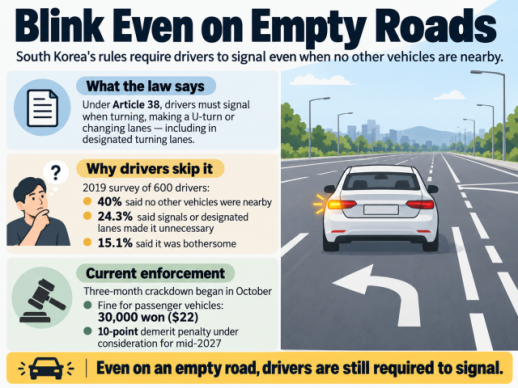 AJP FAQ: No cars around? You still need to blink in Korea An empty road or a designated turning lane may seem like a reason to skip signaling. But South Korean traffic rules make no exception for the absence of other vehicles. Under Article 38 of South Korea's Road Traffic Act, drivers must signal when turning left or right, making a U-turn or changing lanes, even in designated turning lanes. Still, many drivers do not see the need to signal. A 2019 survey of 600 drivers by the Korea Road Traffic Authority found that 40 percent had skipped signaling because other vehicles were absent or too far away. Another 24.3 percent saw no need to signal when following traffic lights or designated lanes, while 15.1 percent found it bothersome. Police began a three-month crackdown on turn signal violations in October. Drivers of passenger vehicles already face a 30,000-won ($22) fine, with an additional 10-point demerit penalty under consideration for mid-2027. Even on an empty road, drivers are still required to signal. 2026-10-13 17:10:15
 -
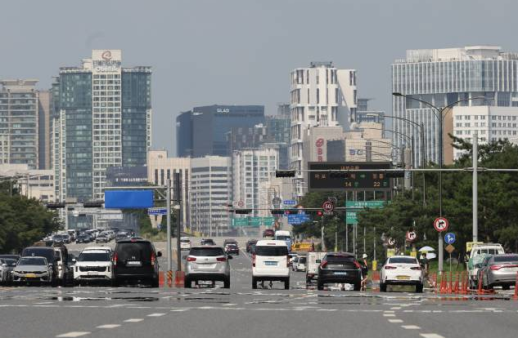 Korean drivers' blinker blind spot prompts nationwide crackdown SEOUL, October 13 (AJP)— It should be a habit for drivers to signal before turning or changing lanes. Or is it? South Korean police are not convinced and launched a nationwide crackdown. Nearly one in four drivers failed to signal when turning left at intersections in 2025, according to a survey by the Korea Transportation Safety Authority. At 75.7 percent, compliance lagged behind the rates for obeying traffic signals, at 96.7 percent, and wearing seat belts, at 85.4 percent. From 2023 to 2025, authorities received 1,497,280 public reports of drivers failing to signal, making it the second-most frequently reported traffic violation after disobeying traffic signals or directions, according to the Korean National Police Agency (KNPA). "It's basic driving etiquette," said Kim Jae-min, a Seoul resident in his 30s. "I wonder how some don't realize that failing to signal could leave them with greater responsibility if an accident happens." The fines are nothing new. Failing to use a turn signal has carried a penalty in South Korea since 1973. Police are conducting a three-month crackdown from October through December and seeking to introduce a 10-point demerit penalty as early as mid-2027. Drivers caught failing to signal face a 30,000-won ($22) traffic fine for passenger vehicles, while violations reported by the public can result in a 40,000-won ($30) administrative penalty. "Too many drivers are still failing to comply," a KNPA traffic safety official said. The tougher approach, however, has drawn skepticism from a traffic expert who questions whether more enforcement is the best way to change a longstanding driving habit. "This ultimately comes down to driving habits," said Kang Kyung-woo, a professor of traffic and logistics engineering at Hanyang University. "Raising awareness is a good thing, but devoting so many officers to enforcement is a waste of manpower," he said. "Those officers could be deployed where they're needed more." When should drivers signal? Under Article 38 of South Korea's Road Traffic Act, drivers must signal when turning left or right, making a U-turn or changing lanes. The law and its implementing rules require signaling to begin at least 30 meters before the maneuver on regular roads and 100 meters on expressways, and continue until it is complete. The requirement also applies when drivers are waiting in designated left- or right-turn lanes, even when road markings make their intended direction appear obvious. At roundabouts, drivers must signal left when entering and right when exiting. A 2019 survey of 600 drivers by the Korea Road Traffic Authority found that 40 percent had skipped signaling because no other vehicles were nearby or surrounding traffic was far away. Another 24.3 percent considered it unnecessary when following traffic signals or designated lanes, while 15.1 percent simply found it bothersome. In other words, many drivers appear to signal only when they think someone else needs to see it. Kang argued that this distinction mattered when deciding how aggressively to enforce the law. "Turn signals are essentially a way of warning other road users of your intentions," he said. "Raising awareness is important, but if there is no one else around, do we really need police officers enforcing it?" The law, however, makes no exception for an empty road. The gap between what drivers consider necessary and what the rules require lies at the heart of the enforcement debate. A different kind of countdown Some U.S. states incorporate time or speed into their signaling rules and guidance alongside distance. California's Department of Motor Vehicles advises drivers to signal at least 100 feet, or about 30.5 meters, before turning — nearly identical to South Korea's 30-meter requirement on regular roads. For lane changes on freeways, it advises signaling at least five seconds in advance. It also tells motorists to signal even when no other vehicles are visible. Pennsylvania's driver's manual ties signaling distance to speed. Drivers traveling below 35 miles per hour must signal for at least 100 feet before turning. At 35 mph or faster, the manual specifies at least 300 feet, or about 91 meters. Kang called for more detailed signaling rules that reflect different driving conditions. "It would definitely be better to have more specific rules, as some U.S. states do, rather than applying the same requirements in every situation," he said. "The rules should take into account factors such as speed, road type and location." Technology is already changing how vehicles respond to drivers who neglect their blinkers. Many newer cars have lane-departure warning or lane-keeping assistance systems that can warn drivers or intervene when they cross lane markings without signaling. Depending on the system, cameras detect lane markings and trigger visual alerts, steering wheel vibrations or corrective steering. Kang said increasingly sophisticated safety systems raised questions about whether traffic regulations were keeping pace with modern vehicles. "Technology is advancing faster than traffic regulations," he said. "Cars are becoming more like electronic devices, with systems that can intervene to prevent unsafe movements." Automated driving could further complicate questions of responsibility when a vehicle fails to signal. "If a self-driving car fails to use its turn signal, who is responsible?" he asked. For now, the nationwide crackdown turns on a much simpler question: whether drivers can make a habit of telling others where they are going. 2026-10-13 17:09:00