
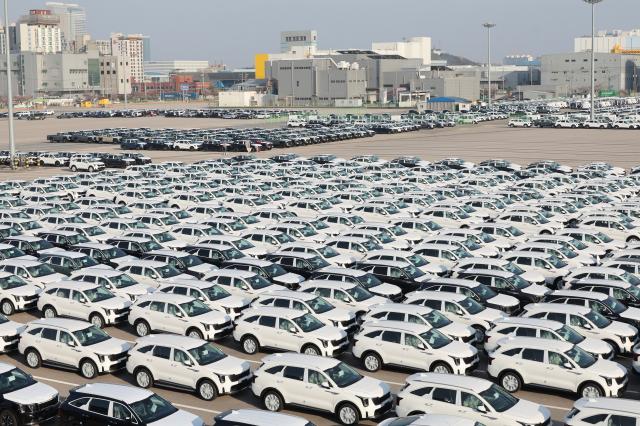
With the AI froth fizzling out, the weaknesses of another traditional export pillar are coming into sharper view.
The country crossed $1 trillion in annual exports on Nov. 19, becoming only the fourth nation to do so after the United States, Germany and China. Semiconductors brought in $396.8 billion in the first 10 months, accounting for about 43 percent of the total.
Cars kept a low profile at the party.
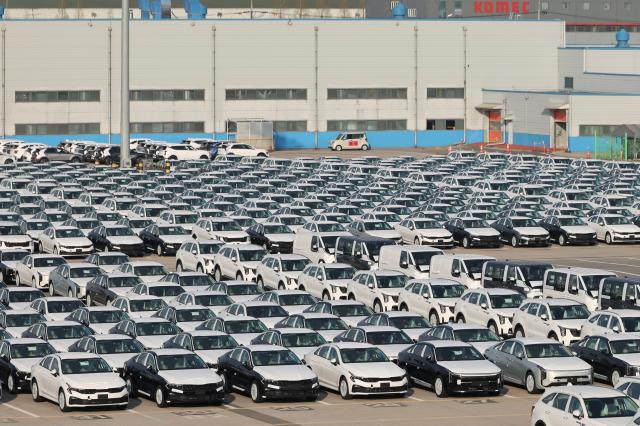
Auto exports fell 1.7 percent to $58.61 billion over the same period, reducing their contribution to about 6.3 percent of export earnings. Passenger car exports fell another 5.6 percent in the first 20 days of November.
While chipmakers and chip stocks stayed in the limelight throughout the year, carmakers struggled against multiple whammies: U.S. tariffs, higher production costs, sluggish demand, gaps in their model lineups and Chinese competitors offering more car for the money.
Korea shipped 3.2 percent more vehicles through October but earned fewer dollars, implying a roughly 4.7 percent decline in average export value per vehicle.
Hyundai Motor is struggling more than its smaller sister Kia Corp.
According to their November quarterly filings, Hyundai's revenue edged up just 0.6 percent to 140.26 trillion won in the first nine months, while operating profit fell 17.7 percent to 8.04 trillion won. Kia's revenue grew 9.4 percent to 94.14 trillion won, with operating profit down a milder 8.1 percent at 6.65 trillion won.
Kia retained a 7.1 percent operating margin against Hyundai's 5.7 percent, although Hyundai's consolidated business also includes substantial financial operations.
Hyundai's global sales volume fell 7.0 percent to about 2.89 million vehicles through September. Kia's rose 4.4 percent to about 2.48 million.
Strikes and production disruptions helped drive Hyundai's third-quarter domestic sales down 27.2 percent. Overseas wholesale sales fell 8.0 percent. The company subsequently cut its annual sales target to 4 million vehicles and lowered its operating-margin forecast to 5.5 to 6.5 percent.
Kia's strength has been its grip on the family-car market. Its filing credits the Sorento, Sportage and Carnival, together with new models including the Seltos, with lifting domestic sales 5.4 percent through September.
Hyundai's domestic sales fell 16.3 percent over the same period, leaving its lead over Kia at barely 12,000 vehicles.
The smaller sister has kept its SUV and minivan lineup supplied with powertrains buyers want, expanding hybrids alongside smaller, more affordable EVs.
In the United States, Kia's hybrid sales more than doubled to about 175,000 vehicles through September, according to its filing. Overall retail sales rose 4.9 percent. Hyundai's U.S. retail sales also increased, by 3.0 percent.
Europe offers a sharper contrast. Hyundai reported a 9.2 percent sales decline in its European market, citing Chinese EV competition and weakness in established volume models. Kia reported 10.0 percent growth in Western Europe, supported by its expanding EV lineup, although the companies use different regional definitions.
Kia's third-quarter EV retail sales jumped 75.4 percent to 123,000 vehicles, with roughly half sold in Western Europe.
For Hyundai, moving upmarket has offered less shelter than expected.
Genesis, its premium brand, saw Korean sales fall 29.4 percent to 68,683 vehicles through October. Its mainstay G80 sedan and GV70 SUV date to 2020, while its first hybrid arrived only this autumn.
"It is impossible to beat Chinese EVs in a price war," said Esther Yim, a Samsung Securities analyst, pinning Hyundai and Kia's slowdown on Chinese competition rather than one-off production disruptions.
She expects Hyundai's global sales to fall short of 4 million units this year for the first time since 2010, excluding 2020.
Investors have bought a different story.
Hyundai's market value topped 100 trillion won for the first time in January after Boston Dynamics unveiled its latest Atlas humanoid at CES 2026.
Hyundai's union has warned that "not a single robot" can enter its factories without a labor-management agreement. Analyst estimates put Atlas at about $130,000 per unit, with a targeted payback period of roughly two years.
Vice Chairman Chang Jae-hoon has said human workers will remain essential for maintaining and training robots, while the group says the machines will take on dangerous and repetitive tasks.
Autonomous driving is a sorer point.
Hyundai plans to introduce Nvidia-based Level 2+ driving assistance in the first half of 2028, followed by more advanced functions later that year. Its in-house Atria AI is scheduled for production vehicles in the second half of 2029. These systems still require driver supervision.
"Our partnership with Nvidia is not about leaving our destiny entirely in their hands," Park Min-woo, who heads the group's autonomous driving unit, told a media briefing.
On the showroom floor, price speaks loudest.
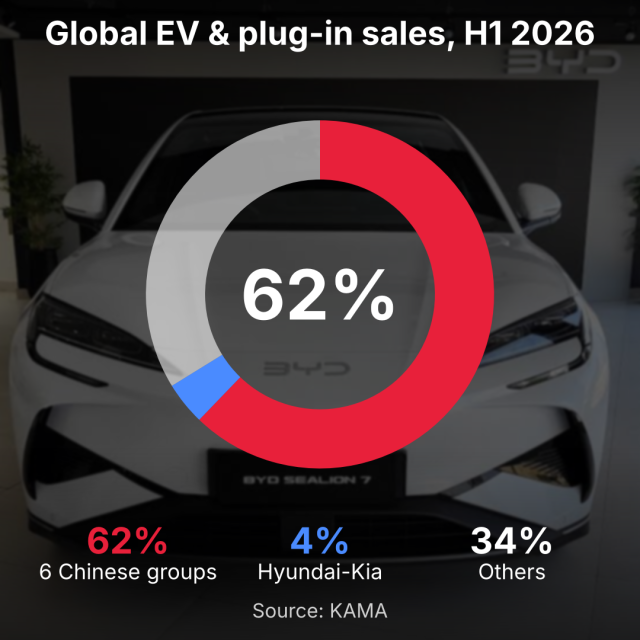
BYD's Dolphin starts at 24.5 million won, about 15 million won below the sticker price of Kia's EV3 compact SUV, though the gap narrows after subsidies for eligible Korean models. BYD lost access to government purchase subsidies in July.
Hyundai's new Avante launched in August at 23.98 million won—3.64 million won above the previous entry price of 20.34 million won cited in subsequent pricing reports. The driver's instrument display was a 350,000-won option on the base trim, although Hyundai is now offering it free under a promotion running through December.
Chinese production is making its presence felt well beyond Chinese badges. Tesla’s Shanghai-built Model Y sold 78,631 units in Korea through October, approaching the Sorento’s 81,717. BYD registered 21,731 vehicles, more than triple its 2025 total.
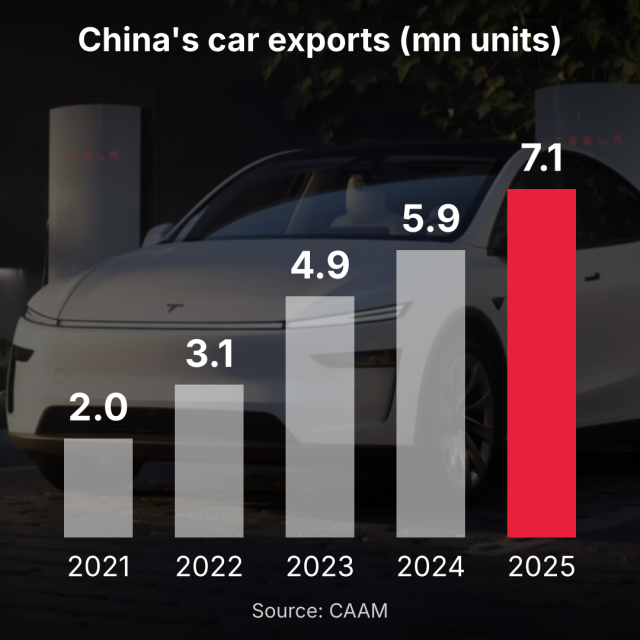
Hyundai and Kia's service advantage at home is also facing a challenge. BYD has nearly doubled its Korean service network from 11 centers at launch to 21 and plans 26 by year-end. That remains far short of the more than 1,200 domestic service centers available to Hyundai and Kia customers.
"Right now, everyone is focused purely on the sticker price," said Brian Lee of CLSA Securities Korea.
He cautioned that resale values, service access and maintenance costs could temper Chinese brands' appeal as the market matures.
Defending the sticker price is already expensive for Kia. Incentives and price reductions shaved 727 billion won from its third-quarter operating profit compared with a year earlier.
Raw-material increases and the prolonged Middle East conflict added roughly 577 billion won in pressure. U.S. tariffs remained a burden even after the rate fell from 25 percent to 15 percent.
Exchange rates provided some relief: both companies reported favorable currency effects in the quarter. But neither escaped a decline in nine-month operating profit.
Abroad, Hyundai and Kia have all but vanished from China, where their combined retail share fell to 0.6 percent in the first nine months, from more than 10 percent at their mid-2010s peak. Their combined retail sales there fell 22 percent to about 115,000 vehicles.
"Automakers exposed to price competition with Chinese EVs will see their profitability come under pressure unless they secure a competitive cost structure and differentiation," Hana Securities analyst Song Sun-jae said.
Korea’s trade barriers offer less protection than those in other major markets. It charges an 8 percent tariff on Chinese passenger cars, against triple-digit U.S. duties on Chinese EVs. Lawmakers are debating whether to extend a new domestic production tax credit to EVs, which were left out of the government's August tax plan.
Building more vehicles overseas can reduce tariff exposure, although those sales do not count toward Korea's vehicle exports. October brought some respite, with auto export earnings rising 18.1 percent, but the recovery has yet to erase the year’s decline.
The pressure is mounting just as Seoul and Beijing warm to each other. President Lee Jae Myung and Xi Jinping agreed at the APEC summit in Shenzhen on Nov. 18 to expand cultural and content exchanges in stages.
Automakers see little room for goodwill on the road. The Korea Automobile and Mobility Association has warned that Chinese EVs "could trigger the collapse of not just domestic EV makers, but the entire auto industry."
For now, the trillion-dollar headline belongs to chips. Whether cars get a bigger share of the next one may be decided as much in Korea’s own showrooms as in overseas ports.
Kim Dong-young
Kim Dong-young is a bilingual journalist at AJU Press (AJP), covering Korean tech, energy, and bio/pharma.
He reports from the field at events like CES and APEC, runs AJP's YouTube channels,
and is pursuing a master's at Sogang's MOT program.
Copyright ⓒ Aju Press All rights reserved.
Related News
-
 Government Urges Petrochemical Industry to Complete Business Restructuring by Year-End
The government has urged the petrochemical industry to finalize discussions on business restructuring by the end of the year. While initial restructuring results have emerged from Daesan and Yeosu, concerns are growing that the slow pace of other projects, coupled with prolonged global oversupply, may lead to missing the critical timing for restructuring.The Ministry of Trade, Industry and Energy announced that Minister Kim Jung-kwan held a meeting on November 23 with CEOs of petrochemical companies at the Korea Chamber of Commerce and Industry, urging the seamless implementation of previously approved restructuring plans and the prompt completion of ongoing projects.This meeting was organized to assess the progress of business restructuring in line with the 'Direction for the Revitalization of the Petrochemical Industry' announced by the government in August last year and to encourage further restructuring within the industry.Last year, the government received restructuring proposals from companies related to 16 naphtha cracking facilities (NCC) and propane dehydrogenation facilities (PDH) in the three major petrochemical complexes of Yeosu, Daesan, and Ulsan. So far, two projects have received government approval: Daesan No. 1 and Yeosu No. 1. The Daesan No. 1 project was approved in February, followed by the Yeosu No. 1 restructuring plan in July, with progress also noted in subsequent procedures such as the establishment of a consolidated corporation and facility rationalization in September.The Daesan No. 1 project focuses on the suspension of operations at Lotte Chemical's Daesan plant, which has an annual capacity of 1.1 million tons, and the integration of operations with HD Hyundai Chemical. The government has prepared a support package exceeding 2.1 trillion won (KRW), including financial, tax, and cost-reduction measures, upon approving the restructuring plan in February.The Yeosu No. 1 project involves four companies: Yeocheon NCC, Lotte Chemical, Hanwha Solutions, and DL Chemical. The plan includes integrating Lotte Chemical's NCC and basic materials business with Yeocheon NCC, as well as combining some downstream operations of Hanwha Solutions and DL Chemical. The government has arranged over 650 billion won (KRW) in financial support, along with tax and technology development assistance.However, voices are growing louder for accelerating restructuring as global oversupply of petrochemical products continues and recovery in the market is delayed. In particular, the approved restructuring plans must lead to actual reductions in production capacity and improvements in profitability, while discussions among companies that have yet to finalize their restructuring plans also need to be concluded.The government plans to demand the seamless implementation of planned facility rationalization for approved projects and urge companies to finalize agreements on incomplete projects by the end of the year.Minister Kim Jung-kwan stated, "The approved restructuring in Daesan and Yeosu is not the end but just the beginning," adding, "We must fulfill our responsibilities to ensure that planned facility rationalization is implemented without disruption and leads to tangible results."He particularly urged companies that have not yet established final restructuring plans, saying, "I understand that the decisions are complex and not easy, but all companies must share the responsibility for the future of the entire industry rather than focusing solely on immediate gains and losses. I hope you will conclude the restructuring discussions by the end of this year to avoid missing the golden time."The government will continue to support restructuring companies. The Ministry plans to establish a 'Comprehensive Support Plan for the Chemical Industry Ecosystem' to link restructuring with the transition to high value-added and advanced materials industries. This aims to strengthen the supply chain of key raw materials and materials while addressing potential impacts on local economies and employment during the restructuring process.Minister Kim emphasized, "The government will spare no necessary support for restructuring companies," and added, "We will actively support the spread of restructuring outcomes beyond individual companies to the overall industrial ecosystem, including the transition to high value-added and advanced materials industries, local economies, and employment."* This article has been translated by AI.
-
FC Seoul Returns to K League 1 After 10 Years, Invites 100 Multi-Child Families to Home Game
FC Seoul, which lifted the championship trophy with a victory in the final league match in Jeonju in 2016, has confirmed its return to the top of K League 1 at Seoul World Cup Stadium after 10 years. To share the joy of its seventh league title with the citizens of Seoul, the city and FC Seoul are inviting 100 multi-child families to a home game in Sangam. On the 23rd, the city of Seoul announced that it will invite 100 multi-child families, approximately 400 people, residing in Seoul to the K League 1 match between FC Seoul and Daejeon Hana Citizen at 2 p.m. on the 28th at Seoul World Cup Stadium. This event is designed to celebrate the victory of the local team with the citizens and to expand opportunities for multi-child families to enjoy professional soccer together. The circumstances surrounding the two championships are notably different in terms of timing and location. FC Seoul secured its title in 2016 with a 1-0 victory over Jeonbuk Hyundai in the final match, thanks to a decisive goal from Park Ju-young. This year, the team confirmed its championship with a draw of 1-1 against Gangwon FC in Sangam on October 24, leaving five matches in the final round. Fans who had to wait until the last match of the season away from home 10 years ago were able to witness the team's early return to the top from the stands this year. This invitation is an opportunity to celebrate that victory with their children. The invitation is open to families residing in Seoul with two or more children, where the youngest child is under 18 years old. Families expecting a second child are also eligible to apply. The city will prioritize families with three or more children and will select two-child families through a lottery. Applications will be accepted from 10 a.m. to 5 p.m. on the 25th via the Birth and Parenting Information Center. Applicants who are not selected for the free invitation and multi-child families visiting the venue on match day can receive discounts on tickets for Zone E·N. The discount rates are 39% for adults, 44% for teenagers, and 50% for children. They will need to present proof of family relationship, such as a family certificate, at the ticket booth on match day. Families expecting a second child must provide documents confirming the pregnancy. On match day, the north plaza of Seoul World Cup Stadium will host a 'Cannon Shot Event' where families can experience shooting together. The city will also provide information on its pregnancy, childbirth, and childcare support policy, 'Seoul Child Companion,' at the event booth. Since 2023, the city has been working with local professional sports teams to expand opportunities for citizens to watch games, and in January of this year, it invited 50 multi-child families to a home game of the Seoul Samsung Thunders. Cho Sung-ho, director of the Seoul Tourism and Sports Bureau, stated, "It is especially meaningful to share the joy of FC Seoul's return to the top of K League 1 after 10 years with children and families. We will strengthen cooperation with local sports teams to allow citizens to enjoy sports more closely in their daily lives."* This article has been translated by AI.
-
KOSPI Plummets 4.88%, Threatening 4600 Level Amid Selling Pressure
The KOSPI index expanded its losses to nearly 5% on the 23rd, falling to the early 4600 level. The sell-off in artificial intelligence (AI) and semiconductor stocks triggered by the U.S. stock market has spread to the domestic market, causing major stocks, including Samsung Electronics and SK Hynix, to plummet. Foreign investors, who initially engaged in net buying at the start of the session, have also shifted to net selling, increasing downward pressure on the index. According to the Korea Exchange, as of 11:31 a.m. on the 23rd, the KOSPI was trading at 4632.42, down 237.54 points (4.88%) from the previous trading day. The index, which had dropped to the 4700 level early in the session, has continued to widen its losses, now threatening the 4600 level. The shock from the sell-off of AI-related technology and semiconductor stocks in the U.S. stock market on the 20th is believed to have carried over to the domestic market. In particular, large-cap semiconductor stocks that have led the domestic market are experiencing significant declines, driving the index lower. The supply and demand situation is also deteriorating. In the securities market, individuals and foreign investors are net selling 169.9 billion won (KRW) and 158.1 billion won (KRW), respectively. In contrast, institutions are net buying 191.8 billion won (KRW), absorbing the sell-off. Foreign investors, who had net bought over 120 billion won (KRW) early in the session, have turned to net selling, exacerbating supply and demand instability. Major stocks by market capitalization are all showing declines. Samsung Electronics has dropped 5.41%, while SK Hynix is down 4.94%. Samsung Electronics preferred shares (-4.30%), SK Square (-3.25%), and LG Energy Solution (-4.01%) are also showing weakness. Samsung Biologics (-5.76%) and Celltrion (-5.87%) have fallen nearly 6%, while KB Financial (-4.72%) and Hyundai Motor (-4.71%) are also experiencing significant declines. Samsung Electro-Mechanics (-2.33%) is also in a downward trend. The sell-off is spreading across major sectors, including semiconductors, biotechnology, automotive, and finance. The KOSDAQ market is also widening its losses. At the same time, the KOSDAQ index recorded 624.15, down 21.53 points (3.33%) from the previous trading day. In the KOSDAQ market, individuals and foreign investors are net selling 82.1 billion won (KRW) and 13.3 billion won (KRW), respectively, while institutions are net buying 95 billion won (KRW). Among the top KOSDAQ stocks, Alteogen (-4.87%), EcoPro BM (-4.59%), and EcoPro (-4.91%) are down around 5%. JUSUNG Engineering (-4.20%), Rino Industry (-3.97%), Rainbow Robotics (-2.57%), and HLB (-1.85%) are also showing weakness. In contrast, Roboteers is up 3.64%, demonstrating strength even in a declining market.* This article has been translated by AI.