

[Gettyimages Bank]
According to Ahn Lab, an online security solution and service company in South Korea, cryptocurrency exchanges and data systems of government bodies and partner companies were the main target of cyberattacks in 2020. Banks and online shopping malls were also attacked by hackers who tried to disable servers using the denial-of-service (DDoS) attack method which basically creates a data bottleneck phenomenon at communication gateways by repeatedly sending useless data packets.
Ahn Lab said that about 1.7 million cyberattacks against government systems and affiliated companies take place every day. More than 84 percent of hackers tried to send faux emails containing malicious codes or steal important data. Hackers wanted victims to pay ransom with cryptocurrency.
Starting in May, the Defense Acquisition Program Administration (DAPA) will roll out a 2.6 billion won ($2 million) project to inspect the cyber security system of 85 defense companies. DAPA will find security loopholes and possible breach points and upgrade systems.
"Data breach in defense companies is a serious problem that could pose a threat to South Korea's security. It is vital to prevent such attacks to ensure the safety of the country and its people," DAPA's national technology security bureau officer Lee Young-bin told Aju Business Daily on March 3.
DAPA will simulate hacking attacks on security systems and carry out anti-hacking training programs to prevent hacking and minimize damage in case of data breaches.
Park Sae-jin
Experienced journalist and editor at AJU PRESS specializing in multilingual news. I cover international diplomacy, geolpolitics, and policy, consistently delivering highly accurate, compelling reporting for a worldwide audience.
Copyright ⓒ Aju Press All rights reserved.
Related News
-
 Toss Wins Top Prize at Financial Security AI Hacking Defense Competition
Toss has won the top prize at the AI-based hacking defense competition organized by the Financial Security Agency. Toss Securities also secured second place, marking six consecutive years of winning teams from the Toss group, including previous iterations of the competition. Viva Republica, the operator of Toss, announced on November 13 that it received the grand prize at the 2026 Financial Security AI Hacking Defense Competition. This competition, hosted by the Financial Security Agency and sponsored by the Financial Services Commission, was revamped from the previous Financial Security Threat Analysis Competition (FIESTA) to evaluate AI-based attack and defense capabilities. This year, a total of 10 teams competed in the finals. The Toss team, consisting of white hat hackers Choi Jeong-su, Kwon Jae-seung, Kim Jae-seong, and Jeon Hye-rim, participated under the team name 'Decaf Amaretto Latte' and claimed first place. They received the Financial Services Commission Chairman's Award and a cash prize of 12 million won. The Toss Securities security technology team, made up of Kwon Hyuk-joo, Kim Beop-seong, Kim Tae-wook, and Lee Sang-hyun, finished second with their team 'Kim Mong-som Fan Club,' earning the top excellence award from the Financial Security Agency. With this achievement, Toss affiliates have produced winning teams in this competition and its predecessor for six consecutive years since 2021. Toss won four consecutive years from 2021 to 2024, and last year, Toss Securities took first place. Toss operates a dedicated team of white hat hackers to assess security vulnerabilities and manage its own security solutions. They also conduct ongoing cyber attack response training and a vulnerability reporting reward program known as 'bug bounty.' A Toss representative stated, "We will proactively prepare for emerging threats in the AI era to create a safe financial environment."* This article has been translated by AI.
-
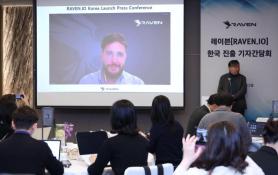 AI-powered hacking calls for real-time policing: Raven.io
Roi Abitboul, co-founder and CEO of cybersecurity firm Raven.io, speaks via video link during the company's Korea launch press conference at JW Marriott Hotel Seoul on Nov. 12, 2026, as Adrian Ong, managing director of The Executive Action, stands beside the screen. Courtesy of BrandFuture SEOUL, November 12 (AJP) - South Korea’s financial industry reported 40 cyber incidents in just over a month, exposing about 473,000 personal data records and resulting in roughly 1 billion won in stolen funds, underscoring the scale and speed of hacking facilitated by AI tools. As hackers employ AI technologies to find weaknesses and turn them into attacks, financial companies face a shrinking window to respond. The incidents affected 37 financial companies between Sept. 30 and Nov. 3, according to the Financial Services Commission (FSC). Banks, insurers, securities firms and digital financial service providers were among those hit. The stolen funds came from company-managed accounts, including cryptocurrency wallets and accounts holding customer deposits. No losses to individual customers had materialized as of the regulator’s Nov. 5 announcement. The incidents have not all been attributed to AI. But a separate investigation by U.S. cybersecurity firm CrowdStrike showed that attackers were already using the technology against Korean financial institutions. In an Oct. 7 report, CrowdStrike identified a campaign that used ARTEX, an AI-powered security testing tool, alongside large language models to target Korean financial organizations. Active from late September to early October, the campaign resulted in data theft, the company said. Journalists attend Raven.io's Korea launch press conference at JW Marriott Hotel Seoul on Nov. 12, 2026, as CEO Roi Abitboul delivers a presentation remotely via video link. A television camera and a monitor displaying his remarks are visible in the foreground. Courtesy of BrandFuture AI can help attackers search for software weaknesses and develop ways to exploit them, potentially moving faster than companies can investigate and install fixes. “It is so easy to find the vulnerability and build an exploit today using AI,” said Roi Abitboul, co-founder and CEO of cybersecurity company Raven.io, during a press briefing in Seoul on Thursday. Abitboul, who joined remotely, said AI was narrowing the time between discovering a software flaw and using it to launch an attack. That shrinking interval is central to Raven’s pitch as it enters South Korea, with banks and insurance companies among its initial targets. Modern financial systems rely on software assembled from many components. Banks write some themselves and obtain others from outside developers, including publicly available code known as open-source libraries. These libraries help developers build applications faster and at lower cost. Their openness also allows security researchers and attackers to study the same code for weaknesses. Raven.io holds a press conference to announce its entry into the South Korean market at JW Marriott Hotel Seoul in Seocho District, southern Seoul, on the morning of Nov. 12, 2026. AJU Business Daily Ha Sung-min A bank’s confidential systems are not thereby open to public view. But a flaw in a widely used component can expose organizations that depend on it. Installing security updates remains an essential defense. The difficulty arises when attackers exploit a weakness before a fix is available — or before a company has deployed it. Raven says its technology is designed to help protect applications during that gap by monitoring what individual software components do while they are running. Abitboul compared the approach to “having a camera on every library.” The company installs a monitoring program, known as an agent, on the server running an organization’s applications. The agent observes which libraries are being used, what they do and how they interact with the rest of the system. Raven says it uses its understanding of those components to identify actions outside their intended functions. A component designed to process data, for example, might trigger a warning if it unexpectedly tries to launch an unrelated program or access a sensitive file. The company says its system can block such an action without shutting down the entire application — a distinction that matters for banks, where an interruption could disrupt payments or other customer services. Adrian Ong, managing director of The Executive Action, speaks during Raven.io's Korea launch press conference at JW Marriott Hotel Seoul on Nov. 12, 2026. Ong discussed the company's plans to expand into South Korea's financial and other highly regulated industries. Courtesy of BrandFuture “We don’t change your source code. We don’t kill your application,” said Adrian Ong, managing director of The Executive Action, Raven’s Singapore-based partner overseeing its Korean expansion. Raven also says its protection does not depend on a flaw first receiving an official vulnerability identifier, known as a CVE, or on a developer releasing an update. “The moment you deviate from it, we catch you,” Abitboul said, referring to behavior outside a component’s expected function. The proposition is straightforward: restrict what software is allowed to do, regardless of whether a human attacker or an AI tool is trying to misuse it. Delivering that protection without disrupting legitimate activity is more complicated. Unusual software behavior is not always malicious, and incorrectly blocking it could itself interfere with a financial service. Abitboul said Raven’s technology uses approximately 0.2 percent of a server’s processing capacity and 200 to 300 megabytes of memory. Those performance figures have not been independently verified, and the company has not demonstrated that its product would have prevented the recent Korean attacks. Founded in 2023 by Abitboul and two longtime colleagues who previously developed security technology at Javelin Networks and Symantec, Raven is entering Korea as regulators intensify scrutiny of financial companies’ defenses. The FSC announced on Nov. 5 that it would inspect approximately 580 financial businesses, strengthen vulnerability assessments and examine internal security controls following the series of incidents. Abitboul said the attacks were a major reason Raven had prioritized South Korea despite its smaller market compared with the United States. “This market is very sophisticated,” he said, explaining that the urgency created by the breaches had strengthened the case for expansion. The company says it already serves customers in the United States, Western Europe and Africa. In Korea, it plans to pursue direct contracts and work with local resellers and companies that manage cybersecurity for other businesses. Several Korean organizations are testing the technology to assess its effectiveness and business value, Ong said. He declined to identify them, citing confidentiality agreements. No completed Korean commercial contracts were confirmed at the briefing. Ong, who first worked in South Korea’s cybersecurity industry in 2006, said the biggest change he had witnessed was the speed at which attacks could now develop. For financial companies, the challenge is to investigate weaknesses, deploy defenses and keep essential services running before an attacker finds a way through. “You can have many things, smart people, AI, whatever, money, but you never have enough time,” Ong said.
-
Park Sang-won, Head of the Financial Security Agency, Issues Official Apology for Hacking Incident
Park Sang-won, the head of the Financial Security Agency, officially apologized for a recent hacking incident and pledged to implement measures to prevent future occurrences. Speaking at the 'Financial Information Security Conference (FISCON 2026)' held at the Conrad Hotel in Yeouido, Seoul, on November 12, Park stated, "I apologize for causing great concern to the public and those in the financial sector due to the data breach that occurred on our self-assessment system on November 9." He expressed regret, saying, "As a specialized financial security institution, we should maintain a high level of security, and I am deeply sorry that this incident occurred." Park emphasized that they are currently investigating whether there are any additional leaks and the cause of the incident, stating, "We will conduct a thorough inspection of the entire Financial Security Agency system and establish fundamental measures to prevent recurrence." He added, "We will use this incident as an opportunity to improve our overall information security system and fulfill our role in supporting the security of financial companies more diligently." Earlier, on November 9, the Financial Security Agency detected abnormal access to the 'Continuous Information Security Assessment Site,' where financial companies submit evaluation materials, and subsequently blocked the service. They reported the incident to relevant authorities, including the Financial Services Commission. To date, it is estimated that files from 48 financial companies, totaling over 130, have been leaked. The Financial Security Agency has requested the police to trace the internet protocol (IP) addresses involved, while the Financial Services Commission and the Financial Supervisory Service are conducting on-site inspections of the Financial Security Agency.* This article has been translated by AI.