
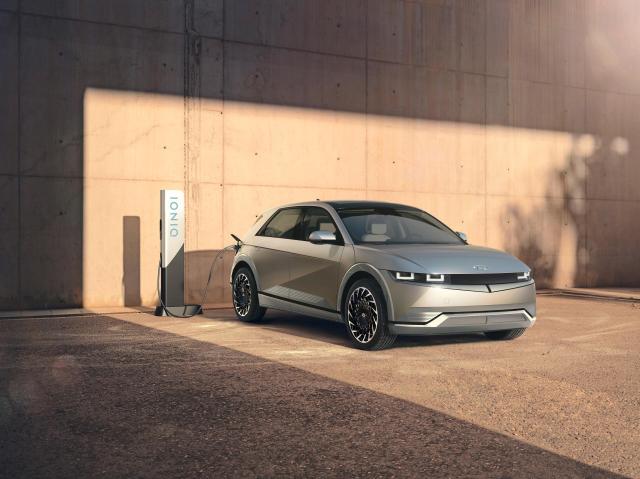
SEOUL -- Starting in the fourth quarter of 2024, all Hyundai and Kia electric vehicles released in the United States will be equipped with charger ports that match the North American Charging Standard, also known as the Tesla Charging standard.
EVs made by Hyundai Motor Group companies -- Hyundai Motor and Kia -- use Combined Charger System (CCS) charger ports and they are not compatible with Superchargers, EV chargers operated by American EV maker Tesla. Tesla is America's favorite EV company with some 200,000 Supercharger ports installed in more than 1,800 Tesla Supercharger stations across the U.S.
The American office of the Hyundai auto group said on October 5 (local time), that the North American Charging Standard (NACS) will be adopted by Hyundai and Kia EVs in 4Q 2024. The American EV charging standard will be adopted by EVs sold in Canada in 1Q 2025.
According to the South Korean carmaker group, special adapters will be provided for conventional EV owners so that they can connect to Tesla's Superchargers. They would be able to use charger apps released by Hyundai and Kia without having to use an app released by Tesla.
Park Sae-jin
Experienced journalist and editor at AJU PRESS specializing in multilingual news. I cover international diplomacy, geolpolitics, and policy, consistently delivering highly accurate, compelling reporting for a worldwide audience.
Copyright ⓒ Aju Press All rights reserved.
Related News
-
 Hyundai, Samsung SDI co-design EV battery pack
Getty Images Bank SEOUL, November 11 (AJP) - Hyundai Motor, Kia and Samsung SDI have moved beyond a buyer-supplier relationship to jointly design an electric vehicle battery pack, according to patent records from the Korea Intellectual Property Rights Information Service (KIPRIS). The patent, made public on Oct. 22, places gas vents on the underside of each battery cell and channels the searing gases released during thermal runaway out through a passage built into the pack's lower cover. The layout merges two compartments, one for venting gas and another for absorbing external shocks, into a single space, freeing up room for higher energy density. Five Hyundai and Kia researchers and two from Samsung SDI are named as inventors. The pack is built around Samsung SDI's prismatic cells, which the company has supplied since this year under its first Hyundai deal, signed in October 2023. The contract runs through 2032 and covers Europe-bound EVs, using cells from its plant in Hungary. The three companies have also filed nine joint patents on all-solid-state batteries, dubbed "dream batteries" for their longer range and lower fire risk, between 2022 and 2025. Their focus has shifted from coating moisture-sensitive sulfide electrolytes toward cell life and mass-production processes. Samsung Electronics on Nov. 9 hosted 177 executives from both groups and their spouses in Yongin, south of Seoul, in their first group-level exchange. The ties date to 2020, when the groups' heirs at the time, Lee Jae-yong and Chung Eui-sun, toured each other's battery and research sites. "Samsung and Hyundai Motor Group are going beyond cooperation in vehicle parts such as electronics, audio and batteries, and broadening the possibilities of cooperation in future industries such as robots and energy," Jang Jae-hoon, vice chairman of Hyundai Motor Group, said at the event. AJP Takeaways - Hyundai Motor, Kia and Samsung SDI jointly designed an EV battery pack that routes thermal-runaway gases through the pack's lower cover, according to a patent made public on Oct. 22, 2026. - The three companies filed nine joint all-solid-state battery patents between 2022 and 2025, with Samsung SDI as lead applicant on seven. - Samsung SDI began supplying prismatic batteries in 2026 for Hyundai Motor's Europe-bound EVs under a deal signed in October 2023 that runs through 2032.
-
 Southeast Asia's EV and Battery Market Expands, Raising Concerns for South Korea
Southeast Asia is emerging as a new production hub for the electric vehicle (EV) and battery industry, with Chinese companies leading the expansion of local production capabilities. As the region is expected to grow into an export base targeting Europe and Australia, South Korean automakers and battery manufacturers may need to adjust their local production and supply chain strategies.According to a report by the International Energy Agency (IEA) on Southeast Asia's energy technology supply chain, the market for clean energy technology in the region is projected to grow from approximately $25 billion in 2025 to over $80 billion by 2035, more than tripling in size. The expansion is expected to be driven primarily by the electric vehicle and battery sectors.Demand for electric vehicles is also rising rapidly. As of the end of the third quarter of this year, more than one in four new cars sold in Southeast Asia was an electric vehicle. This surge is attributed to government support for the development of the EV and battery industries, along with increased investments from foreign companies. Production capacity is also expected to grow sharply, with Southeast Asia's EV production capacity projected to rise from about 1 million units in 2025 to 1.8 million units by 2030.However, the rapid market penetration by Chinese companies poses a challenge for South Korean firms. Chinese automakers accounted for approximately 50% of Southeast Asia's EV production capacity last year. By 2030, their share of planned additional production capacity is expected to exceed 70%.The situation is similar in the battery sector. Southeast Asia's battery cell production capacity is expected to expand from about 40 GWh in 2025 to over 100 GWh by 2030. Currently, Chinese companies hold just over half of the production capacity, and if all announced expansion plans are realized, this share could rise to around 75% by 2030.Chinese automakers are also increasing their local sales. According to the Indonesian Automotive Industry Association (GAIKINDO), BYD, a Chinese company, recorded local wholesale sales of 43,727 units from January to September this year, ranking fifth among all brands. BYD operates a factory in Subang, West Java, with an annual production capacity of 150,000 units.The IEA notes that the production costs for electric vehicles in Southeast Asia are currently 4% to 6% higher than in China. As Chinese companies expand local production, they may enhance both price competitiveness and supply chain efficiency.There is also potential for Southeast Asia to evolve from a mere consumer market into a global export hub. The IEA forecasts that by 2035, the region's EV production could exceed 3.6 million units, transitioning it into a net exporter. Key export markets are expected to include Europe, Australia, and New Zealand. If Chinese companies leverage their Southeast Asian production bases to target third-country markets, competition with South Korean automakers and battery manufacturers is likely to intensify.* This article has been translated by AI.
-
Component Manufacturers Benefit from Battery Performance Competition as EV Thermal Management Market Expands
The domestic thermal management component market is gaining momentum alongside the expansion of the electric vehicle market. As automakers engage in a technological competition to extend battery life and enhance rapid charging performance, the importance of related components has increased. Domestic component manufacturers are also seizing new growth opportunities by expanding their supply of thermal management systems.According to financial information firm FnGuide on October 27, Hanon Systems and Hyundai Wia are projected to report operating profits of 112 billion won and 53.9 billion won, respectively, for the third quarter of this year. This marks an increase of 17.5% and 3.9% compared to 95.3 billion won and 51.8 billion won during the same period last year.Hanon Systems and Hyundai Wia produce thermal management components that regulate the temperature of electric vehicle batteries and drive systems. Hanon Systems, the second-largest player in the global automotive thermal management market, primarily manufactures vehicle thermal conditioning systems, including heat pumps and electric compressors. Recently, it has expanded its supply of battery cooling systems for electric and hybrid vehicles, establishing a foothold in the global market.Hyundai Wia is nurturing its thermal management business as a future growth driver. Following its decision to sell a special business division, the company is focusing more on developing thermal management systems. According to its recently announced mid- to long-term growth strategy, Hyundai Wia plans to increase the combined revenue of its thermal management systems (TMS) and robotics businesses from approximately 400 billion won this year to 4 trillion won by 2035. The TMS business alone is expected to grow at an average annual rate of 40.4%, reaching 2.7 trillion won by 2035.The commitment of domestic component manufacturers to the thermal management sector is driven by the acceleration of battery technology advancements among major global automakers, their primary clients. As battery performance and lifespan emerge as key factors influencing the marketability of electric vehicles, there is a swift movement toward securing related technologies.Hyundai Motor has announced that it is pursuing in-house research and development of solid-state batteries, which are considered the next-generation battery technology. Solid-state batteries replace the liquid electrolyte in conventional lithium-ion batteries with a solid, enhancing safety and energy density. Chinese company BYD has also entered the rapid charging performance competition by unveiling its second-generation blade battery this year. The competition among automakers is intensifying as they strive to reduce charging times and extend driving ranges.With the activation of the electric vehicle market, the thermal management component market is also experiencing growth. According to global market research firm Fortune Business Insights, the global electric vehicle thermal management system market is projected to grow from $26.84 billion this year to $84.11 billion by 2034, at an average annual growth rate of 15.3%. Furthermore, there is potential for additional growth as the business scope expands beyond vehicles to include data centers, energy storage systems (ESS), and robotics.Moon Hak-hoon, a professor at Osan University’s Future Electric Vehicle Department, stated, "The automotive thermal management market grows in proportion to vehicle production volumes, but there is a high potential for utilization in other industries. Since thermal management is essential wherever batteries are used, the growth trend of related companies is likely to continue for some time."* This article has been translated by AI.