
 Lieutenant General Xavier T. Brunson. Courtesy of the U.S. Army
SEOUL, September 12 (AJP) - Lieutenant General Xavier T. Brunson has been named as a nominee to lead the U.S. Forces Korea, the Pentagon said on Wednesday.
U.S. President Joe Biden nominated him to replace General Paul LaCamera who has led the position since July 2021. Brunson's nomination, which comes as LaCamera's tour in Seoul ends, requires approval from the Senate.
Brunson currently serves as the Commanding General of I Corps and Joint Base Lewis-McChord (JBLM) in Washington.
While the triple-hatted position, which also oversees the Combined Forces and United Nations Command, is usually filled by a four-star general, the African-American general is set to be promoted from his current three-star rank.
Majoring in political science at Hampton University in Virginia, Brunson was commissioned as an infantry officer in 1990. He has served in various roles, including deployments to Afghanistan and Iraq.
Brunson has two sons and one daughter with his wife, Kirsten, who is a retired colonel.
Copyright ⓒ Aju Press All rights reserved.
Related News
-
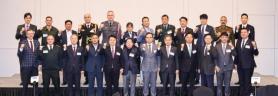 2026 Defense Industry forum held in Seoul
AJP Yoo Na-hyun Participants pose for a group photo at the 2026 Defense Industry Forum held at Nine Tree Premier ROKAUS Hotel Seoul Yongsan in Yongsan-gu, Seoul, on November 20, 2026. Clockwise from the top left are Rafael Jose Vieira Barreto, Brazilian defense, army, navy and air attaché; Gino Chretien, Canadian defense attaché to South Korea; Navy Capt. Aldrin Gacusan, naval attaché at the Philippine Embassy in Seoul; Ahmed Elhadidi, attaché at the Egyptian Embassy in Seoul; Pawel Janik, attaché at the Polish Embassy in Seoul; Pamela T. Stein, air attaché at the U.S. Embassy in Seoul; Yang Wook, research fellow at the Center for Foreign Policy and National Security of the Asan Institute for Policy Studies; Boldkhuu Batkhuyag, attaché at the Mongolian Embassy in Seoul; Eom Hyo-sik, head of the Defense Industry and Security Division at the Korea Defense Security Forum; Park Mae-hoon, head of the 4th Business Group at Hanwha Aerospace's LS Business Division; Aqeel Ibrahim Mohammed Al-Karawi, Iraqi defense attaché to South Korea; Yeo Sang-jae, team leader at HD Korea Shipbuilding & Offshore Engineering's Autonomous Unmanned Naval Vessel Research Laboratory; Choi Ki-il, professor of military studies at Sangji University; Antonio P. Villareal, Jr., second secretary at the Philippine Embassy in Seoul; Jang Won-jun, professor of advanced defense industry at Jeonbuk National University; Shin Beom-chul, senior research fellow at the Sejong Institute; Lee Nam-woo, executive vice chairman of the Korea Defense Industry Association; Kim Il-dong, acting administrator of the Defense Acquisition Program Administration; Yoo Yong-won, member of the National Assembly's National Defense Committee; Kwak Young-gil, chairman of Aju News Corporation; Kim Ki-young, director general for force policy at the Ministry of National Defense; Yang Oh-bong, president of Jeonbuk National University; Gino Chretien, Canadian defense attaché to South Korea; and Tanel Sepp, Estonian ambassador to South Korea. AJP Yoo Na-hyun
-
 2026 Defense Industry Forum: Park Mae-hoon of Hanwha Aerospace Discusses Challenges in Unmanned Systems
Park Mae-hoon, head of the LS Division at Hanwha Aerospace, emphasized on November 20 that "the competition in unmanned systems development is accelerating," highlighting that resolving issues related to communication and costs is a crucial task.Park made these remarks during a presentation on 'AI-Enabled Unmanned and Manned Combat Systems: Technologies and Challenges for Implementing Future Battlefields' at the '2026 Defense Industry Forum' held at the Nine Tree Premier Hotel in Yongsan, Seoul.The forum, co-hosted by Aju Economy, the Korea Defense Industry Association, and Jeonbuk National University, was organized under the theme 'The Future Battlefield Transformed by AI: A New Leap for K-Defense.'Park stated, "As the competition in unmanned systems development accelerates, securing the reliability of artificial intelligence (AI) and autonomous driving technologies in actual operational environments, as well as how quickly we can integrate and deploy software-based unmanned and manned teaming (MUM-T) and swarm operation capabilities, will determine market leadership."He identified communication and cost issues as barriers that need to be overcome. In the communication sector, he pointed out the necessity for 'hybrid communication' that can quickly switch between various communication networks based on the situation. This approach is similar to how smartphones switch between Wi-Fi and mobile networks; unmanned systems should also connect to alternative networks if issues arise with a specific communication network.Park explained, "We are developing technology aimed at implementing communication redundancy and hybrid communication," adding that the high costs associated with large devices represent a hurdle that must be overcome, and efforts are underway to reduce these costs.He presented cost reduction as a key condition for the widespread adoption of unmanned systems, stating that to operate multiple devices in a distributed manner, the prices of individual products must be lowered. Park remarked, "Companies need to generate profits, and we must enhance national defense capabilities," asserting that low-cost products must be developed in conjunction with distributed systems.Additionally, he noted that AI technology is now at a stage where it needs to prove its reliability. Park stated, "The usefulness of AI technology has been demonstrated," but emphasized the need for high-quality data collected outdoors, mentioning that there is a lack of testing grounds, prompting inquiries into various local government and military facilities. However, he acknowledged that building large testing grounds domestically is challenging due to civil complaints and security issues.In reality, the government budget supporting the development of AI-based unmanned and manned systems is significantly lacking. Of the approximately 66 trillion won (KRW) defense budget, only about 340 billion won (KRW) is allocated for related expenses, accounting for just 0.5%. There are calls for changes in budget allocation and acquisition methods for AI technology to translate into actual military capabilities.* This article has been translated by AI.
-
Takaichi's First Visit to China Highlights Defense Policy and Party Congress Variables
Japanese Prime Minister Sanae Takaichi concluded her first visit to China since taking office, stating, "Japan's position on Taiwan is as per the 1972 Japan-China Joint Communiqué." However, she did not address China's demand to retract her parliamentary response regarding Taiwan in case of a contingency, and a formal meeting with Chinese President Xi Jinping did not take place. The resumption of dialogue between the two countries is expected to be influenced by Japan's defense policy revision at the end of the year and China's Communist Party Congress next year.Takaichi made these remarks during a press conference in Shenzhen, China, following the conclusion of the Asia-Pacific Economic Cooperation (APEC) summit on November 19. She emphasized that there is "no change in the status of the four political documents" that define Japan-China relations, including the 1972 Joint Communiqué. She added, "China is an important neighboring country," and stressed the importance of dialogue and communication due to existing issues and challenges.In the 1972 Joint Communiqué that announced the normalization of diplomatic relations between China and Japan, China stated that Taiwan is an inseparable part of its territory, and Japan expressed that it "fully understands and respects" this position. China has demanded that Takaichi retract or amend her parliamentary response suggesting the possibility of collective self-defense in the event of a Taiwan contingency to normalize Japan-China relations. According to the Asahi Shimbun, China has also requested reaffirmation of the positions outlined in the four political documents, including the Joint Communiqué. While Takaichi reaffirmed the status of the basic documents, she left the contentious response unchanged.During the two days of the APEC summit, the two leaders had three brief encounters. Most were ceremonial occasions where President Xi, as the host, welcomed leaders from various countries. Takaichi seized the short opportunity to express gratitude for the invitation and congratulations on hosting. On November 19, they briefly held hands and exchanged words for about 10 seconds, but Xi only nodded in response. Despite the favorable conditions for the host country, no formal meeting was held, and the annual Japan-China summit that has been held since 2022 during APEC has been interrupted. The gap in summits has now exceeded one year since October of last year.In negotiations for a formal meeting, reaffirming the four political documents, including the Joint Communiqué, was mentioned as a compromise, but the two governments could not find common ground, according to the Nihon Keizai Shimbun (Nikkei). Takaichi also did not take the initiative to facilitate a meeting. Her statement that there is no change in the status of the basic documents came just before her return home after the APEC schedule had concluded. There was an early sentiment within the Japanese government that a meeting at this APEC would be difficult.Japan and China Face Major Events Next YearJapan's lack of urgency for a meeting at this APEC was also influenced by the upcoming year-end defense policy schedule. The Japanese government plans to revise three major security-related documents, including the national security strategy, and prepare a budget reflecting increased defense spending. China has criticized Japan's strengthening of its defense capabilities as "new militarism." Even if a meeting were to occur at APEC, there is a high likelihood that China would react again at the end of the year, leading to a view within the Japanese government that there is little benefit in focusing on improving relations now, according to Nikkei.China also has little reason to rush. In the second half of next year, a leadership reshuffle is expected at the quinquennial Communist Party Congress. Analysts suggest that during this politically unstable period, China will adopt a cautious approach to its relationship with Japan, which has many contentious issues, including historical matters. There are also speculations about how long the Takaichi administration will last.Additionally, Takaichi's term as president of the Liberal Democratic Party (LDP) lasts until September next year, and if rival candidates emerge, she will have to hold a party leadership election. In 2028, elections for Taiwan's presidency in January, Japan's House of Councillors in the summer, and the U.S. presidential election in November will follow. With significant events lined up that could shake domestic politics and regional dynamics in both countries over the next two years, there are many variables in determining the timing for resuming dialogue.However, opportunities are not entirely absent. Wang Yi, the Chinese Foreign Minister, mentioned the 55th anniversary of the normalization of diplomatic relations between China and Japan during a meeting with former Japanese Foreign Minister Takeaki Iwaya, who visited China in September. However, the anniversary in September next year coincides with the timing of the Communist Party Congress. Shin Kawashima, a professor at the University of Tokyo, told Nikkei, "If relations between China and Japan are to improve, the reference point would be by March next year, when China holds the National People's Congress."Meanwhile, while political dialogue has stalled, economic issues continue to accumulate. China's export restrictions on rare earths show no signs of easing. As Japanese companies rely on China for rare earth procurement, prolonged or intensified regulations could burden various industries, including automotive, electronic components, and semiconductors. Facing economic slowdown, China has begun to show a more proactive attitude toward economic exchanges with Japan, which is a positive sign. However, Nikkei analyzed that without political backing, such movements are unlikely to lead to substantial improvement in relations.With the conclusion of the APEC hosted by China, opportunities for the two leaders to meet will be limited for the time being. As export restrictions may continue without a political solution, Japan faces an increasing need to expand its procurement sources and production bases to Southeast Asia and Australia while considering the impact on its business with China.* This article has been translated by AI.