
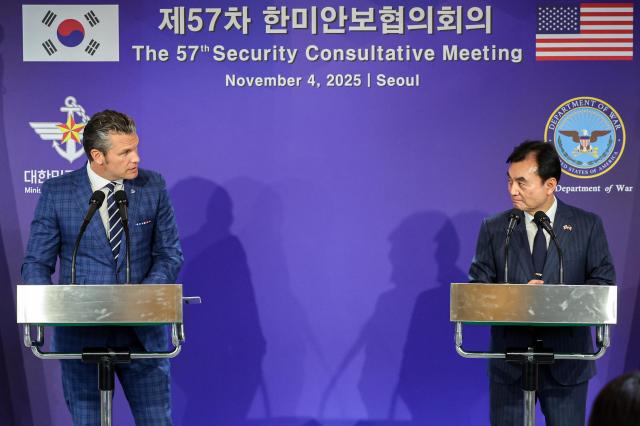
SEOUL, November 04 (AJP) - Defense Minister Ahn Kyu-baek and U.S. Defense Secretary Pete Hegseth reaffirmed plans to move ahead with South Korea's nuclear-powered submarine program and other key alliance issues during the 57th Security Consultative Meeting held Tuesday at the Ministry of National Defense in Yongsan.
The two discussed follow-up measures from last month's summit between President Lee Jae Myung and U.S. President Donald Trump in Gyeongju, where Trump approved South Korea's plan to develop a nuclear-powered submarine.
At a joint press conference after the meeting, Hegseth said that Washington "fully supports" the initiative and confirmed that Trump's authorization remains valid. "President Trump wants America's allies to strengthen their own defense capabilities," he said. "South Korea represents a model ally in that regard, and we will actively support this effort while coordinating closely with related agencies such as the State Department and the Department of Energy."
He added that both sides would continue to discuss the program in good faith and expressed confidence that it would lead to a positive outcome. Hegseth also noted South Korea's "world-class shipbuilding capabilities," saying the U.S. government hopes to expand cooperation beyond submarines to surface and combat vessels as well.
Asked whether South Korea plans to pursue nuclear weapons, Ahn replied, "There will never be nuclear weapons development in the Republic of Korea." He emphasized that South Korea, as a party to the Nuclear Non-Proliferation Treaty, "cannot and will not possess nuclear arms," calling denuclearization of the Korean Peninsula an "unshakable commitment."
The ministers also reviewed progress on the transfer of wartime operational control, a long-standing alliance issue. South Korea has completed its Full Operational Capability assessment, and verification procedures are underway. Both sides exchanged views on the timeline for completing the transition.
Ahn briefed Hegseth on Seoul's plan to raise defense spending, and Hegseth welcomed the move, saying he was encouraged by South Korea's decision to invest more in missile and cybersecurity capabilities.
The two also discussed the strategic flexibility of U.S. Forces Korea. When asked whether U.S. troops could be deployed in the event of a Taiwan Strait crisis, Hegseth stressed that Washington remains committed to maintaining stability on the Korean Peninsula while ensuring regional readiness. He added that South Korea would take the lead in conventional defense against North Korea while continuing close coordination with the United States.
The Security Consultative Meeting, the highest-level defense coordination forum between the two countries, is held alternately in Seoul and Washington each year. Officials said this year's joint statement will be released after both governments finalize the fact sheet on security and trade issues from the Lee-Trump summit.
Park Sae-jin
Experienced journalist and editor at AJU PRESS specializing in multilingual news. I cover international diplomacy, geolpolitics, and policy, consistently delivering highly accurate, compelling reporting for a worldwide audience.
Copyright ⓒ Aju Press All rights reserved.
Related News
-
 Conditions for Nuclear Power Export: Challenges Ahead for Czech Project
The failure of construction contract negotiations for the Czech Dukovany nuclear power project has put South Korea's nuclear export competitiveness to the test. Despite securing a contract worth tens of trillions of won, the country now faces the challenge of finding a new contractor to handle the actual construction. Observers suggest that the ability to manage promised construction costs and timelines will significantly influence the credibility of future South Korean nuclear exports. ◆ Construction permit application set for April, contractor selection delayed until July... Concerns over work gapsAccording to the Ministry of Trade, Industry and Energy on the 18th, the government held the second 'Korea Hydro & Nuclear Power (KHNP) Project Review Meeting' chaired by Vice Minister Park Dong-il to assess follow-up measures for the Czech Dukovany nuclear project. Following the conclusion of construction contract negotiations between KHNP and the Daewoo Engineering & Construction and Doosan Enerbility consortium on September 29, the government has activated an emergency management system. The key focus is to minimize work gaps that may arise during the contractor transition process. The Dukovany nuclear project involves the construction of two 1,000 megawatt (MW) APR1000 reactors. A main contract was signed between KHNP and the Czech ordering party last June, but a separate contract for actual construction has not been finalized. While a construction permit application is scheduled for April next year, the target date for selecting a new contractor is three months later, in July. This means that necessary design and site-related tasks for permits must proceed without a confirmed contractor. KHNP plans to either carry out these tasks directly or assign them to a local contractor in the Czech Republic, while separately issuing contracts for any new work required. They are developing a detailed management plan to be implemented weekly until the end of the year, dividing tasks such as design and permitting, site information verification, and accommodation site selection. However, there remains the possibility of delays and additional costs. If continuity of work is not secured during the contractor transition, it could hinder subsequent contract signing and schedule management. Particularly, if urgent tasks are issued separately without clearly defining contract scope and responsibilities, conflicts over additional costs may arise again. The background of the failed construction contract negotiations also involved disagreements over construction costs and risk sharing. KHNP has maintained the principle of a fixed-price contract while proposing measures to alleviate burdens due to fluctuations in quantities. In contrast, Daewoo Engineering & Construction argues that transferring the cost burden of increased construction quantities and additional work to the contractor is unreasonable in the absence of finalized designs. ◆ Lack of cost information sharing... Government pushes for nuclear export system reformThis situation has raised calls to review the overall contract and project cost management systems for nuclear export projects. A lack of information sharing among export agencies has previously hindered the effective utilization of past project experiences. According to audit results released by the Board of Audit and Inspection in May, KHNP requested project cost data for the Barakah nuclear power plant in the United Arab Emirates from Korea Electric Power Corporation while preparing for the Czech nuclear bid, but was denied due to trade secrets. This has led to difficulties in estimating bid prices due to the inadequate use of cost information from past projects. The Ministry of Trade, Industry and Energy is working to streamline the nuclear export system by promoting the enactment of the Nuclear Export Promotion Act. This plan aims to strengthen government oversight by requiring consultation with the ministry before major decisions such as borrowing, investment, and signing export contracts. A system is also being developed to seek resolution through a dispute mediation committee composed of neutral experts in the event of disputes among participating companies. In fact, after the negotiation breakdown, Daewoo Engineering & Construction requested mediation from the ministry for renegotiations, but the ministry stated it has no legal authority to mediate commercial contract negotiations between companies. While the government is reviewing the overall export business, its institutional means to intervene in individual contract disputes are limited. Ultimately, to maintain competitiveness in nuclear exports, a system must support not only price competitiveness at the bidding stage but also risk management throughout the project execution process. It is crucial to clarify the standards for cost and risk sharing among participating companies and manage contract disputes to prevent them from causing delays in the overall project schedule. The ability to prove the 'completion within the set period and budget,' which has been touted as a strength of South Korean nuclear power, is expected to determine future export competitiveness. Vice Minister Park Dong-il emphasized, "By thoroughly implementing a systematic plan that supports the achievement of key milestones, we will ensure the normal progress of the project," adding, "We must proceed more swiftly to prepare for unexpected schedule delay risks while adhering to quality and price commitments."* This article has been translated by AI.
-
Conditions for Nuclear Power Export: Is There Work for South Korea's Construction Capability?
The global nuclear power market is expanding, and the competitive standards of the nuclear industry are shifting from mere contract awards to the actual capabilities of construction and equipment supply. As major countries that had suspended nuclear construction for an extended period face challenges in restoring their workforce and manufacturing bases, South Korea is recognized as a nation with steady construction experience and a robust supply chain. However, there are concerns that to maintain this capability, domestic and international follow-up projects must continue without interruption.According to the World Nuclear Association (WNA) report titled 'World Nuclear Outlook' released on November 18, South Korea is classified as a 'leading country' alongside China and Russia, possessing continuous nuclear construction capabilities. The report analyzed that a steady volume of construction supports the maintenance of skilled labor and investment in manufacturing facilities, while standardized designs and repetitive construction experience enhance predictability in project duration and cost management.However, the WNA assessed that South Korea's future plans for new nuclear construction are limited compared to the scale of existing nuclear facilities. The Organisation for Economic Co-operation and Development (OECD) Nuclear Energy Agency (NEA) identified supply chain bottlenecks and a shortage of specialized personnel as major factors hindering global nuclear expansion.Domestically, the foundation for nurturing talent in the nuclear sector appears to be weakening. According to the 'Nuclear Industry Status Survey' released by the Ministry of Science and ICT this year, the number of students enrolled in nuclear-related majors across 16 universities and graduate schools nationwide has decreased by 25.4% from 2,777 in 2017 to 2,071 this year. The number of new students enrolled is 654, a 7.8% decrease from the previous year.Winning nuclear contracts does not immediately translate into securing work for the domestic supply chain. Even if a main contract is signed overseas, there can be a time lag of several years before the production of major equipment and the ordering of materials, as well as the commencement of on-site construction. If existing projects are exhausted during this period, there is a risk that skilled workers may leave or that corporate investment in facilities may decline.Localization demands from export destinations also pose a variable. As major nuclear-importing countries, including those in Europe, begin to foster their own industries and supply chains, even if contracts are secured, the production volume and added value that domestic equipment companies can secure remain separate challenges. In particular, there are calls to closely examine the scope of the industrial acceleration legislation being pursued by the European Union (EU), local procurement requirements, and the potential impacts on foreign companies.Industry experts emphasize the need to broaden the criteria for evaluating the success of nuclear exports. They argue that it is essential to consider not only the total contract amount but also the work allocated to the domestic supply chain, the maintenance of core design and manufacturing technologies and skilled personnel, and the division of roles between local and domestic production. The aim is to ensure that the timing and volume of domestic and international projects are linked so that contract achievements lead to the maintenance of the industrial base.Professor Jeong Beom-jin of Kyung Hee University’s Department of Nuclear Engineering pointed out, "While South Korea's nuclear power has construction and technological competitiveness, past policy fluctuations and a compensation structure centered on local transfers and public enterprises have led to a reluctance among talented individuals to pursue this field and a reduction in the number of related departments. Even as exports are promoted, the increase of personnel in public institutions remains stagnant, and Team Korea agencies are dispersed across regions, resulting in decreased efficiency and momentum on-site."He further emphasized, "Beyond simply investing in workforce training budgets, it is necessary to resolve policy discrepancies between departments and create practical incentives and compensation structures that allow skilled personnel to flow into the field so that they can actively engage in exports."* This article has been translated by AI.
-
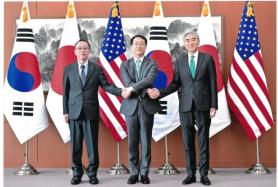 Denuclearization is a decades-long fight Seoul can't abandon: ex-nuclear envoy
Rep. Kim Gunn of the People Power Party, right, stands beside former Foreign Minister Gong Ro-myung, left, at a ceremony honoring Gong. Kim served as Gong’s aide early in his diplomatic career. Courtesy of Rep. Kim Gunn’s office SEOUL, November 18 (AJP) - South Korea must prepare for a long effort to end North Korea’s nuclear threat, as the arsenal creates dangers that go well beyond the risk of a nuclear attack, according to a former nuclear envoy turned lawmaker. “North Korea’s denuclearization is a goal we cannot abandon,” Rep. Kim Gunn of the main opposition People Power Party (PPP) told AJP in an interview marking the release of his book, "On a Knife’s Edge: Diplomacy over North Korea’s Nuclear Program” published Monday. In the book, Kim recounts his experience as a junior diplomat during the 1994 nuclear crisis and later as South Korea’s chief nuclear negotiator. “As long as North Korea possesses nuclear weapons, we cannot escape that nuclear shadow.” For the former chief nuclear negotiator, the shadow translates into confidence emboldening a regime to take risks with conventional forces in the belief that its opponents will hesitate to retaliate. It is a judgment shaped by more than three decades in diplomacy since he entered the foreign service in 1989, including negotiations over North Korea’s nuclear program, crisis management at the presidential office and postings as ambassador to Britain and consul general in Vancouver. His understanding of nuclear deterrence took on a sharper meaning during his assignment to Cheong Wa Dae, the presidential office, beginning in 2010. That March, the sinking of the South Korean warship Cheonan killed 46 sailors in an attack Seoul attributed to a North Korean torpedo. In November, North Korea shelled Yeonpyeong Island. Kim and his colleagues maintained round-the-clock coverage, taking turns sleeping on a folding bed in the office. “At the time, we could not understand why this was happening. We were overwhelmed with responding to it,” he said. “Looking back, I think it was the nuclear shadow.” North Korea had conducted its second nuclear test in 2009. In Kim’s assessment, its growing confidence in its nuclear capability helps explain its willingness to take military risks the following year. He linked that to the “stability-instability paradox”: the theory that fear of nuclear escalation can discourage all-out war while making confrontations below that threshold seem more manageable. “North Korea thought that because it had nuclear weapons, it could take these actions and the other side would be afraid to retaliate properly,” he said. That calculation, he argued, creates another problem for Pyongyang. If confrontations stay below the nuclear threshold, missiles, warships, drones and other conventional capabilities still matter. Rep. Kim Gunn, center, then South Korea’s special representative for Korean Peninsula peace and security affairs, shakes hands with Sung Kim, right, the U.S. special representative for North Korea, and Takehiro Funakoshi, left, director-general of the Japanese Foreign Ministry’s Asian and Oceanian Affairs Bureau, at trilateral talks on North Korea’s nuclear program in Seoul. Courtesy of Rep. Kim Gunn’s office “The more it develops nuclear weapons, the more it has to build up its conventional weapons,” he said. “Can the North Korean economy sustain both? It is not sustainable.” Kim sees that burden as one reason to maintain pressure and keep denuclearization as the destination, even when progress appears remote. Asked whether he would support a verifiable agreement negotiated by a Democratic Party administration that reduced the nuclear threat without achieving complete denuclearization, he said abandoning the ultimate objective would leave South Korea permanently exposed. “Denuclearization serves North Korea’s interests, too,” he said, arguing that ordinary North Koreans have gained little from decades of nuclear development, isolation and economic hardship. His time horizon extends well beyond a presidential term. “In international relations, achieving a major goal often takes 40 to 50 years,” he said. He cited the struggle against apartheid, South Africa’s system of institutionalized racial segregation, and the U.S. policy of containing Soviet expansion. Apartheid was formally established in 1948, and South Africa held its first fully democratic national election in 1994. American containment took shape in 1947, more than four decades before the Soviet Union dissolved in 1991. For Kim, these examples show how sustained effort and changing international conditions can eventually open a path through seemingly intractable problems. He suggested South Korea should be prepared to stay committed to denuclearization for another two decades or so, a strategic horizon rather than a prediction of when a settlement would come. The patience he advocates in policy has a counterpart in the personal relationships behind diplomacy. Kim described how those relationships helped him secure American support for the “Audacious Initiative,” the North Korea policy unveiled by then-President Yoon Suk Yeol on Aug. 15, 2022, which offered substantial economic assistance linked to progress toward denuclearization. The foreign ministry’s Office of Korean Peninsula Peace and Security Affairs, which Kim headed, developed the proposal using material supplied by the presidential office. Before the announcement, he was asked to help ensure that Washington would promptly express support. He traveled to Indonesia to discuss it with Sung Kim, then the U.S. special representative for North Korea and ambassador to Indonesia. Rather than trying to settle every detail of the roadmap, the two concentrated on what the American side could endorse: the plan’s objective. “Once you start getting into the details, there is no end to it,” he said. Back in Seoul, he met Edgard Kagan, then a senior White House National Security Council official visiting the city. The two had known each other since serving in Beijing as liaison officers for the six-party talks involving the two Koreas, the United States, China, Japan and Russia. Kim explained what Seoul hoped to achieve and what he had already discussed with Sung Kim. “When you have known each other for a long time, there is trust. You have worked on the same issues,” he said. “You do not have to explain everything at length. With just a few words, you understand what the other person is thinking and what they want.” Rep. Kim Gunn, right, then a South Korean diplomat, shakes hands with then-U.S. Secretary of State Hillary Clinton, left, at ROK-U.S. foreign ministerial talks during the Lee Myung-bak administration. Courtesy of Rep. Kim Gunn’s office Such work rarely gives the public a full view of what diplomats do. Kim encountered another example in London, where he served as ambassador to Britain and as the first head of South Korea’s permanent mission to the International Maritime Organization, established within the embassy in 2021. The IMO, a United Nations agency, develops international rules governing shipping safety, security and environmental performance. For a major shipbuilding and trading country, Kim said, the stakes are substantial. Rules intended to cut ships’ greenhouse gas emissions can influence the fuels vessels use, the technologies shipyards develop and the investments shipping companies make. “The decisions made there can completely change the landscape of our shipping and shipbuilding industries,” he said. “Our jobs, the future of our shipbuilding industry and the future of our shipping industry are all at stake.” He said South Korea needs to take an active part in shaping those standards and contribute more to the institution. “It may not attract much attention, but it is enormously important,” he said. Years before those assignments, a visit to Liberia had given him a more immediate understanding of the responsibility carried by a diplomatic title. Kim was serving as first secretary and deputy head of mission in Côte d’Ivoire when he traveled to Liberia in the aftermath of its first civil war. He remembers a damaged airport, severe shortages and a hotel where the noise of a generator made sleep difficult. Around 50 Koreans were living in Liberia, he recalled, and members of the community came to the airport to welcome him with flowers. During visits to their homes, his hosts repeatedly served janchi-guksu, Korean noodles in broth. Kim liked noodles. After several consecutive meals, however, he began to wonder why they appeared everywhere he went. He eventually learned that the community had asked people in Côte d’Ivoire what the visiting diplomat enjoyed eating. “They had specially brought the noodles in from overseas to serve me,” he said. “When I found out, I was deeply moved.” Before leaving, he invited the community to dinner at his hotel and handed out calendars and towels supplied by government ministries, modest gifts that drew a response he had not expected. Some people cried. After years of war and isolation, Kim said, “They seemed to feel that their country was finally looking after them.” The gathering brought another unexpected development. The small community had been divided by a dispute, but over dinner and drinks, people began reconciling. “Who was I, for them to regard me as so important?” he said. “It suddenly hit me that I represented my country.” Rep. Kim Gunn, then South Korea’s ambassador to Britain, wears a pale blue hanbok as he addresses guests at a National Day reception in Britain. Courtesy of Rep. Kim Gunn’s office That understanding stayed with him through later assignments, including Vancouver, where he visited a gravely ill Canadian veteran of the 1950-53 Korean War. The veteran had become a successful businessman, contributed to his community and maintained a generous regard for Koreans, and Kim wanted to express his country’s gratitude while there was still time. He took a commemorative medal to the hospital and thanked him for his service. According to Kim, the veteran, who had been barely responsive, regained some strength afterward. His family told Kim that he had been able to speak with them and share his final wishes before he died several weeks later. “The family sent me a letter thanking me,” he said. “That has stayed with me.” Asked which single photograph he would keep from his diplomatic life, Kim chose one with former Foreign Minister Gong Ro-myung, taken at a ceremony honoring Gong after Kim had entered the National Assembly. As a younger diplomat, Kim had served as an aide to both Gong and former Foreign Minister Han Sung-joo. “There are several people who were like teachers to me, who taught me diplomacy,” he said. “I learned a great deal from those two ministers.” “I had reached that position through the guidance of many mentors,” he added. “That is why the photograph feels so precious.” Public service also demanded sacrifices he now describes with equal candor. Before leaving for an overseas assignment expected to last five years, Kim visited his maternal grandfather, who had helped raise him and was a deeply loving presence in his childhood. His grandfather was already very old, and Kim feared he would not see him again. “After saying goodbye, I cried and cried in the car on the way back,” he said. His grandfather died while Kim was abroad, and Kim was unable to return. It remains one of the most painful memories of his diplomatic career. Asked what he would tell the young man who passed the foreign service examination in 1989, he spoke about family. “Spend a little more time with your family,” he said. “I thought I was doing important work for our country, so I poured all my energy into it. That meant I did not spend much time with my children.” When he was stationed in Seoul, weekends disappeared into work, and there were periods when he saw his children mainly as they slept. “Looking back, even if it meant sacrificing something else, I should have spent a little more time with them and been that kind of father,” he said. “I regret living that way.” In the National Assembly, Kim wants to make the connection between diplomacy and everyday life more visible. South Korea’s geography, dependence on overseas markets and extensive investment abroad make foreign relations central to its prosperity, he argued. Yet much diplomatic work takes place confidentially, leaving the public with an incomplete understanding of its importance, and when its value is poorly understood, diplomacy struggles to receive the resources it needs. Rep. Kim Gunn of the People Power Party wears his National Assembly badge on his left lapel on Nov. 9, 2026. Courtesy of Rep. Kim Gunn’s office “Someone has to serve as the link between the public and diplomacy,” he said. “I think that is the most important responsibility of former diplomats who enter the National Assembly.” The same concern for protecting people shapes his legislation. A bill he introduced in January would strengthen coordination and information sharing among the foreign ministry, other central government agencies and local authorities when Koreans encounter trouble abroad. Another, introduced in June, would require authorities to automatically notify stalking victims of developments in proceedings involving their alleged perpetrators, rather than leaving victims to request the information themselves. For Kim, those efforts belong to the same responsibility he first felt so sharply among the Korean community in Liberia. “The goal of a foreign affairs and security specialist is to help people live safely and well,” he said. “I want to pursue more legislation and activities that directly help people in their everyday lives,” he added. “That is my ambition as a politician.”