[This opinion article was contributed by Abraham Kwak, the Chairman of the Global Economic and Financial Research Institute (GEFRI)]
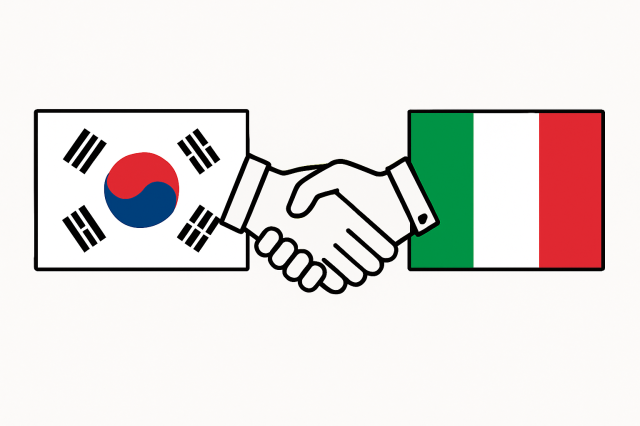
SEOUL, December 01 (AJP) - Korea and Italy may sit on opposite ends of the Eurasian landmass, yet the pulse of the two nations beats with a surprisingly similar rhythm. Both societies brim with passion; both celebrate life through food, drink, music and dance; and both possess an instinctive sensitivity to beauty that permeates daily life. From the colors of their alleyways to the craftsmanship in their workshops, the two countries mirror each other in unexpected ways. It is no coincidence that each has risen as a cultural powerhouse—Korea in Asia and Italy in Europe—even if the sources of their global influence differ. Korea leads the 21st century with K-pop, film and drama, while Italy sustains the world’s artistic imagination through its Renaissance heritage, classical arts and fashion traditions.
Upon these distinct yet complementary cultural foundations, Seoul and Rome have steadily expanded cooperation across diplomacy, economics, security and culture. Now a rare moment lies directly ahead. On July 29, 2027, Pope Francis will travel to Seoul to attend World Youth Day—one of the largest international gatherings of young people anywhere on the planet. His visit will be far more than a religious event. It will be a global stage where culture, diplomacy, tourism and faith intersect. And for many non-Catholic Koreans, the Pope is one of the most recognizable global symbols naturally associated with Italy’s history, culture and artistic heritage. This makes the 2027 World Youth Day in Seoul an unexpected yet powerful moment to deepen Korea’s ties with Italy as well.
The two nations are already widening their cooperation in five critical arenas.
First, the strategic partnership itself is deepening. In an era shaped by geopolitical instability, the two governments are expanding dialogue on supply-chain resilience, climate policy, maritime security and global governance—anchored by shared commitments to democracy and human rights.
Second, cooperation in advanced industries and technology is accelerating. Italy’s strengths in precision machinery, aerospace and robotics align naturally with Korea’s leadership in batteries, AI, semiconductors and space technologies. Korea’s recent focus on “physical AI”—the intelligence that animates manufacturing, logistics, mobility and urban systems—offers particular promise for collaboration with Italian industry. A bipartisan initiative in Korea, led jointly by Democratic Party lawmaker Jeong Dong-young and People Power Party lawmaker Choi Hyoung-doo, aims to build “physical AI pioneer cities,” an effort that fits neatly into the global industrial transformations underway in Italy.
Third, trade and investment are diversifying. Korea’s automotive, semiconductor and battery sectors are increasingly interlinked with Italy’s machinery, fashion and food industries, with new space for partnership in ESG and green technologies.
Fourth, cultural exchange continues to flourish. As Korean films, music and television saturate Italian youth culture, Italian fashion, cinema and classical arts remain a vital source of inspiration for Korean creators. The Pope’s visit will further amplify this cultural dialogue in ways neither nation has experienced before.
Fifth, youth and education exchanges are expanding. Universities and conservatories in both countries are launching joint programs in design, architecture, music and AI, while start-up ecosystems are beginning to interact more actively. World Youth Day 2027 will serve not as a slogan for change, but as a living venue where those exchanges become tangible.
At this crossroads, Korea and Italy must move beyond simple cultural affinity and step into the role of global partners capable of generating 21st-century synergy. The Pope’s arrival in Seoul can mark the symbolic beginning of this new chapter. For one week, the city will become a gathering place for hundreds of thousands of young people dreaming, questioning and reimagining universal values. At the heart of that moment will be the legacies and aspirations that Korea and Italy have built—separately and together.
History often advances when culture leads diplomacy and when shared values redefine strategic purpose. Seoul in 2027 may become one such moment. If the two nations align their strengths—cultural and technological, traditional and innovative—they will shape not only their own future but carve out a partnership the world cannot ignore. In doing so, Korea and Italy may once again show how two culturally rich nations can create, against all odds, a new kind of modern miracle.
Copyright ⓒ Aju Press All rights reserved.