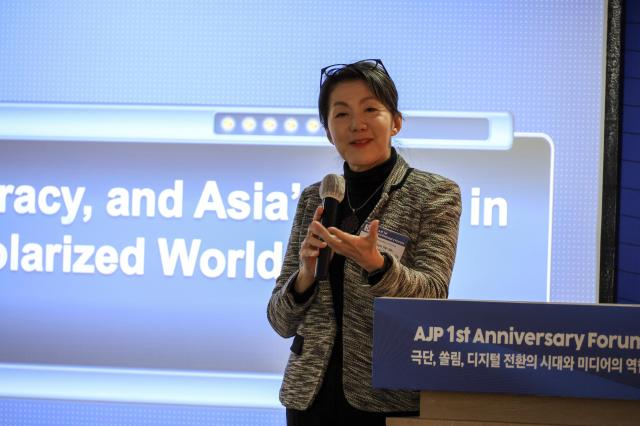
SEOUL, December 02 (AJP) - The waning influence of Western-centric narratives in global media presents a critical opening for Asian news platforms to assert their own voice, said Sohn Jie-ae, visiting professor at Ewha Womans University and former CNN Seoul bureau chief, at a forum in Seoul on Tuesday.
Citing a recent New York Times column, Sohn said the United States' global narrative has grown "incoherent" and its brand "toxic," arguing that the shift marks a historic moment for Asian journalism. "This is not a vacuum, but an opportunity — a moment when alternative voices must be heard. And opportunity comes to those who are prepared," she said in her keynote address at AJP's forum, "The Era of Extremes and Polarization in Digital Transition and the Role of Media."
While Asian media institutions have matured, Sohn said global news flows still overwhelmingly reflect Western framing. "As many countries withdraw correspondents, we depend on Reuters, AP and CNN. We learn about our neighbors not through their media, but through Western reporting," she said, contrasting the region's lived realities — from Hong Kong fires to Southeast Asian flooding — with the U.S.-centric top pages of leading Western outlets like The Washington Post.
Sohn recalled watching Korea's democratic transformation unfold — from pro-democracy protests to the trials of former presidents and the elections of former dissidents Kim Young-sam and Kim Dae-jung. "In 1985, we marched without fully knowing what we wanted, except a country where we could shout and protest freely. CNN broadcast that process to the world, and through those events the world saw Korean democracy at work," she said.
After leaving CNN, Sohn served as government spokesperson and later led Arirang TV, navigating tensions between journalistic independence and representing a national perspective. "There were fierce debates between those who insisted we could never air negative news about Korea and those who said credibility requires standards," she said, noting that the newsroom eventually found a realistic middle ground. Similar dilemmas, she added, face Asian platforms including Singapore's Channel News Asia, China's CGTN, the Philippines' Rappler and Hong Kong's South China Morning Post.
Sohn outlined three strategies for AJP and emerging Asian newsrooms: Be Smart, Be Bold and Know Your Region. Journalists must be anchored in ethics yet willing to innovate, she said, pointing to Korean eyewear brand Gentle Monster's collaborations with Google and Samsung as an example of bold thinking in the generative AI era. She also underscored the importance of regional fluency. "AJP is only one year old, but Asia is a young region. China, Japan and Southeast Asia remain key markets. Young Koreans and young Asians must know their region — and show they are part of it."

Copyright ⓒ Aju Press All rights reserved.

![[WNMC 2026] AJP Director Seo Hye-seung: AI Native News Agency is the Answer – Korean Model Unveiled in Marseille](https://image.ajunews.com/content/image/2026/06/03/20260603160445551206_278_163.jpg)