SEOUL, December 02 (AJP) - "C-democracy" — where wagering meets political motive — is emerging in South Korea, as bets on former president Yoon Suk Yeol’s impeachment odds illustrate how fandom-driven political participation is evolving into fortified camps amid deepening polarization, a media scholar said at a forum in Seoul.
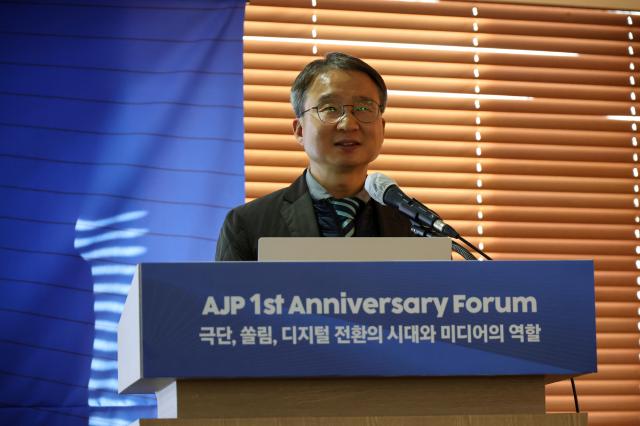
"The fandom-engaged, interest-based model of democracy is shifting into a fortress-centered one — a fragmented, hybrid structure marked by ideological defense," said Park Han-woo, a professor of media and communication at Yeungnam University, speaking at AJP’s first-anniversary forum titled "Extremism, Polarization and the Role of Media in the Digital Transition."
Park contrasted today’s digitally driven rallies with the hierarchical and closed protests under the 1970s–80s military regime. Contemporary participation, he noted, spans K-pop–style collective action seen in impeachment demonstrations, seniors expressing political views through YouTube, and teenagers mobilizing both online and on the streets through smartphones, livestreaming and social media.
"Modes of participation are diversifying across generations," he said.
Drawing on Australian media scholar Axel Bruns’s framework, Park pointed to a broader shift toward "individual publics," "issue publics," and "networked publics." These digitally connected groups can accelerate information flow, he said, but also amplify distortion and misinformation.
The impeachment period revealed the interplay of "strong publics," capable of organized political action, and "weak publics," driven more by emotional affiliation. Both can broaden democratic debate, Park said, but also heighten social conflict.
A new layer is emerging in the form of what Park describes as "financialized publics," a concept from his recent research. Studying overseas users who place bets on Korean political outcomes through the blockchain-based prediction platform Polymarket, Park found that political messaging often diverged from actual wagering behavior.
"Emotional expression is intense, but financial risk-taking moves on a separate track," he said, calling this a new hybrid of political and economic participation.
Park warned that rising news avoidance, algorithm-driven information consumption, and deepening emotional polarization are creating conditions in which "even basic facts fail to gain consensus." Trends such as election denial and the spread of conspiracy theories, he noted, have become visible in both South Korea and the United States.
With democratic norms under strain, Park emphasized that rebuilding public trust is essential. He called for transparent communication, stronger civic empathy, and institutional structures that can bridge increasingly segmented publics.
"Media must help rebuild trust at a moment when traditional value systems are shaking," he said.
Copyright ⓒ Aju Press All rights reserved.