

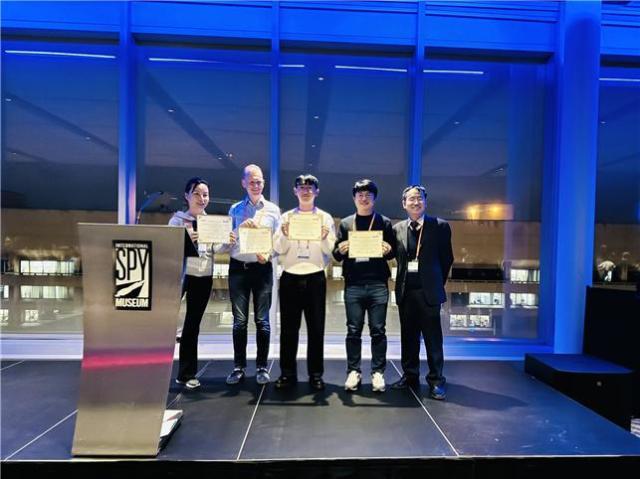
SEOUL, December 09 (AJP) - A research team from the Korea Advanced Institute of Science and Technology (KAIST) has achieved a historic first for South Korean universities by winning the prestigious Best Paper Award at the International Conference on Data Mining (IEEE ICDM). This top honor, awarded to just one paper out of 785 global submissions, marks the first time a South Korean university research team has claimed the award in 23 years, underscoring KAIST's technology leadership on the world research stage.
The award recognizes the team's development of a breakthrough AI technology capable of predicting complex social group behavior. The team is led by KAIST Kim Jaechul Graduate School of AI Professor Shin Ki-jeong.
On December 9, KAIST announced the development of the groundbreaking AI model, which predicts complex social group behavior by analyzing how individual characteristics, such as age and role, influence group relationships.
Group interactions, spanning online communities, research collaborations, and large chat groups, are exploding in modern society. However, existing technology struggles to precisely explain the underlying structure of these group behaviors and how individual characteristics simultaneously influence them.
To overcome this limitation, Professor Shin Ki-jeong's research team developed an AI model named "NoAH (Node Attribute-based Hypergraph Generator)." NoAH is a sophisticated artificial intelligence designed to accurately reproduce the dynamic interplay between individual characteristics and group structure. For example, it analyzes how people's specific attributes, like their interests or professional roles, combine to create collective group action, and then reproduces that behavior.
By simultaneously reflecting human tendencies and relationships, NoAH creates remarkably "realistic group behavior." It was demonstrated to reproduce diverse real-world group behaviors, including purchase combinations in e-commerce, the spread of online discussions, and co-authorship networks among researchers, far more accurately than previous models.
Professor Shin Ki-jeong said, "This research opens a new AI paradigm that allows for a three-dimensional understanding of complex interactions by considering not only the group's structure but also the characteristics of the individuals. This means the analysis of online communities, messengers, and social networks will become significantly more precise."
The study was conducted by Professor Shin Ki-jeong and the research team from KAIST Kim Jaechul Graduate School of AI, including Master's students Jeon Jae-wan and Yun Seok-beom, and Ph.D. students Choi Min-young and Lee Geon. The findings were presented at IEEE ICDM on November 18. The research received support from the AI Research Hub project, AI Graduate School Support (KAIST), and the Technology Development for Neural Network Variation and Intelligence Enhancement Based on AI Agent Collaboration.
Copyright ⓒ Aju Press All rights reserved.
