

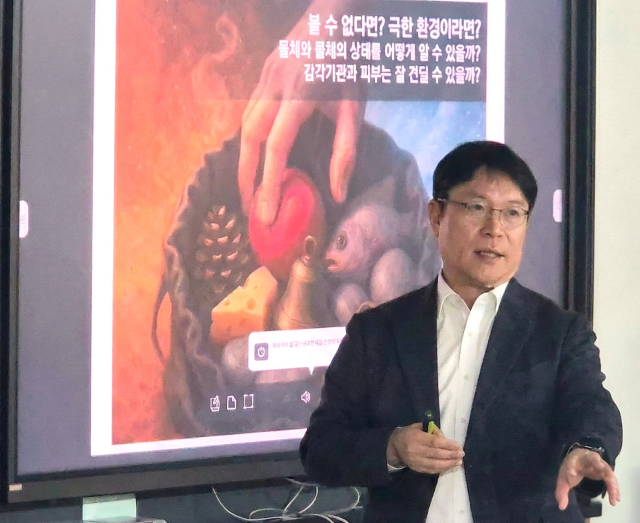
SEOUL, December 11 (AJP) - Kookmin University hosted a K*-Colloquium on December 9 at its Industry-Academic Cooperation Building, where Professor Lim Si-hyung of the School of Mechanical Engineering presented the vision and roadmap of the newly selected Engineering Research Center (ERC) on Robotic Functional Skin and Enhanced Perception.
The K*-Colloquium is a regular seminar series organized by the university's Industry-Academic Cooperation Foundation. It serves as a forum for sharing research outcomes and future plans from new faculty members, as well as examining core technologies driving the Fourth Industrial Revolution, including AI, semiconductors and advanced convergence technologies. The "K*" mark reflects Kookmin University's identity and its focus on innovation-driven research.
During the session, Lim introduced the center's strategy and research scope following its selection this year by the Ministry of Science and ICT and the National Research Foundation of Korea. The center aims to overcome the limits of conventional vision-dependent robotic systems by integrating functional skin technologies with multisensory perception.
The research program is structured around three pillars: a non-visual hypersensory cognition platform combining tactile, auditory and olfactory sensors; multifunctional skin capable of dustproofing, waterproofing, heat resistance and radiation protection; and high-precision nano- and micro-scale surface manufacturing technologies.
The long-term goal is to enable robots to "sense, judge and respond" to their surroundings in a manner more similar to biological organisms. By embedding human-skin-like sensory functions into robotic surfaces, the center seeks to develop technologies that could be applied to disaster-response robots, nuclear and industrial plant inspection systems, space and deep-sea exploration platforms, and defense-related unmanned systems.
The consortium includes Kookmin University as the lead institution, joined by Seoul National University, UNIST, Kumoh National Institute of Technology and Gachon University. Ten partner companies, including Hyundai Motor, are providing about 1.3 billion won in private-sector investment to support demonstration projects and commercialization pathways. The center aims to establish global research standards, expand technology transfer and promote deep-tech startup efforts as part of a broader strategy to reinforce South Korea's competitiveness in foundational robotics.
"This project aims to elevate the most essential elements of robotics — skin and perception — to a world-class level," Lim said. "We hope to create a turning point for South Korea to become a global leader in foundational robotic technologies that function even in extreme environments."
Lim received his bachelor's degree in mechanical engineering from Seoul National University and a Ph.D. from the University of California, Berkeley. His research covers next-generation sensors and devices, functional robotic materials and high-reliability manufacturing processes. He currently serves as a professor in Kookmin University's School of Mechanical Engineering and has led multiple national research initiatives in related fields.
Copyright ⓒ Aju Press All rights reserved.
