

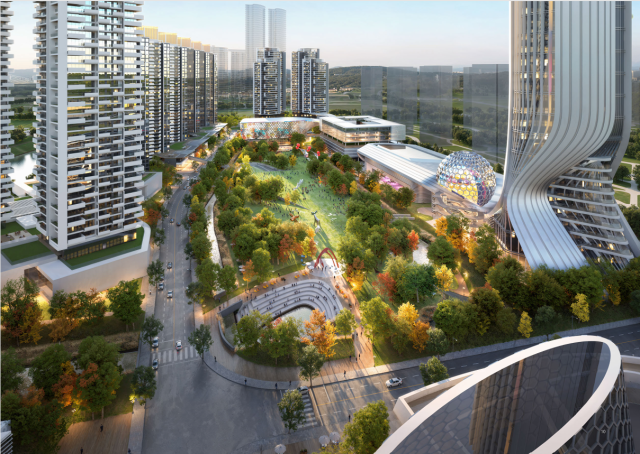
That, at least, is the fantasy behind Incheon's ambitious bet on what officials are calling "K-Con Land" — a sprawling cultural complex designed to give K-pop, K-drama and digital content something they've never really had before: a permanent home.
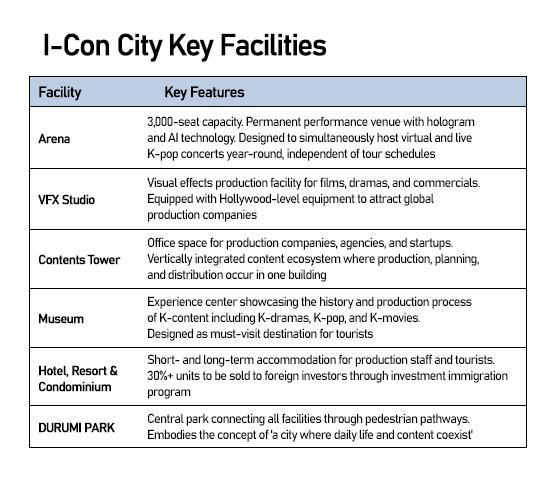
At the heart of the plan is a concert hall where holograms of past and present stars perform on a rotating basis. Die-hard fans won't have to wait for comeback tours or overseas dates. The show, in theory, is always on.
But K-Con Land is not just about concerts. The larger vision, unfolding across the Cheongna and Yeongjong districts, is to stitch together production studios, performance venues, hotels and tourism infrastructure into a single ecosystem — one that turns K-content from a series of one-off events into something closer to a standing attraction.
Think less "festival weekend," more "content district."
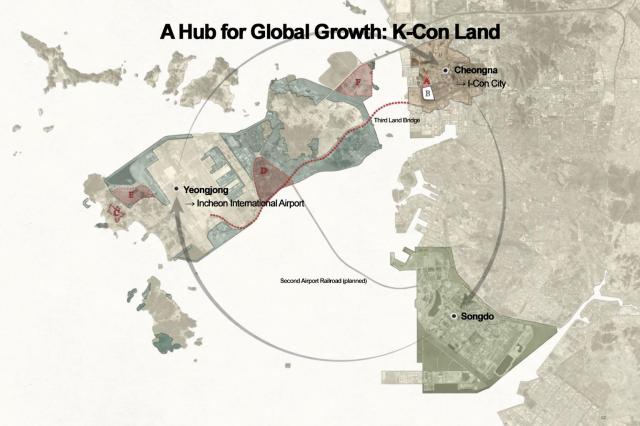
Incheon's pitch starts with geography. The city sits next to Korea's main international gateway, and with the opening of the Third Sea Bridge this week, Cheongna and Yeongjong are now directly linked. The goal is to turn airport proximity — long a logistics advantage — into a cultural one.
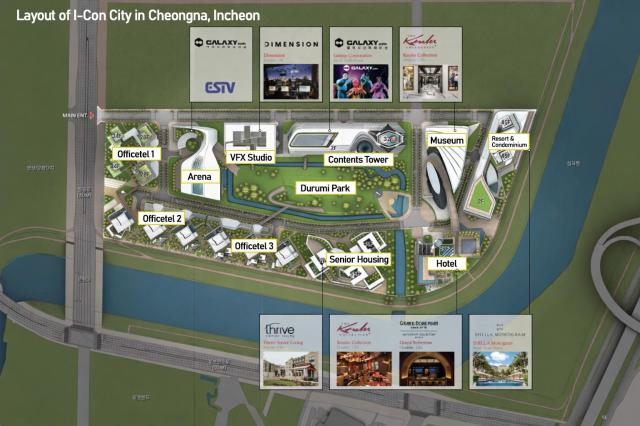
At the center of the plan is I-Con City, a massive complex slated for Cheongna International City, just west of Yeongjong Island. The project covers 260,000 square meters — roughly the size of Yeouido Park — with total floor space exceeding that of COEX. Rising up to 49 floors, the complex will house an arena, VFX studios, a content tower, museums, hotels and resort facilities, all wrapped around a central public space dubbed "Durumi Park."
The idea is frictionless circulation: artists arrive, shoot, perform and stay in one place; visitors watch, tour, sleep and move on — or stick around longer.
Transportation is meant to do the rest. Subway Line 7's extension to Cheongna, scheduled for 2027, will cut travel time to Gangnam to about 68 minutes without transfers. A KTX connection from Incheon via Songdo would link the area to Busan in just over two hours. For a city long seen as peripheral to Seoul’s cultural core, those minutes matter.
Cheongna's biggest selling point may be what it lacks: density.
Unlike Seoul's Sangam Digital Media City, where land is tight and costs are high, Cheongna offers room to build large-scale studios and move bulky equipment — and to house international crews without scattering them across the capital.
Production, performance and accommodation in one zone is not just convenient; developers argue it cuts costs and time.
"With the Third Land Bridge, Cheongna is now directly connected to Yeouido in 30 minutes and to Yeongjong," said Eum Jae-sang, CIO at DAOL Asset Management. "With Starfield Cheongna and a university hospital also coming in, this won't be a bedroom town. It's becoming a district with its own purpose."
The lineup of partners reflects that long-game thinking. U.S.-based boutique hotel franchise The Kessler Collection will oversee overall development and hospitality operations. DAOL manages the funds. POSCO E&C is handling construction. Galaxy Corporation — which represents G-Dragon — is in charge of content operations. Financial structuring is being led by SK Securities. Hotel Shilla will operate serviced residences, while a U.S. senior-living operator is joining the residential side.
"This isn't a build-and-sell project," Eum said. "We're talking about operating this for 20 to 30 years after completion."
The real test: content, not concrete
Construction is slated to begin in the second half of 2027, with completion targeted for 2031. By then, the buildings will likely be impressive.
What's less guaranteed is what happens inside them.
Industry officials say tax incentives for foreign content producers could make or break the project's appeal. Incheon's Free Economic Zone authority has been calling for stronger breaks, arguing that global competition for film and content production is intensifying.
"If production costs one unit, the regional economic impact can be seven to ten times that," said Commissioner Yun Won-sok early last year, noting that many advanced economies now offer aggressive incentives to attract studios.
For a project estimated at 1.9 trillion won, the stakes are high. K-content has proven it can draw global attention — but turning that attention into a permanent tourist habit is another matter entirely.
A hologram concert may draw crowds once. The challenge will be making them come back.

Copyright ⓒ Aju Press All rights reserved.
