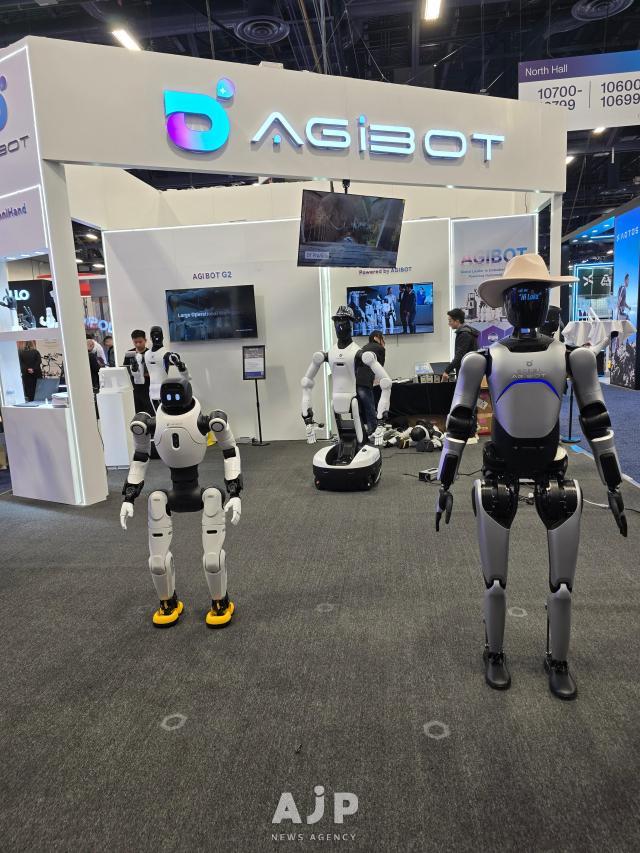
China, which has already begun rolling humanoid robots off assembly lines and into retail stores and homes in various forms and scales, used CES 2026 to show the United States and the wider world just how far it has moved ahead in physical AI.
Of the 38 companies participating in CES's humanoid robotics category, 21 were Chinese — ranging from established players such as Unitree Robotics to newer entrants including AgiBot and Noetix Robotics.
The self-sufficiency drive comes as Chinese firms accounted for the vast majority of the roughly 13,000 humanoid robots shipped globally in 2025, according to research firm Omdia. Shanghai-based AgiBot topped the list with an estimated 5,168 units, followed by Unitree Robotics and UBTech Robotics.
Except for Nvidia chips, everything else is homemade
Despite the push for deep vertical integration, one component remains a near-universal import: the processor.
An AgiBot employee told AJP that the company uses Nvidia chips as the computing brain for its robots — an irreplaceable component for every machine standing, spinning or twirling on the show floor.
The company trains its robots at a data center in Shanghai, combining synthetic and real-world data to develop the artificial-intelligence models that power its humanoids. Beyond the processor, however, AgiBot manufactures nearly all components in-house, excluding only small standardized parts such as bolts and nuts.
The reliance on Nvidia extends across China's robotics landscape. Unitree, Galbot, Engine AI and UBTech have all adopted Nvidia’s Jetson platform, with many becoming early users of the Jetson AGX Thor modules launched in August 2025.
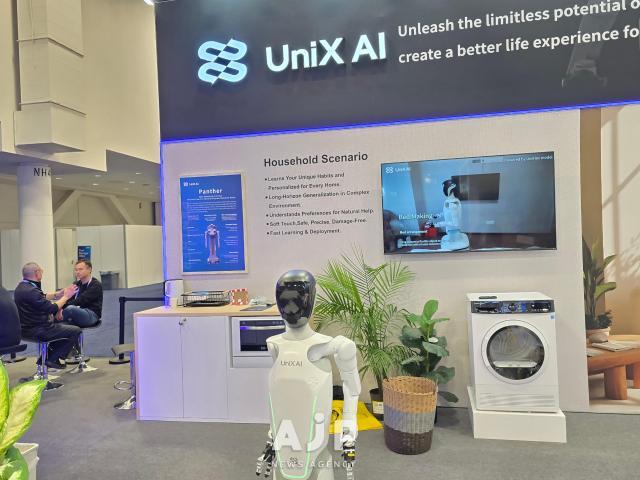
At UniX AI's booth, the vertical-integration story ran even deeper.
Jerry Wu, the company's chief financial officer, said the Suzhou-based firm manufactures everything from joint mechanisms to the internal components of its robotic hands. The only exceptions are standardized parts, including optical sensors.
"We developed everything by ourselves," Wu said. "Even the very inside of the joints."
For processors, UniX AI also relies on Nvidia chips. The company has developed a two-layer AI model architecture: one layer functions as the "brain," interpreting situations and making decisions, while the other controls physical movement.
Its Wanda series models are already generating revenue in China. Hotels have deployed the robots for housekeeping tasks such as bed-making and cleaning, while security applications use the machines to patrol buildings.
"These are general models," Wu said. "They can even make alcoholic drinks as well."
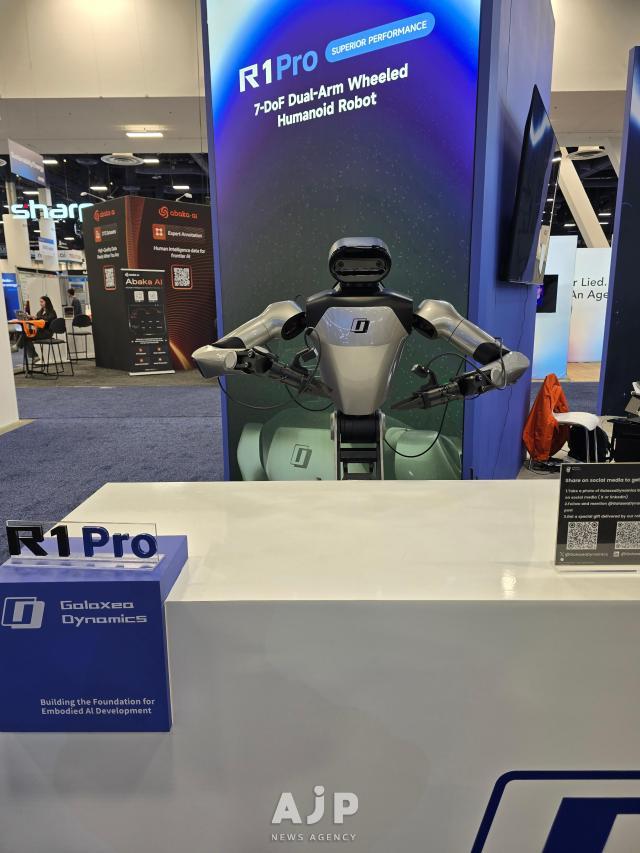
Galaxea Dynamics, a Beijing-based company whom also has a office in San Jose, follows a similar playbook.
Lei Yu, the company's chief business officer, said manufacturing is done entirely in-house — down to the motors — with Nvidia processors used for computing.
"We build our own robots in-house," Yu said. "We design and control the body and manufacture everything ourselves."
The rationale is as much economic as it is strategic. Training robots for manipulation tasks requires enormous volumes of real-world data, which in turn demands large fleets of robots to collect it.
"To have a lot of data, you have to walk on it. So we need to have a lot of robots," Yu said. "And to have a lot of robots, it can be extremely expensive. That's why we use our own motors — to reduce costs at the data-collection stage."
Galaxea Dynamics plans to bring its latest model to market between March and September this year, with educational discounts available. The company has partnered with research institutions to deploy about 200 robots.
Synthetic data, real deployment
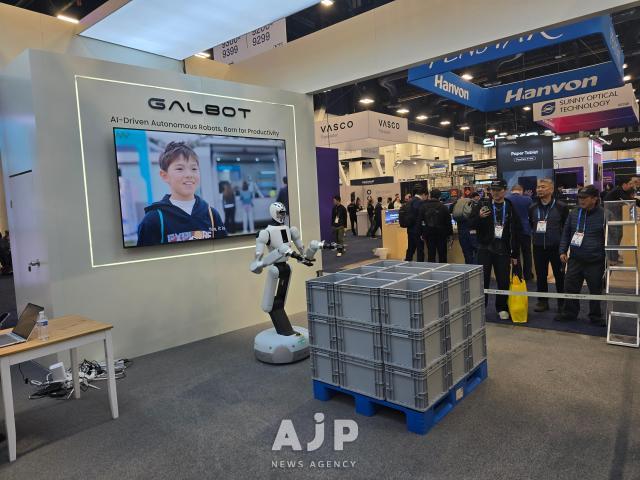
Founded in May 2023, Galbot has positioned itself as one of the most valuable embodied-AI companies in the humanoid robotics sector.
Yvonne Yuan, head of overseas marketing, said the company produces most components — from arms to wheels — using proprietary technology. Galbot was among the first globally to adopt Nvidia's Jetson Thor chipset.
"It's all our own proprietary technology, including the hardware," Yuan said.
Galbot's training strategy reflects a broader industry shift toward efficiency. About 90 percent of its training data is synthetic, generated in simulators, with only about 10 percent derived from real-world environments.
"We do not rely so much on real-world data," Yuan said. "We train them in a simulator, then fine-tune using real-world data."
Its G1 robots are already deployed in factories and warehouses across China, sorting vehicle parts and assisting production-line workers. The machines can operate for up to eight hours on a single charge and automatically return to charging stations when battery levels drop.
A heavier model is in development. The current G1 can lift between 10 and 50 kilograms using both hands. The upcoming version will be able to lift at least 32 kilograms and feature a redesigned appearance, Yuan said.
The push for vertical integration aligns with Beijing's broader industrial policy. China's Ministry of Industry and Information Technology has set a goal of achieving global leadership in humanoid robotics by 2027.
The strategy appears to be gaining traction. ABI Research forecasts the global humanoid robot market will reach $6.5 billion by 2030, with China's state funding and regulatory environment positioning domestic firms for outsized growth.
Yet the reliance on Nvidia processors highlights a persistent vulnerability. Washington restricts Nvidia from exporting its most advanced chips to China, though the modules currently used in robotics applications remain available.
For now, China's robotics industry is betting that controlling everything else — from the hands that grasp to the motors that move — will be enough to win the race.

Copyright ⓒ Aju Press All rights reserved.