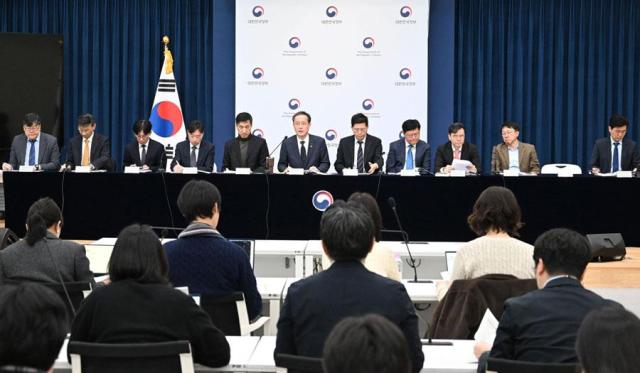
It also pledged to make this year the starting point for an "economic leap" and to draw up a master plan for spurring growth and narrowing economic gaps.
To achieve these goals, the government plans to roll out action plans by the first half of the year, setting growth targets through 2045, the 100th anniversary of the country's liberation from Japanese colonial rule and establishing a long-term vision to address mid- to long-term objectives.
The 2-percent target is higher than the roughly 1.8 percent forecasts recently presented by major institutions such as the Korea Development Institute and the Bank of Korea. With external uncertainties and structural constraints weighing on the economy, the government's target appears ambitious.
The government said domestic demand will be this year's main growth engine, projecting that private consumption, which grew 1.3 percent last year, will rise 1.7 percent in 2026, supported by improved consumer sentiment, policy measures, favorable employment conditions, and households' stronger purchasing power.
Investment in construction is expected to rebound 2.4 percent this year after falling 9.5 percent in 2023. The government said the shift after a prolonged downturn should help boost the economy and domestic demand, though it expressed concern that unsold homes outside the capital and other provincial areas could limit the recovery.
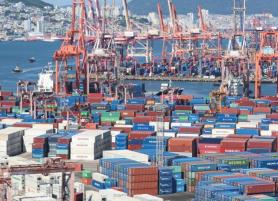
Exports are projected to rise 4.2 percent this year, supported by strong semiconductor demand, despite concerns that global trade could slow as the effects of U.S. tariffs intensify.
Vice Minister Lee Hyeong-il said, "In recent forecasts, the growth rate of semiconductor sales has risen to 40 to 70 percent," adding that this increase is reflected in this year's outlook.
The government forecast the current account surplus will widen to US$135 billion this year from $118 billion last year. It projected inflation will rise 2.1 percent, unchanged from last year, citing factors including lower international oil prices.
Facility investment is also expected to rise 2.1 percent, driven by technology sectors including memory chips. With competition intensifying in advanced industries such as artificial intelligence (AI), the government projected a 3.3 percent increase in investment in intellectual property, driven by higher spending on research and development (R&D).
But the job market is expected to slow due to structural factors such as a shrinking working-age population and an aging society. The government projected that the number of employed people will increase by 160,000 this year, about 30,000 fewer than last year.
To meet its growth target, the government emphasized an expansionary fiscal stance, increasing total spending by 8.1 percent, the highest in four years. It also raised planned investment by public institutions by 4.3 trillion won, bringing the total to 70.5 trillion won. Based on this, the government plans to allocate 633.8 trillion won to support advanced strategic industries and small- and medium-sized businesses.
To boost domestic demand, tax incentives for passenger cars will be extended until June, along with a 1 million won subsidy for those purchasing electric vehicles and other eco-friendly cars.
More promotional and sales campaigns to support small business owners will also be organized to stimulate consumption.
To spur corporate investment, the government will provide 54.4 trillion won in facility investment, while also encouraging foreign-invested companies to shift towards domestic R&D investment.
While risks such as foreign exchange volatility, real estate market instability, household debt, and structural challenges remain, the government pledged to manage external risks and enhance the quality and sustainability of growth.
"While focusing on economic recovery last year, we achieved visible results including strengthening growth momentum and the KOSPI surpassing 4,000 points," Lee said. "Based on these results, we will make an all-out effort for a major economic leap this year."
Copyright ⓒ Aju Press All rights reserved.