But Taiwan’s newly secured tariff exemptions tied to expanded U.S. investment are now forcing Seoul and Korean chipmakers back to the negotiating table with fresh offers.
Taiwan’s tariff outcome has been closely watched in Seoul, given the scale of its semiconductor trade with the United States. In last year’s negotiations, South Korea secured a “most-favored treatment” clause, ensuring that any future U.S. semiconductor tariff arrangements with third countries would not place Korea at a disadvantage.
That assurance is now being tested. While South Korea and Japan previously agreed to cut reciprocal tariffs from 25 percent to 15 percent in exchange for pledges of $350 billion and $550 billion in U.S.-bound investment, respectively, Taiwan has tied tariff relief more directly to semiconductor capital expenditure.
President Donald Trump on Wednesday issued a proclamation imposing additional tariffs of up to 25 percent on certain high-performance artificial intelligence (AI) semiconductors on national security grounds, putting major chip-producing countries, including South Korea, on alert.
According to the White House, the measure targets advanced AI chips used across 16 critical infrastructure sectors—such as data centers, defense, communications and energy—but does not apply uniformly. Instead, it is limited to products exceeding specific thresholds for logic operation performance and memory bandwidth, a structure widely interpreted as a “pinpoint tariff” aimed at top-tier accelerators such as Nvidia’s H200 and AMD’s MI325X.

Seoul moved swiftly. On Thursday, the government convened emergency meetings with Samsung Electronics and SK hynix, both key suppliers of high-bandwidth memory (HBM) to Nvidia and AMD. Trade Minister Yeo Han-koo extended his stay in Washington to assess the situation, while the Ministry of Trade, Industry and Energy held an emergency task force meeting chaired by Minister Kim Jung-kwan.
“We must closely examine our response efforts, continue monitoring the situation, and communicate closely with the industry to thoroughly analyze the potential impacts,” Kim said.
The pressure intensified hours later when Washington finalized a trade agreement with Taiwan. Under the deal, mutual tariff rates were lowered from 20 percent to 15 percent. In return, Taiwan pledged up to $500 billion in U.S.-focused support—$250 billion in direct investment by firms such as TSMC and another $250 billion in government-backed credit guarantees.
The agreement also grants Taiwanese chipmakers significant tariff exemptions tied to U.S. production. During construction of semiconductor plants, output volumes up to 2.5 times installed capacity will be tariff-free, while after completion, tariff-free treatment continues for volumes equivalent to 1.5 times capacity. South Korea’s earlier agreement with Washington explicitly promised “treatment no less favorable than Taiwan” for its semiconductor sector.
Kang Seung-kyu of the People Power Party warned that the timing was troubling. “With a $20 billion cash investment in the U.S. already on the table and exchange rate volatility creating turmoil, it’s worrying that the White House has issued another proclamation like this,” he said.
Independent lawmaker Kim Jong-min said the intent behind Washington’s move was clear. “The purpose of this proclamation seems to be to push firms to build more factories in the U.S.,” he said, adding that “honoring the promise that Korea will not be treated less favorably than Taiwan is critical.”
Experts say the tariffs reflect Washington’s broader industrial strategy. Cho Dong-jun, professor of political science at Seoul National University, said, “The answer is obvious: it means ‘produce in the United States.’” He added that while the policy aims to rebuild U.S. manufacturing, “even if semiconductor factories are built in America, there will be no one to work in them,” warning of inefficiencies driven by domestic politics.
Cho Sung-hoon, an economics professor at Yonsei University, said the proclamation serves dual purposes: “populist political motivation and an attempt to increase tariff revenue by exploiting America’s dominant position.”
Others emphasized the strategic nature of semiconductors. Heo Jung, professor of economics at Sogang University, said chips are classified in the U.S. as a national security industry and are central to the AI race. “Trump likely targeted them as part of U.S. efforts to control China’s access to advanced technology,” he said.
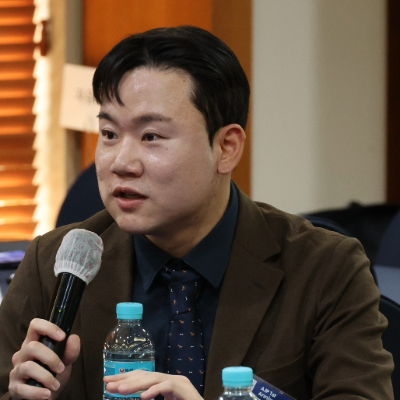
For now, the direct impact on Korean firms may be limited. KIEP researcher Kim Hyuk-jung noted that the proclamation’s annex focuses on logic semiconductors rather than memory. “Korea primarily exports memory modules to the U.S., while Taiwan exports far more logic-based products,” he said.
Still, analysts warn the longer-term implications are clear. As Trump expands product-based tariffs and links exemptions to concrete investment pledges, Korea’s export-driven semiconductor industry is likely to face mounting pressure to commit more capital to U.S. production—testing both the limits of alliance politics and the durability of last year’s “most-favored” promise.
Copyright ⓒ Aju Press All rights reserved.