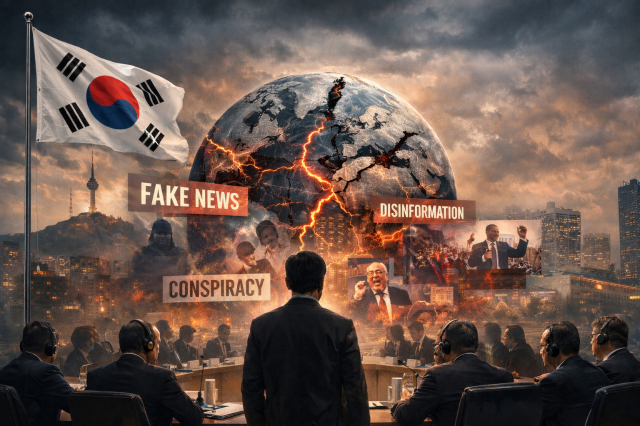
This is no longer a national problem. It is not an American problem, a European problem, or an Asian problem. It is a civilizational one.
The modern infrastructure of falsehood runs on global platforms—most notably YouTube and other social media networks—whose algorithms reward outrage over accuracy, repetition over verification, and emotion over evidence. Lies now travel faster than facts not because they are truer, but because they are more profitable. What began as tools of connection have become accelerants of division, radicalization, and social decay.
Yet for all its technological novelty, this crisis is not new. Humanity has confronted the corrosive power of falsehood before—and long ago recorded its conclusions.
Two to three thousand years ago, the foundational religious and philosophical texts of civilization converged on a single insight: societies collapse when truth is abandoned.
Buddhism identified false speech and malicious language as among the gravest moral offenses, not because they offend etiquette, but because they poison the mind and unravel communal trust. Confucian philosophy warned that when words lose their proper meaning, governance itself becomes impossible. The Abrahamic traditions placed truth at the heart of divine order, treating false testimony not as a private sin but as a public crime against justice.
Different civilizations, different theologies—one shared conclusion. Lies are not merely errors; they are structural threats.
What distinguishes our moment is scale. Falsehood is no longer episodic or local. It is industrialized, monetized, and globalized. Pseudo-religions exploit spiritual anxiety. Pseudo-journalism imitates the form of reporting while hollowing out its substance. Pseudo-politics thrives on grievance, conspiracy, and spectacle rather than governance. Together, they form a shadow civilization that mimics legitimacy while corroding it from within.
This is why appeals to “platform self-regulation” or isolated national laws are no longer sufficient. The problem has outgrown them. Just as humanity eventually recognized that weapons of mass destruction, climate change, and pandemics required coordinated international responses, so too must we now accept that systemic disinformation demands a global framework.
What is needed is not censorship, but responsibility. Not suppression of dissent, but protection of reality itself.
At this juncture, the world would do well to consider a coordinated, multilateral mechanism—something akin to a United Nations–level response—dedicated to confronting organized disinformation and predatory pseudo-movements that exploit digital platforms.
Such a body would not police opinion, but establish shared standards of accountability, transparency, and algorithmic responsibility. It would recognize that when platforms profit from deception at scale, they cease to be neutral intermediaries and become consequential actors in global stability.
In this emerging conversation, South Korea occupies a position of quiet but unusual relevance.
Korea is not a military superpower. It does not dominate global finance, nor does it impose ideological blocs. Yet it is a country shaped by some of the most intense contradictions of modern history: colonization, national division, war, authoritarianism, and rapid democratization—followed by one of the world’s most advanced digital societies. It has lived through ideological extremism and learned, at great cost, what happens when truth is subordinated to power.
Equally significant is Korea’s civilizational inheritance. The founding ethic of Korean civilization—Hongik Ingan, often translated as “to broadly benefit humanity”—is neither sectarian nor nationalistic. Rooted in the ancient Dangun tradition, it is a moral principle that predates modern religion and anticipates modern humanism. It does not seek dominance, but harmony; not conversion, but coordination.
In contemporary Korea, multiple religions—Buddhism, Christianity, Catholicism, Confucian ethics, and indigenous traditions—coexist with relatively limited sectarian violence. This pluralistic equilibrium is neither accidental nor trivial. It offers a living example of how divergent belief systems can share a civic space without annihilating one another.
For that reason, Korea is uniquely positioned to serve not as an enforcer, but as a convener. One can reasonably imagine an International Commission on Disinformation and Pseudo-Movements, headquartered in Korea, operating in cooperation with United Nations structures. Its mandate would be narrow but essential: to study systemic disinformation networks, propose global norms for platform accountability, facilitate cross-border cooperation, and anchor modern policy debates in the ethical insights humanity has already agreed upon for millennia.
Such an institution would not dictate belief. It would defend the conditions under which belief remains meaningful.
Critically, this effort must be grounded not only in technology and law, but in moral memory. The ancient texts were right: truth is not optional infrastructure. It is the load-bearing pillar of social order. When truth collapses, everything built upon it—democracy, trust, coexistence—follows.
The choice before humanity is stark. We can continue treating disinformation as background noise, trusting that markets or platforms will self-correct. Or we can acknowledge that we are facing a systemic threat to shared reality—and respond accordingly, with humility, coordination, and resolve.
History suggests that civilizations do not fall because they lack innovation. They fall because they lose their ability to distinguish truth from falsehood, meaning from manipulation.
The knowledge to prevent that outcome is already in our possession. It was written down thousands of years ago. What remains is the courage to translate ancient wisdom into modern structures—and the will to act together, before the lies finish their work.
Copyright ⓒ Aju Press All rights reserved.