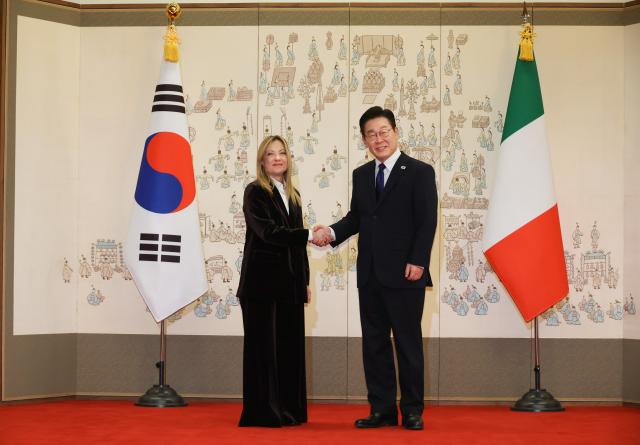
SEOUL, January 21 (AJP) - When President Lee Jae Myung welcomed Italian Prime Minister Giorgia Meloni to Seoul, the meeting followed the familiar choreography of modern summitry. There were discussions of supply chains, advanced industries, and strategic cooperation. Yet beneath the formal language of diplomacy, the encounter revealed something more enduring: a convergence of technology, culture, and temperament between two nations that stand at opposite ends of Eurasia.
At the center of the talks was semiconductors—no longer a niche industry but the backbone of contemporary geopolitics. Korea’s dominance in memory chips and manufacturing capacity complements Italy’s long-standing strengths in precision machinery, materials, and industrial design. Cooperation in this field is not merely transactional. It reflects a shared understanding that technological sovereignty in the twenty-first century depends on trusted partnerships rather than isolated national efforts. In an era of fractured supply chains, the decision to coordinate across continents signals strategic maturity on both sides.
Equally telling was the attention paid to culture, particularly the global trajectory of Korean popular music and creative industries. K-pop has already conquered charts and streaming platforms, but its next challenge lies in evolution rather than expansion. Italy, a country that transformed opera, cinema, and fashion into universal cultural languages, offers valuable lessons. The discussion was not about exporting Korean culture wholesale, but about how it might be reinterpreted within Western frameworks without losing its core identity. Cultural exchange, when done well, is not dilution but transformation.
Recent visits to Korea by executives from major Italian film studios underscore this point. They point toward a future of co-production and shared storytelling, where Korean narrative dynamism meets Italian aesthetic tradition. Such collaborations, if sustained, could redefine how non-English cultural content circulates globally. Culture, often dismissed as soft power, here emerges as a serious industry—disciplined, competitive, and strategic.
Yet the most intriguing aspect of the Korea–Italy dialogue lies beyond policy documents. Despite their geographic distance, the two societies share strikingly similar temperaments. Both cherish music, conversation, food, and the social rituals of drink. Both value emotional expression as much as technical excellence. This cultural DNA—passionate, human-centered, and communal—forms an invisible but powerful foundation for cooperation. Diplomacy ultimately rests not on contracts alone, but on mutual recognition of character.
The Seoul summit demonstrated a modern truth: sustainable international partnerships must engage both the mind and the spirit. Semiconductors address the logic of survival; culture speaks to the meaning of coexistence. Korea and Italy, by embracing both, have offered a glimpse of diplomacy suited to an age where technology accelerates but humanity still seeks resonance.
When East and West sat across the table, it was song that opened the conversation—and silicon that anchored it. That balance may well define the future of their relationship.
Copyright ⓒ Aju Press All rights reserved.