

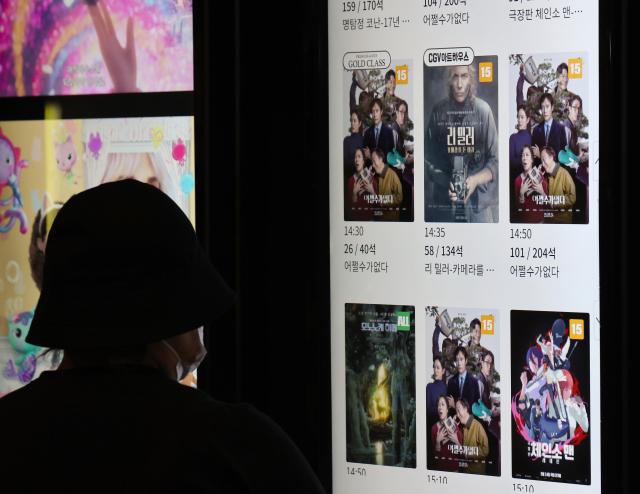
The Ministry of Culture, Sports and Tourism said Tuesday it plans to expand “Culture Day,” currently held on the last Wednesday of each month, to every Wednesday. The timing of the change has not yet been finalized.
Since its launch in 2014, Culture Day has allowed the public to visit national heritage sites such as Changgyeong Palace and Deoksu Palace for free and receive discounts at movie theaters and other cultural venues.
Under the program, major cinema chains including CGV, Lotte Cinema and Megabox have offered 2D movie tickets priced at 7,000 won — less than half the average ticket price of about 15,000 won — for screenings between 5 p.m. and 9 p.m.
While roughly one-third of moviegoers used the discount in 2014, participation surged to 85 percent by 2024, highlighting how deeply audiences have come to rely on price incentives.
The proposed expansion comes as alarm grows over the state of South Korea’s film industry, which has been hit hard by the rapid shift toward streaming platforms.
“The uncomfortable truth is that the film industry has practically collapsed,” said Kim Han-min, director of The Admiral: Roaring Currents, at a film forum hosted by the Korean Film Council and the National Assembly’s Culture Committee in January 2024.
Director Kim Sung-soo echoed that assessment at the 2025 Mise-en-scène Short Film Festival. “If I had to describe it in one word: collapse,” he said. “Korean films simply aren’t being made.”
“There used to be 50 to 60 commercial features shooting at any given time,” said one production executive. “Now it feels like barely half that.”
“When films like Avatar or Zootopia 2 succeed, it’s not a crisis of theaters — it’s a crisis of Korean cinema,” said one film distributor.
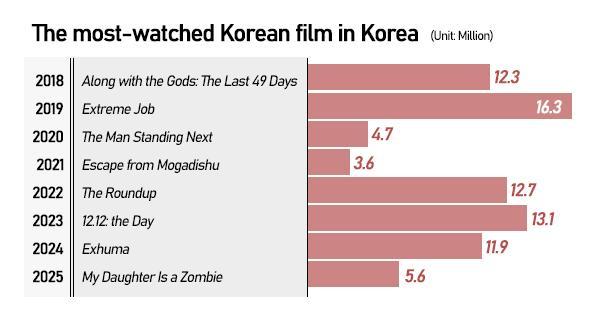
Domestic audiences have continued to reward strong local titles, including The Roundup series, 12.12: The Day (2023) and Exhuma (2024), during the post-pandemic recovery period.
Yet not a single Korean film surpassed 10 million viewers last year, an unprecedented result except for 2021, when theaters were largely shuttered by social distancing rules.
Globally, the film market has recovered to roughly 80 percent of pre-pandemic levels, but Korea’s remains “stuck at the bottom,” industry insiders say.
The Culture Day expansion has drawn support from lawmakers, though many describe it as only a temporary remedy.
Rep. Lee Ki-heon of the ruling Democratic Party said the proposal demonstrates “a strong and proactive will by the government to revive an industry on the verge of collapse by lowering barriers to cultural consumption.” He added that consistent pricing incentives could help “rebuild the habit of moviegoing.”
However, Lee cautioned that discounts alone cannot address deeper issues. “The crisis in the film industry stems not only from financial burdens, but also from a shortage of compelling content,” he said.
Progressive Party lawmaker Son Sol called the measure “necessary and timely” to expand cultural access, but stressed that participation by private businesses — which operate nearly all theaters — is essential.
“Public enthusiasm is high, but the system relies on voluntary participation,” she said. “The government must actively engage theater chains and production companies to sustain it.”
Son also warned of a “vicious cycle” in which falling attendance has reduced Film Development Fund revenues, weakening support for emerging directors and film workers. “Korea’s global cinematic standing is at risk,” she said.
Rep. Jung Yeon-wook of the opposition People Power Party supported the intent of the policy but criticized its rollout as rushed. “Without financial support, it could place undue burdens on private theaters,” he said. “Without proper consultation, it risks becoming a well-meaning but hollow gesture.”
As the government collects public feedback on the proposed decree through Feb. 28, questions remain over whether cheaper tickets can truly reignite a film ecosystem facing structural decline.
Copyright ⓒ Aju Press All rights reserved.
