

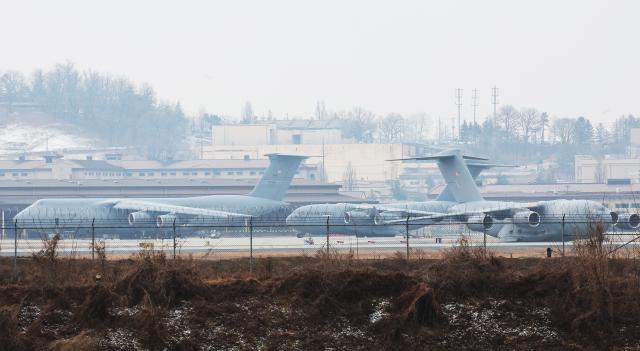
SEOUL, March 08 (AJP) - A series of departures by large U.S. military transport aircraft from a key American air base in South Korea has fueled speculation that some U.S. Forces Korea (USFK) air defense assets could be redeployed to the Middle East amid the escalating conflict involving Iran.
According to the real-time flight tracking service Flightradar24, multiple U.S. Air Force C-5 and C-17 transport aircraft that arrived at Osan Air Base in Pyeongtaek, south of Seoul, in late February departed the base in early March.
Most of the aircraft were tracked heading toward Anchorage, Alaska, a major U.S. military logistics hub.
Particular attention has been drawn to the movements of the C-5 Galaxy, a strategic transport aircraft significantly larger than the more commonly seen C-17 Globemaster. At least two C-5 aircraft arrived at Osan in late February and departed on Feb. 28 and March 2, respectively.
The aircraft’s final destinations were not publicly listed, though flight data showed journeys lasting more than 14 hours, raising the possibility they were bound either for the U.S. mainland or the Middle East.
While C-17 aircraft regularly operate through Osan to transport personnel and equipment, visits by the larger C-5 are considered relatively uncommon.
The activity has prompted speculation that the aircraft may have transported Patriot air defense components. U.S. Forces Korea is known to have recently moved several Patriot missile batteries from other bases in South Korea to Osan.
If confirmed, the movement could suggest that some of those air defense assets have already been loaded onto transport aircraft and relocated outside the peninsula.
Flight tracking data shows that C-17 aircraft departed Osan intensively between March 3 and March 7, with at least six confirmed flights heading to Anchorage.
Some security watchers speculate the increased air traffic could also be linked to preparations for the annual South Korea–U.S. joint military exercise Freedom Shield, which begins March 9.
Others note that if the conflict with Iran becomes prolonged, the temporary redeployment of certain U.S. assets stationed in South Korea could become increasingly likely.
A similar precedent occurred last year, when two Patriot missile batteries stationed with USFK were temporarily deployed to the Middle East in June last year during a major U.S. military operation targeting Iranian nuclear facilities. The systems returned to South Korea in October.
Any redeployment of air defense systems from the peninsula has raised concerns about potential impacts on deterrence against North Korea, though experts say any such move would likely be carefully calibrated.
U.S. Forces Korea declined to comment on the aircraft movements.
“For operational security reasons, we do not comment on the movement, relocation or potential repositioning of specific military capabilities or assets,” USFK said in a statement. “USFK remains focused on maintaining a strong and ready force posture on the Korean Peninsula, and the United States remains firmly committed to the defense of the Republic of Korea.”
South Korea’s defense ministry also declined to comment on USFK operations.
“It is not appropriate for the government to comment on the operational activities of U.S. Forces Korea,” a ministry official said, adding that Seoul and Washington continue close consultations to maintain a firm combined defense posture and ensure stability on the Korean Peninsula and in the region.
Foreign Minister Cho Hyun said during a parliamentary session on Friday that the United States and South Korea are in close consultation regarding the operation of USFK assets, though he declined to provide details.
Copyright ⓒ Aju Press All rights reserved.
