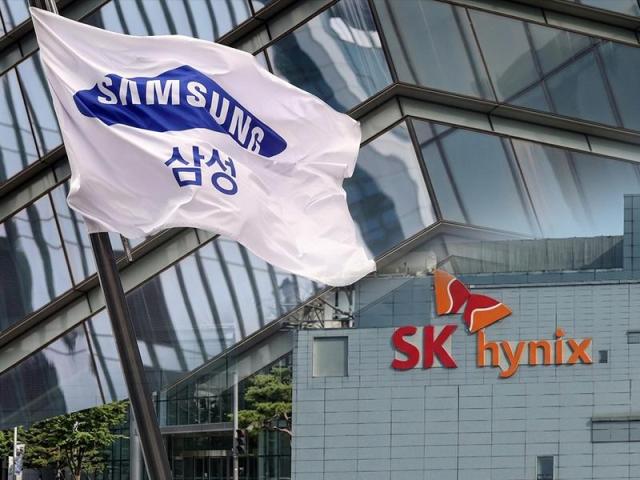
Memory giants Samsung Electronics and SK hynix now account for about 67 percent, or 137.3 trillion won ($XX billion), of total first-quarter operating profits among South Korean companies, according to financial data provider FnGuide.
That is more than double last year’s share, when the two firms contributed less than 30 percent of the total.
Samsung Electronics alone posted more than 57 trillion won in operating profit for the first quarter, surpassing the combined total of all KOSPI-listed companies during the same period last year.
SK hynix, a pure-play memory chipmaker, is also on track for outsized results, with its first-quarter operating profit expected to exceed 40 trillion won in its earnings report due Thursday — nearing its full-year earnings level.
Their stellar performances are attributed to both companies securing strong positions in the semiconductor market while achieving sustained growth in high-value chips such as high-bandwidth memory (HBM), used in artificial intelligence (AI)-related infrastructure.
LG Energy Solution is also projected to remain in the red following the termination of contracts with Ford Motor Company and Freudenberg Battery Power Systems.
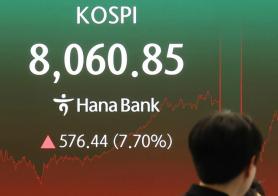
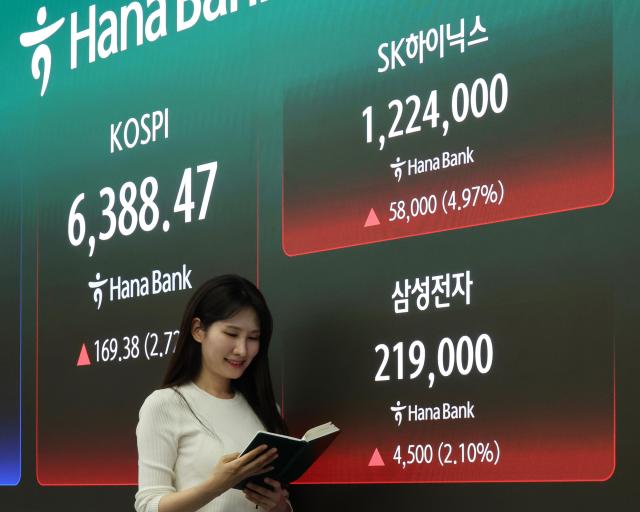
This imbalance has fueled a rally in the stock market. On Wednesday, the benchmark KOSPI closed at 6,417.93, up 0.46 percent, hitting an all-time high for the second consecutive day. However, the gains have been largely concentrated in the two tech giants.
According to the Korea Exchange, as of Wednesday, the combined market capitalization of Samsung Electronics and SK hynix reached approximately 2,140 trillion won. This represents 41 percent of the total KOSPI market cap of 5,200 trillion won ($3.5 trillion). A year earlier, the two companies' combined market cap stood at 1,350 trillion won or around 30 percent of the total.
The most significant risk factor is the surge in debt-leveraged trading. According to the Korea Financial Investment Association, the outstanding balance of margin loans reached 34.7 trillion won as of Tuesday, marking another all-time high. The figure has been on a steady upward trajectory since surpassing 30 trillion won on Jan. 29.
In response to rising volatility, brokerages have raised margin requirements and banned new transactions in contracts for difference (CFDs) - derivative products that allow investors to settle price differences in cash without owning the underlying asset.
Despite these measures, implementation for Samsung Electronics and SK hynix has been slower than for other stocks, raising questions about their effectiveness.
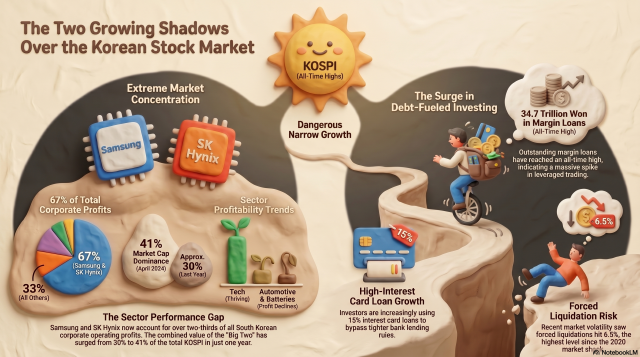
High-credit borrowers are increasingly turning to high-interest card loans, which can carry rates of around 15 percent, to fund real estate and stock investments, the FSS said. The trend is driven by tighter mortgage lending at commercial banks and efforts to capitalize on the surging KOSPI.
While household financial assets have grown significantly from 960 trillion won in 2024 to 1,430 trillion won last year, the KOSPI's volatility remains a concern, as a growing number of investors may struggle to repay their debts.
When the KOSPI plunged more than 12 percent on March 4 following the blockade of the Strait of Hormuz, the ratio of forced liquidations to outstanding credit reached 6.5 percent - the highest level since the market shock during the early stages of the coronavirus pandemic in March 2020.
Copyright ⓒ Aju Press All rights reserved.