

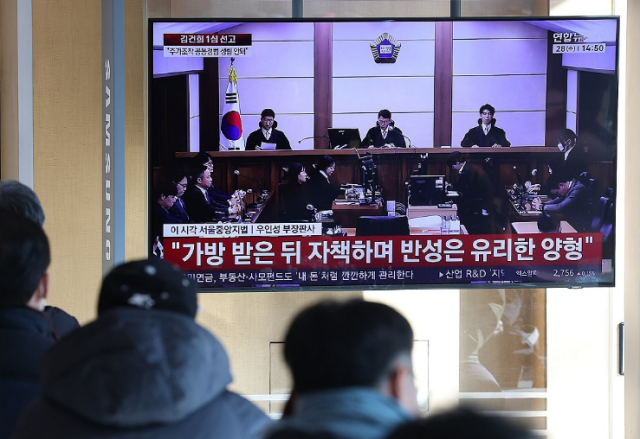
A South Korean court on Tuesday said it recognized Kim Keon Hee’s political influence but ruled that her status alone could not expand criminal liability. The court found her partly guilty over receiving money and valuables linked to the Unification Church, but acquitted her of conspiracy allegations tied to the Deutsche Motors stock manipulation case and an opinion-poll controversy involving Myung Tae-kyun, citing insufficient evidence.
The Seoul Central District Court’s Criminal Division 27, led by Presiding Judge Woo In-sung, said before delivering the verdict that the law cannot be applied differently to the powerful and the powerless. It said core criminal-law principles — the presumption of innocence and resolving ambiguity in the defendant’s favor — do not change based on a person’s position.
On the Deutsche Motors case, the panel said there was room to believe Kim may have recognized or accepted the possibility that her accounts could be used for price manipulation. But it said prosecutors did not prove beyond a reasonable doubt that she coordinated roles or formed a shared intent with the manipulation group to carry out the scheme. The court noted there was no testimony that anyone in the group directly explained the operation to Kim or assigned her a role, and it found no material showing she personally placed trades. It concluded she did not go beyond the role of an investor who provided funds.
“Conspiracy requires strict proof of awareness of the overall crime and performance of a role,” the court said, adding that without such proof it must acquit even if suspicion remains. For some acts, it also found the statute of limitations had already expired, considering trading dates, account-management patterns and time gaps.
The court also acquitted Kim of violating the Political Funds Act. It said the opinion polls provided by Myung could not be seen as an exclusive financial benefit belonging to Kim and her husband, and it found no confirmation of instructions or involvement by Kim’s side in conducting or publicizing the polls. The court also said there was no evidence that a promise of nomination for a specific person was made in return. It concluded the act’s requirements — a contribution and quid pro quo — were not met.
However, the court found her partly guilty in connection with money and valuables received in July 2022, ruling that Kim accepted them while aware of the Unification Church’s request for government-level support. In sentencing, the court said a president’s spouse can have significant influence on the president and is a symbolic figure representing the country, requiring a high level of integrity and restraint.
The panel said Kim misused her position as a tool for personal gain. It said money often seeks access around power and that the higher the status, the more consciously one must guard against it, citing her acceptance of expensive luxury items as an unfavorable sentencing factor.
After the ruling, the special counsel team led by Min Joong-ki said it was “difficult to accept” the court’s reasoning on co-offender liability, the Political Funds Act and solicitation issues, and said the sentence on the guilty portion was also inadequate given the case. The team said it would challenge the first-trial decision on appeal.
Kim’s lawyers said they were grateful to the court for ruling “only according to law and conscience,” but said the sentence for influence-peddling bribery was somewhat high and that they would consider whether to appeal.
The decision highlighted how far a president’s spouse’s political influence can be weighed in assessing criminal responsibility. The court did not deny that such influence exists, but drew a line, saying it does not automatically establish conspiracy or criminal liability.
* This article has been translated by AI.
Copyright ⓒ Aju Press All rights reserved.