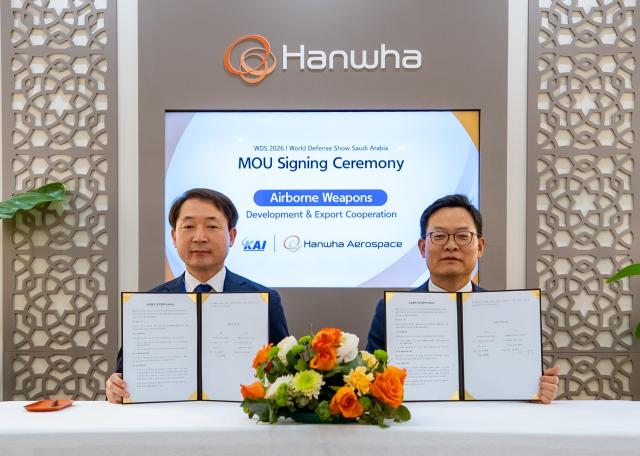
SEOUL, February 10 (AJP) - South Korean defense firms Hanwha Aerospace and Korea Aerospace Industries (KAI) said on Monday they will jointly develop a long-range air-to-air missile and cooperate on overseas marketing to expand exports of South Korean aircraft and air-launched weapons systems.
Under a memorandum of understanding they signed a day earlier at the World Defense Show in Riyadh, Saudi Arabia, they will cooperate on integrating air-launched weapons into South Korea’s KF-21 fighter jet and FA-50 light combat aircraft.
Hanwha Aerospace said it is conducting preliminary research with the agency on next-generation air weapons, including long-range air-to-air missiles powered by solid-ramjet engines, as well as supersonic air-to-surface and air-to-ship missiles.
Demand for comprehensive defense packages has been rising as overseas customers increasingly seek integrated solutions covering aircraft platforms, weapons systems and operational support, KAI Chief Executive Cha Jae-byung said.
“Korean defense products are gaining credibility, and customers are asking for packages that include not only aircraft but entire operational systems,” Cha said in a press release, adding domestic defense firms would work together to expand exports through joint marketing.
Hanwha Aerospace Chief Executive Son Jae-il said combining Hanwha’s missile development experience across air-to-air, air-to-surface and surface-to-air systems with KAI’s aircraft integration capabilities would support the development of indigenous air-launched weapons.
* This article, published by Aju Business Daily, was translated by AI and edited by AJP.
Copyright ⓒ Aju Press All rights reserved.