

The cautious approach, however, has drawn criticism from across the spectrum, with both doctors and civic groups arguing that it avoids addressing structural problems in the healthcare system.
According to an outline released by the Ministry of Health and Welfare, all additional seats will be allocated to regional universities and placed under a “regional physician” track.
Students admitted through the program will receive government support in exchange for a mandatory 10-year service commitment at public medical institutions in provincial areas.
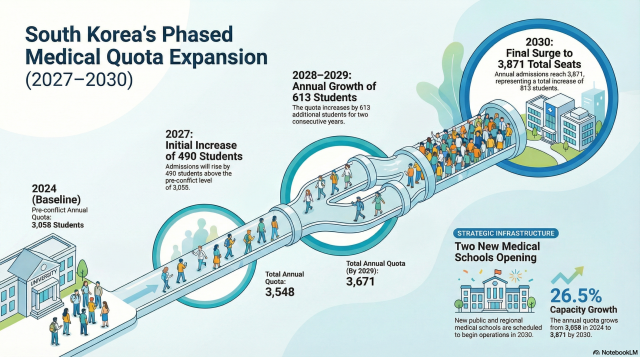
Under the phased plan, medical schools will admit 490 more students in 2027 compared with pre-conflict levels of 3,058 in 2024. The increase will rise to 613 additional students in both 2028 and 2029, and then to 813 from 2030, when two new public and regional medical schools are scheduled to open.
By 2030, Korea’s annual medical school quota will reach 3,871, up 813 from before the dispute.
Health and Welfare Minister Jeong Eun-kyeong said the pace was designed to avoid overwhelming medical schools already coping with overlapping freshman classes from 2024 and 2025.
“Considering the current strain on educational capacity, particularly due to the doubled student cohorts, a 75 percent increase is an appropriate step,” Jeong said.
“This plan prioritizes the quality of medical education and sustainable physician training.”
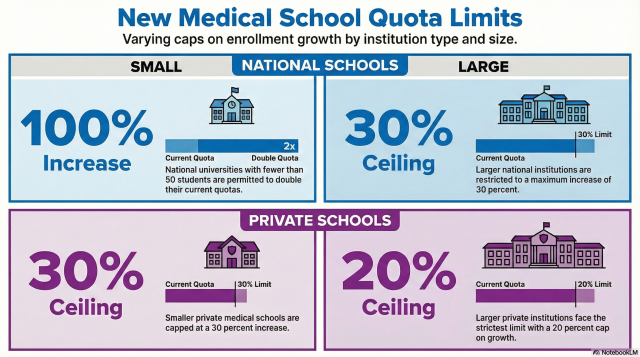
To prevent excessive concentration at major institutions, the government will impose differentiated caps on enrollment growth.
National universities with fewer than 50 students will be allowed to double their quotas, while larger national schools will face a 30 percent ceiling. Private medical schools will be capped at 30 percent for smaller institutions and 20 percent for larger ones.
The government will also provide funding to upgrade facilities and equipment, and support current students preparing for licensing exams and residency placements.
Officials say the expansion aims to address regional healthcare shortages by deploying more doctors to provincial areas, particularly in essential and public medical services.
Funding will come from a newly created special accounting system for regional essential healthcare, which will also strengthen safety nets for patients and medical workers.
Renewed backlash
Despite the compromise, the announcement immediately reignited tensions with the medical community.
During Tuesday’s Health and Medical Policy Committee meeting, Korean Medical Association President Kim Taek-woo walked out in protest, accusing the government of prioritizing numbers over reform.
“The government’s announcement focuses only on figures, not on real normalization of healthcare,” Kim said at an emergency briefing.
“We hold the government fully responsible for any confusion that follows in the medical field.”
Civic and patient groups, meanwhile, criticized the government for not going far enough.
Nam Eun-kyung of the Citizens’ Coalition for Economic Justice said the modest increase left much of the shortage unresolved.
“The government cited educational capacity, but this decision falls short of what’s needed to protect public health,” she said.
The Korea Patient Federation also expressed regret, warning that reduced expansion could prolong shortages in essential and regional services.
As the government moves forward with its phased plan, South Korea’s long-running dispute over medical workforce policy appears set to intensify once again—leaving the central challenge of balancing access, quality, and sustainability unresolved.
Copyright ⓒ Aju Press All rights reserved.
