


The front blends Genesis’ signature twin-line headlamps with a wide grille-style panel, while the coupe-like roofline gives the SUV a more athletic profile. The rear finish and detailing are designed to look balanced and stable.
The GV60 Magma’s strengths were clearer on the road. The test route covered about 100 kilometers round trip from the Genesis Suji showroom to the Korea Automobile Testing and Research Institute (KATRI) in Hwaseong, via the Suwon Northern Ring Road, the Gwacheon-Bongdam Urban Expressway and the Bibong-Maesong Urban Expressway. The mix of national roads, limited-access roads and highways highlighted both long-distance cruising and everyday drivability.
One of the first things drivers notice is the seat. The Magma-specific bucket seats provide strong lateral support without becoming uncomfortable over longer stints, aiming to suit both spirited driving and daily use. A seat slab helps stabilize the lower body under acceleration and braking, while remaining comfortable on regular roads.
Despite ultra-high-performance tires — 275 mm wide up front with a 35% aspect ratio — the cabin stays notably quiet for a performance EV. Genesis credits added sound-absorbing and insulating materials, motor control that reduces harmonic noise, and a design that suppresses gear noise.
A key feature is Active Road Noise Control (ANC-R). Accelerometers mounted on the suspension detect low-frequency road noise, and the audio system plays an opposite-phase signal to cancel it. Cabin microphones continuously adjust the control logic to maintain quiet even at higher speeds.
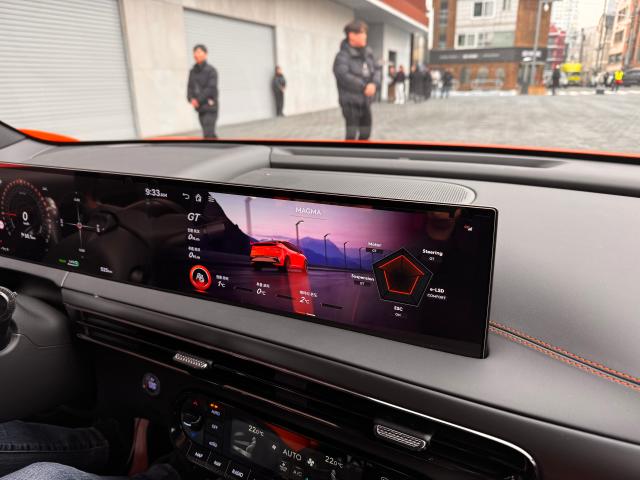
Switching to GT mode changes the electronically controlled suspension’s character: road feedback becomes clearer through the steering wheel, and steering weight increases. The ride does not become harsh, filtering unpleasant impacts while keeping the car usable on public roads.
The variable electronic dampers control body motion without losing compliance. In gentle high-speed corners, the chassis allows natural roll without float, working with a thicker stabilizer bar to underline GT mode’s focus on high-speed cruising.
GT mode also emphasizes power distribution. Even at higher speeds, it maintains rear-motor-biased driving, aiming to deliver the stable acceleration feel of rear-wheel drive while also improving efficiency — a key draw for long highway runs.
Sprint mode opens up the full performance setup. The motors, suspension, steering and e-LSD switch to Sport Plus settings, delivering maximum output within the electronic stability control’s intervention range. Pressing the accelerator beyond 95% triggers a 15-second boost mode automatically.
The suspension firms up without feeling rough, and the tires maintain confident contact on uneven pavement. On curving highway sections, restrained roll and smoothly building lateral acceleration support a steady driving rhythm.
Genesis said the GV60 Magma reaches 100 kph from a standstill in 3.4 seconds and 200 kph in 10.9 seconds. In drag runs at the Automobile Safety Research Institute, the combination of launch control and boost mode delivered strong acceleration, and braking performance stood out. The vehicle remained stable under hard stops despite a curb weight of 2,250 kilograms.
A Genesis official said the GV60 Magma was developed to prioritize balance rather than the traditional approach to luxury high performance. The official said the company aims to use new technology to position Magma not as a sub-brand, but as a way to showcase Genesis’ engineering globally.
* This article has been translated by AI.
Copyright ⓒ Aju Press All rights reserved.