

SEOUL, February 23 (AJP) - A research team at Kookmin University has identified a neuroendocrine circuit in the brain that allows animals to dynamically adjust their salt intake based on internal sodium levels. The study, led by Professor Lee Young-seok of the Department of Bio and Fermentation Convergence, reveals how specific brain cells act as internal sensors to maintain salt balance.
The findings are scheduled for publication in the weekly issue of the Proceedings of the National Academy of Sciences (PNAS) on February 24, 2026, following an online release on February 21.
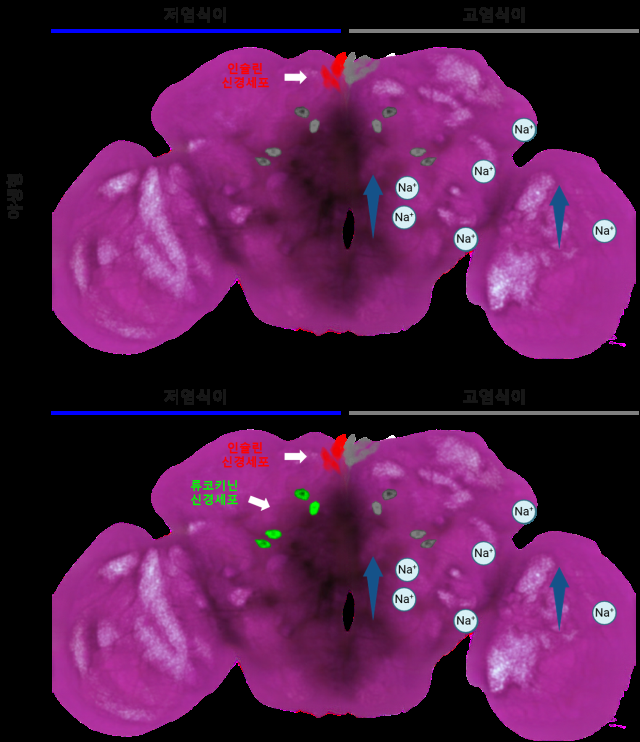
While taste is typically associated with receptors on the tongue, the body also possesses internal mechanisms to maintain homeostasis. When internal sodium levels are already high, the body instinctively limits further salt intake to prevent damage. The research team used Drosophila (fruit fly) models to demonstrate that certain neurons in the brain directly monitor the salt concentration of internal fluids to regulate this rejection response.
The study highlights two key components: insulin-producing cells (MNCs) and Leucokinin (Lk) neurons, which are the insect equivalent of human Tachykinin. When internal salt levels are high, these neurons remain active to sustain a dislike for high-salt foods, preventing overconsumption. Conversely, when the body lacks salt, the Leucokinin signal stimulates the insulin-producing cells to shift the animal's preference, making it consume high-concentration salt that it would normally avoid.
Significantly, the research proves that these neurons function as a central sodium sensor that operates independently of external signals from the tongue or esophagus. This means the brain itself tastes the salt levels within the body's internal environment to dictate behavior.
Professor Lee Young-seok stated that the study identifies the endocrine mechanism by which the brain monitors internal salt concentrations and modifies behavior accordingly. He noted that because this principle is similar to how mammals maintain salt balance, the research provides a basis for understanding why patients with hypertension or diabetes might consume high amounts of salt and could point toward new therapeutic targets.
The study was supported by the Basic Research Program in Science and Engineering through the National Research Foundation of South Korea. The research team was led by Professor Lee Young-seok, with Puri Sonali and Sang Ji-woon serving as co-first authors.
(Paper information)
Journal: Proceedings of the National Academy of Sciences (PNAS)
Title: Insulin and leucokinin pathways coordinate adaptive salt appetite in Drosophila
DOI: https://bit.ly/4sakqHg

Copyright ⓒ Aju Press All rights reserved.
