

The world’s five biggest automakers competing in humanoid robots are pursuing sharply different strategies, drawing attention to which approach will win out. Hyundai Motor Group and Tesla are preparing for mass production based on the idea that humanoids can be used broadly, though they are targeting different areas.
BMW, Mercedes-Benz and Toyota, meanwhile, are focusing on maximizing productivity and moving toward fully unmanned factories using humanoids.
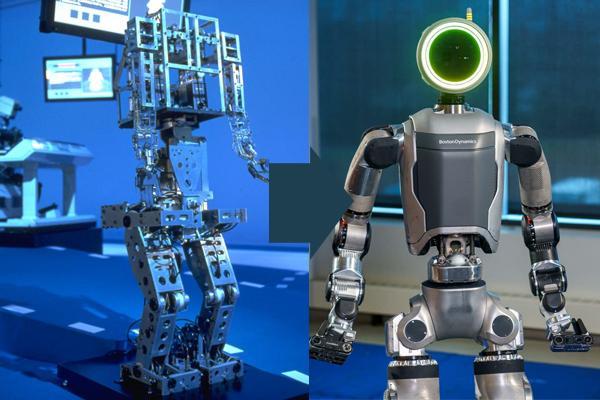
According to the auto industry on Feb. 23, Hyundai is upgrading functions centered on manufacturing processes, aiming to deploy Boston Dynamics’ Atlas in industrial sites in 2028. Atlas is built on an adult male scale — 190 centimeters tall and 90 kilograms — with 56 joints, hands equipped with tactile sensors and 360-degree sensing. It can carry up to 50 kilograms and has cognitive capabilities such as charging itself or swapping batteries when power runs low. It can also work in extreme conditions from minus 20 to 40 degrees Celsius. Hyundai is conducting advanced verification tests with Atlas at its Global Innovation Center in Singapore.
Tesla’s strategy is to mass-produce Optimus by the end of 2027 and enter the general-purpose AI robotics market faster than the other big five automakers. Optimus is 173 centimeters tall and weighs 57 kilograms, and can walk at 8 to 10 kilometers per hour. It has 40 joints and eight sensors and can carry up to 20 kilograms. Tesla plans to validate tasks such as moving battery cells and sorting parts at its Gigafactory by the end of this year, then begin outside sales next year. To support that plan, it has built a production system at its Fremont, California, plant capable of making more than 1 million Optimus units a year.
BMW, Mercedes and Toyota have each chosen alliances with startups, focusing less on retail sales of humanoids and more on boosting vehicle production efficiency.
BMW partnered with U.S. startup Figure AI and deployed Figure 02 at its Spartanburg plant, conducting about a year of testing. Figure 02 is 160 centimeters tall and can carry parts weighing up to 25 kilograms. With AI reasoning capabilities, it can perform tasks autonomously and hold conversations with people. It has reportedly assembled chassis components, handled storage of more than 90,000 parts and worked on production of BMW’s key SUV model, the X3. BMW plans to deploy its next model, Figure 03, this year.
Mercedes is testing Apollo, developed by U.S. humanoid company Apptronik, at plants in Berlin and Hungary. Apollo is 177 centimeters tall, can lift up to 25 kilograms and operate for 22 consecutive hours. Its detachable lower body can be configured with wheels or for bipedal walking, allowing use not only in manufacturing but also in logistics, construction, retail and delivery. For cognition and decision-making, it uses Gemini Robotics.
Toyota placed Digit, a humanoid from U.S. startup Agility Robotics, at its Woodstock plant in Ontario, Canada. When an autonomous vehicle carrying Digit arrives at a destination inside the plant, the robot jumps out of the trunk and moves parts boxes. After about a year of testing, Toyota plans to expand Digit’s duties this year to more difficult assembly processes.
Automakers are moving quickly in humanoids in part because of the industry’s existing strengths. Control, driving and perception technologies already used in vehicles can shorten the development process for AI robotics.
Another advantage is the ability to deploy robots in large factories and directly measure productivity gains. Humanoids can be up to three times more productive than humans and can operate around the clock. AI robotics with action, cognition and language capabilities can also be used for ultra-precise parts assembly, painting and quality inspection — areas traditionally handled by skilled workers — making fully unmanned “dream factories” possible. Hyundai estimates it could save 1.7 trillion won a year by replacing just 10% of its existing production workforce with AI robotics.
Still, companies must keep improving the technology while also cutting costs. Atlas is currently expected to cost about $130,000 per unit (187 million won). The industry estimates an acceptable price point for mass adoption at around 50 million won. Tesla plans to lower Optimus’ average price by 2027 to 27 million to 40 million won, roughly the level of a compact sedan.
Hwang Gwang-taek, a senior researcher at the Export-Import Bank of Korea’s Overseas Economic Research Institute, said humanoids still have limited ability to respond outside specific scenarios and that high upfront investment costs weigh on companies’ short-term profitability. He said longer-term challenges include rebuilding systems to deploy humanoids and rising operating, maintenance and repair costs for robotics.
* This article has been translated by AI.
Copyright ⓒ Aju Press All rights reserved.