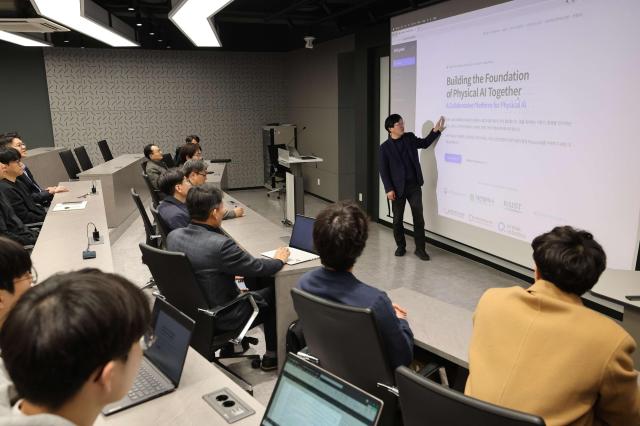
SEOUL, February 27 (AJP) - The Korea Advanced Institute of Science and Technology in South Korea announced on February 27 that it held a performance report meeting for the Deep Tech Scale-up Valley project at its main campus in Daejeon. During the event, the university unveiled its implementation strategy for Physical AI, focusing on moving robot technology out of the laboratory and into actual industrial settings.
The Deep Tech Scale-up Valley is a joint initiative between South Korea's Ministry of Science and ICT, Daejeon Metropolitan City, and the Korea Advanced Institute of Science and Technology (KAIST). The university has secured 13.65 billion won in funding for a three-year and six-month period starting in 2025. Led by Professor Kim Jung, the project aims to build a robotics innovation ecosystem by commercializing deep tech developed at the institute. A Robot Alliance has been formed to support this goal, including KAIST Holdings, Daejeon Techno Park, the Daejeon Center for Creative Economy and Innovation, Angel Robotics, and YuRobotix.
The project operates on a three-pillar system: technology commercialization, deep tech R&D, and commercial scale-up. In its first year, the initiative achieved 23 billion won in technology transfers and investment attraction through Physical AI lectures, startup pitching events, and networking sessions.
Physical AI refers to technology that combines robotics with artificial intelligence, allowing machines to perceive, judge, and act autonomously in the real world. While government R&D and corporate investments are increasing, KAIST noted that practical business models remain limited. The report meeting redefined Physical AI as a challenge of industrial structure rather than just a competition of algorithms, emphasizing that commercialization requires the organic integration of research, factories, and the investment ecosystem.
Researchers highlighted that applying Physical AI to industry requires meaningful data generated from actual worksites rather than just virtual environments. This involves collaborating with skilled professionals in manufacturing to accumulate data that reflects human physical senses and judgment.
Professor Kong Kyoung-chul of the Department of Mechanical Engineering at KAIST emphasized the need for a concrete platform. For AI trained in a virtual environment to function properly in the real world, the accuracy of virtual technology must improve, and physical variables in reality must be managed predictably, Professor Kong Kyoung-chul said.
Professor Myung Hyun of the School of Electrical Engineering at KAIST noted that research into Physics-Informed Neural Networks (PINN) is currently active. The completion of Physical AI is possible when hardware researchers who understand physical systems and AI researchers who implement learning structures work together, Professor Myung Hyun said. He added that AI must understand physical laws rather than just processing large volumes of data.
KAIST plans to establish a value chain connecting researchers, industrial experts, and corporations to solve actual industrial problems.
We must move beyond competing over data volume and consider how to execute AI in the actual physical world, said Professor Kim Jung, Head of the Department of Mechanical Engineering at KAIST. Based on our specific strategies, we will support startups and companies to succeed in commercializing Physical AI.
The Deep Tech Scale-up Valley project will proceed with building Physical AI platforms, discovering and investing in startups, establishing testbeds, and expanding cooperation networks with global robotics companies.

Copyright ⓒ Aju Press All rights reserved.