

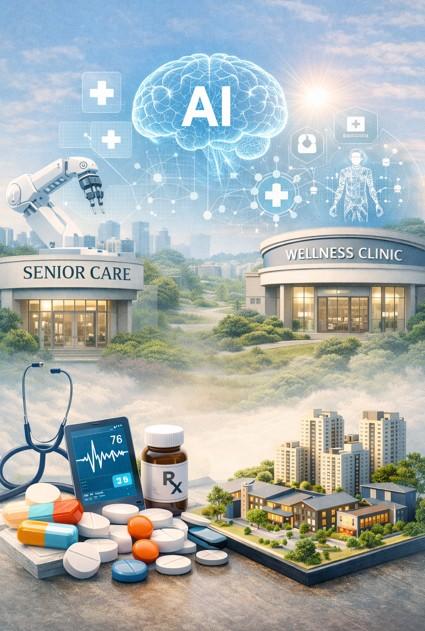
Pharmaceutical and biotech companies are accelerating expansion into senior health care, positioning it as a new growth engine as South Korea enters a super-aged society. With medical and caregiving demand expected to rise structurally, companies are moving into the “silver market,” where they can apply core capabilities while seeking long-term revenue with relatively lighter regulatory burdens.
According to the Korea Insurance Research Institute on the 2nd, the number of older people needing care — including those with dementia and seniors living alone — is steadily increasing. By 2030, it projects that 16.5% to 26.3% of older adults will need elder-care services. Companies are responding by combining real estate development capacity with differentiated models such as health functional foods and digital technology.
Among early movers is Chong Kun Dang. Chong Kun Dang Industry, a property asset management company under Chong Kun Dang Holdings, has expanded its footprint by acquiring nursing-care facilities. It operates “Bellforest” and “Heritage Nursing Home,” offering premium services. Heritage Nursing Home has a system designed to respond immediately in emergencies by linking with major hospitals. “Pharmaceutical companies already have networks among older adults and chronic-disease data, so combining that with the care industry creates strong synergy,” an industry source said.
Still, concerns remain that care businesses may not deliver the profitability companies expect, largely because labor costs dominate spending. Nursing facilities must use 62.5% of government reimbursement payments for labor, and when indirect labor costs are included, staffing can account for about 70% to 80% of total expenditures. The burden can grow as facilities scale and it becomes harder to meet required ratios.
“Separating the business into a separate corporation may limit financial risk, but operating nursing facilities requires distinct capabilities because it involves managing the overall brand image,” another industry official said. Kim Dae-jong, a professor in the School of Business at Sejong University, said, “Korea has the second-largest elderly population after Japan, and the silver industry is structurally bound to grow over the long term,” adding, “Any company will face limits to growth with its core business alone.”
Overseas, pharmaceutical companies’ expansion into senior care is already seen as a proven model as aging becomes a business opportunity. Recently, Asian companies have focused on mental health and elder nursing. Japan’s Eisai, judging that “medicine alone cannot solve the dementia problem,” launched its subsidiary Theoria Technologies in 2023 and entered the dementia management platform business. China’s major drugmaker Sinopharm operates an integrated senior-care system built around combined medical and nursing-care hubs, expanding services on a “whole life-cycle” basis. The offering includes rehabilitation care, chronic-disease management and professional nursing services, in addition to supplying medicines.
In South Korea, drugmakers are pursuing strategies aligned with their strengths. Daewoong Pharmaceutical formed a dedicated digital health care organization and unveiled its integrated artificial intelligence platform, “All New Think.” With more older adults needing ongoing management and more than 90% of domestic hospital beds lacking real-time monitoring systems, analysts see room for growth. However, as the market is still in an early stage, issues such as integrating AI technology and the contribution to sales remain to be assessed.
Senior nutrition is also emerging as a new expansion track. Hanmi Science introduced “Hanmi Care Me,” a premium complete balanced nutrition product aimed at addressing nutritional imbalance among older adults. For seniors who struggle to consume adequate nutrients due to reduced activity and smaller meals, the message that it is “nutrition designed by a pharmaceutical company” can boost trust in purchasing. “Because the senior market is driven by trust-based consumption, pharmaceutical brands have an advantage,” an industry source said, while noting that the food industry already holds high market share and companies must also weigh the cost of building distribution and marketing infrastructure.
Some also see longer-term benefits in understanding seniors’ needs and data. Sung Hye-jin, deputy director at the Pharmaceutical Industry Strategy Institute, said, “The senior market has a trust-based consumption tendency that fits well with pharmaceutical companies,” adding, “With the market still in its early stage, now is the time to enter, and there will be opportunities to lead across diverse fields.”
* This article has been translated by AI.
Copyright ⓒ Aju Press All rights reserved.