

According to industry officials on Tuesday, Dubai crude futures traded on the New York Mercantile Exchange closed at $80.39 a barrel the previous day, up 5.04% from the prior session. That was a 12.7% jump in three trading days from Feb. 27, just before the war began, when it was $71.81 a barrel. After holding a steady $66 to $68 a barrel on average in February, prices have surged more than 5% a day since the Strait of Hormuz was blocked following U.S. airstrikes on Iran, the report said.
Experts said a prolonged conflict could push oil to around $130 a barrel. JPMorgan forecast that if Iran’s blockade of the Strait of Hormuz drags on and disrupts maritime transport for three to four weeks, oil would rise above $100 a barrel. In that case, gasoline now priced at about 1,739 won per liter would climb to 1,850 to 1,900 won, an increase of 6.3% to 9.4%.
If high oil prices persist, demand is likely to grow for hybrids, plug-in hybrids and EVs. An auto industry official said it is difficult to predict a broad shift in the market based on short-term oil forecasts because vehicle replacement cycles typically run five to 10 years. Still, the official said, if high prices continue amid a rise in localized conflicts globally, consumers facing higher living costs will gravitate toward fuel-efficient hybrids or EVs.
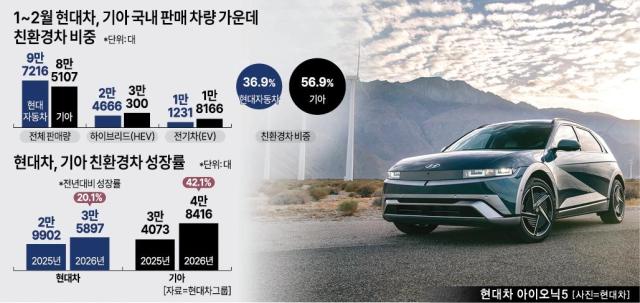
Sales data already show a strong shift. Hyundai sold 97,216 vehicles in South Korea in January and February, including 35,897 hybrids and EVs, or 36.9% of the total, up 20% from a year earlier. Kia sold 85,107 vehicles domestically over the same period, with eco-friendly models totaling 48,416 — 30,300 hybrids and 18,166 EVs — for a 56.9% share, a 42.1% increase from a year earlier. If the trend holds, the share of eco-friendly vehicles — now about 30% to 40% of new registrations — is expected to top 50% within the year.
The high upfront cost, often cited as the main drawback of eco-friendly vehicles, is also easing as battery prices fall. To compete with internal-combustion vehicles on price, EV battery costs need to drop to around $100 per kilowatt-hour. Germany’s electrive.com reported that EV battery prices fell from $115 per kWh at the end of last year to $100 this year, and are projected to reach $69 by 2030. Tesla, BMW, Hyundai Motor Group and Volvo have cut prices on major EV models by about 13% to 20% this year as battery-pack costs declined.
* This article has been translated by AI.
Copyright ⓒ Aju Press All rights reserved.