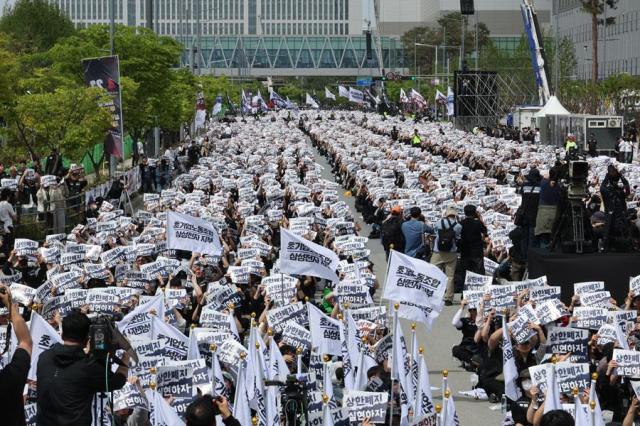
The chip giant's labor union has threatened to stage a three-week strike from May 21 to June 7 if negotiations fail.
Speaking at a forum in southern Seoul last week hosted by think tank Ahnmin Institute for Public Policy, Song Heon-jae, a professor at the University of Seoul, warned that a possible walkout at Samsung Electronics' semiconductor operations could "disrupt production on a massive scale."
Song estimated that even a brief halt in chip production could result in losses of billions per minute, rising to roughly 1 trillion won (about US$676 million) per day. He also warned that if the strike becomes prolonged, operating profit in the semiconductor division alone could fall by as much as 10 trillion won.
"Not to mention immediate financial losses, the even bigger risk would be long-term damage to business relationships," Song also pointed out, adding that global tech giants such as Nvidia and AMD could turn to alternative suppliers like TSMC to ensure supply stability.
"Once customers shift their supply chains, it could take years and significant costs to win them back," Song said, cautioning that the strike could undermine trust, weaken competitiveness in the fast-growing artificial intelligence-driven semiconductor market, and lead to a loss of momentum.
The potential fallout could also spread across South Korea's broader industrial ecosystem, as Samsung Electronics has some 1,760 subcontractors and equipment suppliers, and any production halt could affect their operations.
Many experts say resolving the dispute will require greater transparency in how performance bonuses are calculated, along with clearer guidelines for compensation, warning that prolonged internal conflict could deal a heavy blow to Samsung Electronics at a critical moment when global competition in advanced semiconductors intensifies.
The warning comes as tensions rise between Samsung Electronics and its labor union over bonus structures. The union has threatened a large-scale strike, demanding that 15 percent of operating profit be distributed as performance bonuses. With Samsung's annual operating profit projected to reach as much as 300 trillion won, payouts could climb to around 45 trillion won or hundreds of millions of won per chip division employee if the demand is met.
The dispute follows a recent agreement at rival SK hynix, which shifted to allocating 10 percent of operating profit to employees after removing a cap on bonuses. The move has raised expectations among workers across the semiconductor industry.
Copyright ⓒ Aju Press All rights reserved.