

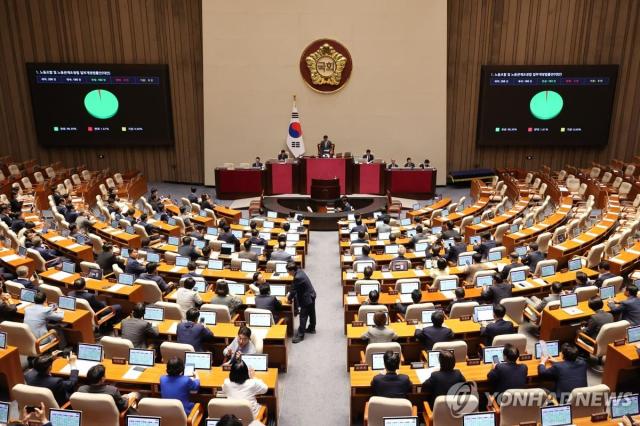
Business groups say the so-called Yellow Envelope Act — revisions to Articles 2 and 3 of the Trade Union and Labor Relations Adjustment Act — will take full effect starting on the 10th, and they warn it could trigger major disruption across industry.
Korea’s manufacturing base — including autos, defense, shipbuilding and construction — relies on dense networks of first-tier suppliers and multilayer subcontractors. An industry official said the subcontracting structure became entrenched during Korea’s rapid industrialization and warned that if the law is used to increase management pressure or as a tool in strikes, companies could face a worst-case scenario of being consumed by labor talks year-round.
As of the 8th, industry officials said they expect more labor-management disputes if the law expands the definition of “employer,” and they fear a rise in cases in which subcontractors challenge corporate management rights. Under the revisions, a prime contractor can be treated as an employer even without a direct employment contract if it is in a practical position to control subcontracted workers’ hours, wages or work methods. Observers say the change could directly affect industries where multilevel subcontracting is common, including shipbuilding, autos, construction, steel, petrochemicals, semiconductors, IT, platform businesses and services.
Hyundai Motor, for example, has about 5,000 subcontractors, including first-, second- and third-tier suppliers. In construction, where partners are often organized by project, three major builders — Samsung C&T, Hyundai Engineering & Construction and GS E&C — have about 1,900 first-tier partners and roughly 16,000 partners in total. Shipbuilding has fewer partner firms than autos or construction, but it relies far more heavily on outsourced labor. The combined subcontractor workforce at three major shipbuilders — HD Hyundai, Samsung Heavy Industries and Hanwha Ocean — totals about 45,000, about 1.5 times their directly employed workforce of 31,000.
An industry official said that with grievances among subcontracted workers already accumulated, negotiations could, in some cases, lead to a surge of demands. The official warned that normal business operations could become difficult and that manufacturing sites could be thrown into confusion and conflict.
Business groups also voiced concern that the law is taking effect as the economy faces multiple pressures, including U.S.-driven tariff risks, a reshaping of global supply chains and what they described as “three highs” — a weak currency, high interest rates and high oil prices — linked to the war in the Middle East. A business official said that with companies facing unprecedented external uncertainty, the law’s ambiguity could make management decisions even harder, and urged labor and management to pursue coexistence for shared interests rather than deepen distrust.
* This article has been translated by AI.
Copyright ⓒ Aju Press All rights reserved.