SEOUL, April 24 (AJP) — South Korea’s economy grew a stronger-than-expected 1.7 percent in the first quarter, nearly double the Bank of Korea’s estimate, raising hopes for resilience despite mounting external shocks. But whether the momentum can last hinges on the duration of the nearly two-month Middle East standoff and Korea’s ability to withstand an energy shock across an economy still fragilely powered by chip exports.
Following the data, the Bank of Korea (BOK) expressed confidence that the economy can weather this year’s Black Swan crisis in the Gulf.
“Since the first-quarter growth rate is heavily reflected in the annual figures, we expect to meet our original growth target of 2 percent without significant difficulty,” said Lee Dong-won, director general of the central bank’s Economic Statistics Department.
“The squeeze from the blockade will be reflected in second-quarter data,” Lee said. “It is clear that the conflict in the Middle East has placed upward pressure on inflation and downward pressure on economic growth.”
Diplomatic efforts to resolve the crisis have stalled, with ceasefire negotiations failing to produce a breakthrough. The deadlock may partly reflect both sides’ need to replenish depleted military stockpiles.
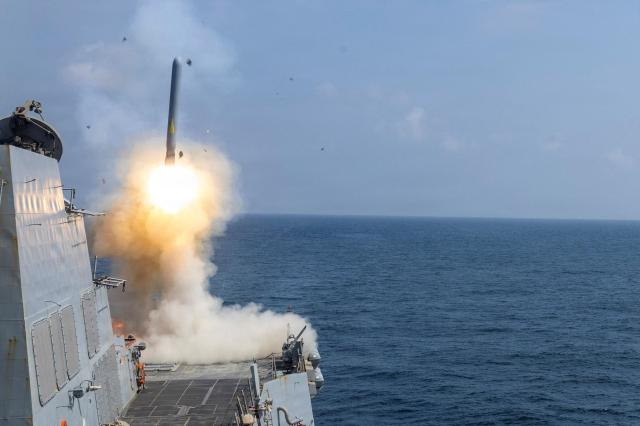
According to the Center for Strategic and International Studies (CSIS), U.S. inventories of precision-strike missiles and Tomahawk cruise missiles have fallen to 60 percent and 70 percent of peacetime levels, respectively. Inventories of the Terminal High Altitude Area Defense (THAAD) system, in particular, have been halved. Iran’s offensive capabilities also remain constrained after the destruction of key launch facilities and infrastructure.
“With both sides facing mounting pressure from a war of attrition, they appear to be seeking a tactical breathing space through negotiations,” said Kim Yeol-soo, a senior research fellow at the Korea Institute for Military Affairs.
Iran remains deeply skeptical of U.S. intentions after being attacked during previous nuclear talks, while Washington has refused Tehran’s demands for the restoration of frozen assets and formal recognition of uranium enrichment.
High-stakes negotiations ended on April 12 without tangible results. Tensions continue in the Strait of Hormuz, with both sides seizing vessels and raising the risk of renewed military action once arsenals are replenished.
The international financial community has taken note of South Korea’s performance. After the 1.7 percent first-quarter growth figure, major investment banks began raising their annual growth forecasts.
Park Jeong-woo, an economist at Nomura Securities, cautioned that the upgrades remain conditional. “It is premature to conclude that inflationary pressures or downside risks to growth have subsided,” he said.
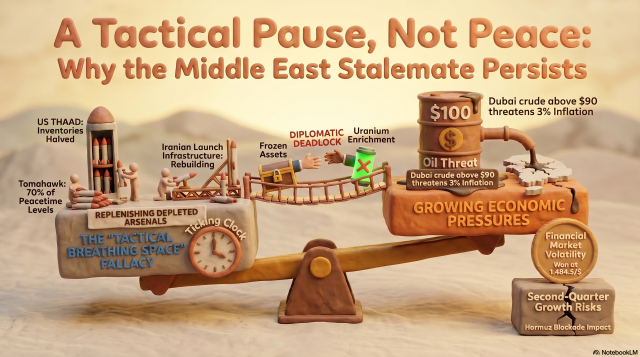
The most immediate threat is a sustained surge in energy costs. Dubai crude, which averaged below $70 per barrel last year, has stayed above $90 this year.
Hyundai Research Institute and other institutions warn that if the annual average oil price exceeds $100, South Korea’s consumer price index could rise by more than one percentage point, pushing inflation into the 3 percent range.
Inflationary pressure is already showing in the currency market. The Korean won, which had briefly stabilized, weakened again toward the end of the week, closing at 1,484.5 per dollar on Friday.
Korean government bonds, once expected to strengthen after their inclusion in the World Government Bond Index, have also weakened. As of Friday morning, the three-year yield rose 3.8 basis points to 3.496 percent, while the 10-year yield climbed 2.6 basis point to 3.817 percent, marking a level of weakness similar to late March.
Copyright ⓒ Aju Press All rights reserved.