

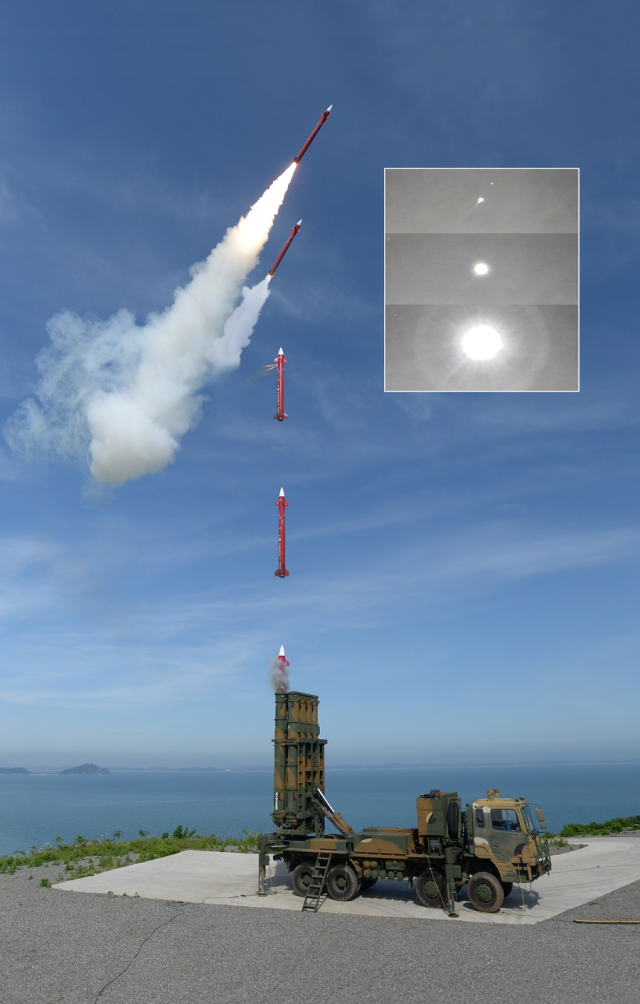
◆Cheongung-II said to have intercepted Iranian missiles, proving capability in the Middle East
Industry officials said Monday that South Korea’s Cheongung-II, a medium-range surface-to-air missile deployed in the United Arab Emirates, has demonstrated interception capability in combat following the outbreak of war in the region.
Rep. Yoo Yong-won, a member of the National Assembly Defense Committee, and others said the Cheongung-II deployed in the UAE hit Iranian missiles earlier this month with a 96% success rate. A Cheongung battery is reported to have fired about 60 interceptors at incoming targets. The reported rate is comparable to the U.S. Patriot, widely regarded as among the world’s top air defense systems. The UAE has recently asked the South Korean government for early delivery of interceptors, according to reports.
Often described as a Korean version of the Patriot, the Cheongung-II is produced by LIG Nex1, Hanwha Systems and Hanwha Aerospace. It uses a cold-launch method, ejecting the missile vertically before igniting its engine in the air. The system includes a multifunction radar for tracking targets, an operations control center, launchers and vehicles, and is designed to strike targets at speeds of Mach 4 to 5.
The Cheongung-II has a maximum range of 40 kilometers (25 miles) and is designed to destroy enemy missiles below 15 kilometers (9 miles) in altitude using a hit-to-kill direct-impact method. Mass production began in 2024, and two batteries are currently deployed in the UAE.
LIG Nex1, the lead contractor, has secured about $9.5 billion (10.2 trillion won) in Middle East orders through contracts with the UAE (about $3.5 billion in January 2022), Saudi Arabia (about $3.5 billion in November 2023) and Iraq (about $2.5 billion in September 2024). Deliveries to Saudi Arabia and Iraq are expected soon. The system’s price — reported to be about half that of the Patriot — is also fueling expectations for additional orders.
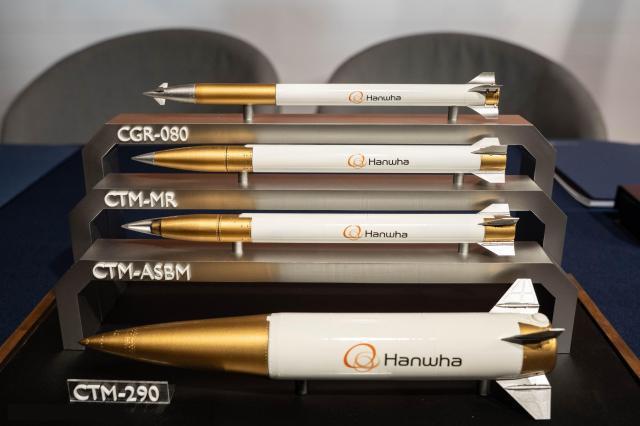
As military tensions rise in the Middle East, demand for air defenses is growing quickly. Iran’s Islamic Revolutionary Guard Corps is confirmed to operate missiles including the Khorramshahr 4, with a range of more than 2,000 kilometers (1,243 miles), as well as the Shahab-3B medium-range ballistic missile and short-range ballistic missiles such as the Fateh-110 and Zolfaghar for precision strikes. The missiles can reach not only Iran’s territory but also Israel, Saudi Arabia, Turkey and southeastern Europe, making stronger air defenses a priority for neighboring countries.
Last month, Israeli newspaper Yedioth Ahronoth warned that Iran continues to expand missile production and could possess at least 5,000 ballistic missiles by the end of 2027.
With the Russia-Ukraine war followed by war involving the United States, Israel and Iran, missile demand is spreading beyond the Middle East and the Caucasus to parts of Europe. Hanwha Aerospace’s Chunmoo multiple rocket launcher has gained traction in those regions. The system can fire up to 12 rockets and can use guided munitions of varying ranges, offering precision-strike capability. It has signed contracts with Poland, Estonia and Norway, and is also reported to have been delivered to some Middle Eastern countries.
The broader push for missile capabilities is also feeding competition to develop hypersonic missiles. The Agency for Defense Development recently said it is working with Hyundai Rotem to field a hypersonic missile by 2034 that can fly at six times the speed of sound. Hyundai Rotem began developing a hypersonic vehicle called “Hycore” in 2018 and said a 2024 test launch maintained stable propulsion at speeds above Mach 6.
Russia’s Zircon is a hypersonic cruise missile with a top speed of Mach 9 and a range of about 1,000 kilometers (621 miles). The United States is developing the AGM-183 ARRW hypersonic missile, and China has entered the competition with the DF-17. Hypersonic missile development is limited to a small number of countries because it requires advanced technology.
Choi Ki-il, a professor of military studies at Sangji University, said modern warfare is increasingly defined by precision strikes using unmanned systems such as missiles and drones rather than traditional wars involving large troop formations. He said the battlespace is expanding beyond land, sea and air to include digital and space domains, and demand for missile weapons is likely to keep rising.
* This article has been translated by AI.
Copyright ⓒ Aju Press All rights reserved.