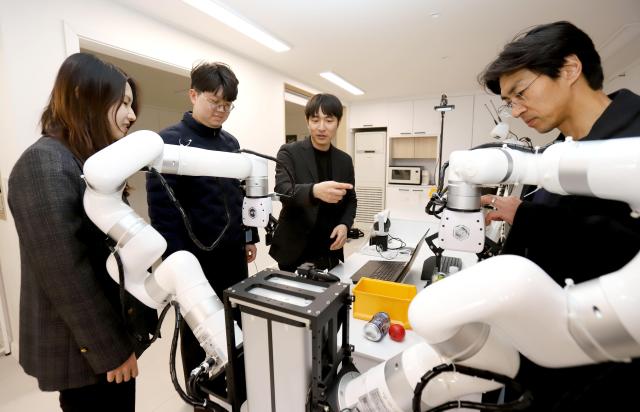
The AI system, built by a team led by Kim Jeong-jung at KIMM's Department of AI Machinery, allows robots to acquire task skills from human demonstrations, replicate them in a virtual environment for training and verification, and then execute them in real-world settings through a hierarchical task-execution framework.
Unlike conventional robotic task technologies that have largely been confined to single-task datasets and simulation-only validation, the new system integrates the entire pipeline — from multi-task dataset construction and real-space virtualization to hierarchical task AI and physical robot deployment, according to KIMM.
The research team said it achieved a success rate exceeding 90 percent across a range of tasks by employing a layered execution structure that breaks down complex operations into sequential steps.
The system was validated on an actual robotic platform operating in real-world conditions, confirming its viability for field deployment.
Potential applications span household and office service tasks, retail shelf arrangement and logistics operations such as picking and sorting — areas where labor-intensive, repetitive work has long been a bottleneck for automation.
"This robotic task AI learns from demonstrations and reasons hierarchically, much like a human worker," Kim said. "We have secured generalized task capabilities applicable across a wide spectrum of everyday operations."
Kim added that the team verified the system's reliability by building a diverse task dataset, securing a real-world testing environment and running validation on an actual robot, confirming that robots can reliably assist with repetitive daily tasks.
The team plans to broaden the range of tasks robots can perform and strengthen their adaptability to shifting environments and unfamiliar objects, with the aim of accelerating deployment in commercial service settings.

Copyright ⓒ Aju Press All rights reserved.