

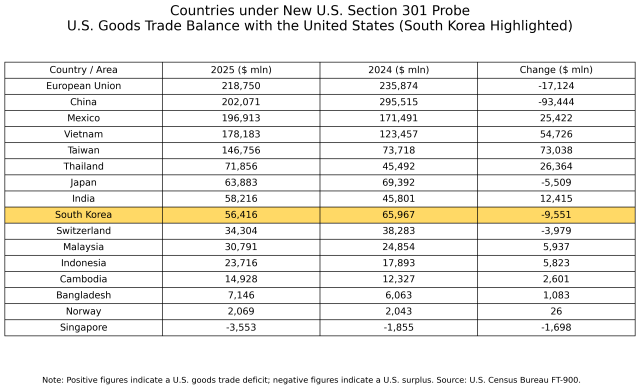
The Office of the United States Trade Representative (USTR) announced Wednesday that it is opening investigations into “structural excess capacity and production in manufacturing sectors” across a range of major trading partners. The list includes China, the European Union, Japan, South Korea, India, Mexico, Taiwan and Vietnam, among others.
While the probe is formally framed as an inquiry into industrial overcapacity and trade distortions, it serves a broader purpose: rebuilding the Trump administration’s tariff framework after the Supreme Court invalidated the reciprocal tariffs imposed under the International Emergency Economic Powers Act (IEEPA).
USTR Jamieson Greer made clear that the administration’s policy direction remains unchanged. “The policy remains the same — the tools may change depending on courts and other circumstances,” Greer said during a briefing with reporters.
In practice, the move shifts the legal foundation for tariffs from emergency powers to Section 301 of the Trade Act of 1974, a longstanding trade enforcement provision that authorizes the U.S. government to investigate and retaliate against foreign practices deemed “unreasonable or discriminatory” toward U.S. commerce.
How Section 301 has been used
Section 301 has historically been one of Washington’s most powerful unilateral trade tools. The provision allows the USTR to investigate foreign policies or practices that harm U.S. commerce and, if necessary, impose retaliatory measures such as tariffs or the suspension of trade concessions.
The tool was widely used before the establishment of the World Trade Organization (WTO) in 1995, after which the United States relied more heavily on the WTO’s dispute settlement system to resolve trade conflicts.
In 2017 the administration launched a major investigation into China’s intellectual property and technology transfer policies. That probe ultimately led to tariffs ranging from 7.5 percent to 25 percent on about $370 billion worth of Chinese imports, marking one of the largest trade enforcement actions in modern history.
The new investigation suggests the administration is now prepared to expand the use of Section 301 beyond China to a broader group of major trading partners.
Washington contends that such excess capacity can distort global markets, displace U.S. production and discourage investment in American manufacturing.
The move comes after the U.S. Supreme Court struck down the administration’s reciprocal tariffs imposed under the International Emergency Economic Powers Act, ruling that the emergency powers law did not provide the authority to impose broad trade tariffs.
The Section 301 investigation therefore represents a new legal pathway to maintain tariff leverage using a statute specifically designed for trade enforcement.
The investigation is proceeding on an accelerated timeline. Written comments from stakeholders will be accepted beginning March 17 and must be submitted by April 15. Public hearings are scheduled to begin May 5.
The schedule aligns with another temporary measure currently in place. The United States has imposed a 10 percent global tariff under Section 122 of the Trade Act, which can remain in force for only 150 days. The administration is widely expected to complete the Section 301 process before that deadline in order to establish a more durable legal basis for tariffs.
If the investigation concludes that foreign practices are harming U.S. commerce, Washington could impose tariffs, introduce service-related fees or pursue negotiations aimed at changing those policies.
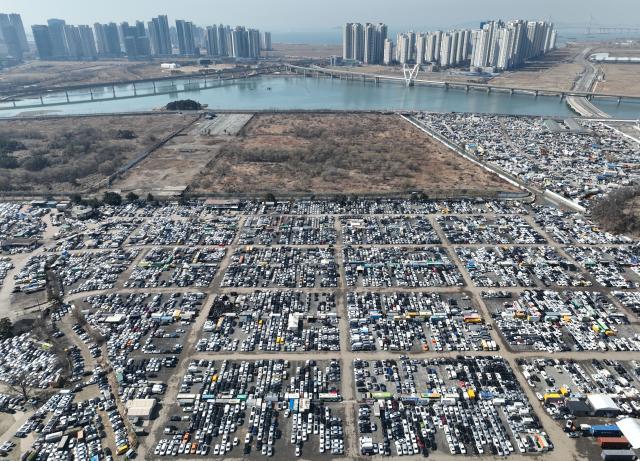
In the Federal Register notice accompanying the investigation, the USTR identifies South Korea as an economy with significant export strength in several key industries. The filing notes that Korea’s global trade surplus is concentrated in sectors such as electronic equipment, automobiles and auto parts, machinery, steel, and ships and marine vessels.
The notice also highlights Korea’s trade relationship with the United States, citing a large bilateral surplus in goods and services in recent years.
U.S. officials argue that such patterns may reflect structural overcapacity that distorts global markets and undermines investment in domestic manufacturing.
By framing the issue in terms of industrial capacity rather than simple trade imbalances, Washington is positioning the probe within a broader strategy aimed at reshaping supply chains and strengthening domestic production.
Although the current investigation focuses on manufacturing overcapacity, USTR officials have suggested that additional Section 301 probes could address other issues affecting U.S. companies abroad.
While U.S. officials say current bilateral trade arrangements remain valid, Section 301 actions could still result in new tariffs or other restrictions.
Seoul highlights that it is ready and not alone in the new offensive.
“The U.S. government has repeatedly explained that it would use Section 301 to restore tariffs to the level that existed before the Supreme Court ruled the IEEPA-based tariffs unconstitutional, and we have been discussing that scenario with them,” Yeo Han-koo, South Korea's trade representative, said Thursday in a briefing.
"The overcapacity investigation is not aimed solely at Korea. It is a broad investigation covering 16 economies,” he said.
Yeo dismissed speculation that the issue could be linked to the regulatory scrutiny surrounding Coupang, noting that the probe concerns manufacturing overcapacity rather than digital-sector policies. “The Section 301 investigation is separate from issues such as digital non-tariff barriers. It has nothing to do with Coupang,” he said.
According to Yeo, the United States also appears focused on maintaining the overall structure of existing trade agreements while using alternative legal tools to restore tariff leverage.
“The U.S. government’s objective is to preserve and maintain the trade deals it has already concluded as much as possible while using other legal instruments to restore tariffs to previous levels,” he said.
He noted that Washington had earlier imposed a blanket 10 percent tariff under Section 122 of the Trade Act as a temporary measure because Section 301 investigations typically require months to complete.
“Section 301 investigations generally take several months to a year, which is why the U.S. first imposed the across-the-board 10 percent tariff under Section 122,” Yeo said.
Based on the expected timeline, he said tariff adjustments under Section 301 could begin emerging around mid-July.
Trade experts say the political context in Washington may also shape how aggressively tariffs are applied.
Heo Yoon, professor of international trade at the Graduate School of International Studies at Sogang University, said tariffs are a major element of economic campaign strategy for U.S. midterm elections.
“Because Section 301 tariffs are item-based, their scope is narrower than the previous reciprocal tariffs and the resulting tariff revenue could be significantly lower,” he said. “That may lead the U.S. government to impose higher tariffs on specific sectors to make up the difference.”
“The USTR hearings are essentially a negotiating table where the 16 economies under investigation will face the United States,” Heo said. “Both the government and the private sector must prepare detailed rebuttals to the U.S. arguments in order to minimize potential tariff damage.”
*AJP's Kim Yeon-jae contributed to this article.
Copyright ⓒ Aju Press All rights reserved.
