K-battery makers bet on premium to fight EV slump and China dominance
by Kim Dong-youngPosted : March 12, 2026, 17:02Updated : March 12, 2026, 17:02
Share
facebook
twitter
URL
Text size
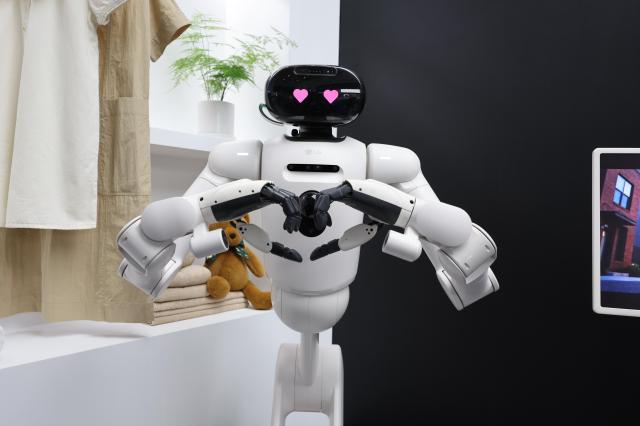
LG Electronics' CLOiD greet visitors with a heart gesture at the InterBattery 2026 held in COEX, March. 12, 2026. AJP Han Jun-gu
SEOUL, March 12 (AJP) - South Korea's battery industry is doubling down on premium technologies — from high-nickel chemistries to all-solid-state prototypes and advanced cell engineering — as it seeks to outpace Chinese rivals and move beyond the slowing electric-vehicle market.
The strategic pivot was on full display at the InterBattery 2026, the three-day exhibition that opened Wednesday at COEX in southern Seoul.
The 14th edition of the show drew 667 companies from 14 countries across 2,382 booths, marking the largest turnout in the exhibition's history and underscoring how battery technology is rapidly expanding beyond automobiles into robotics, artificial intelligence and energy storage.
National pavilions from Sweden, the United Kingdom, the United States, Australia, Canada and the Netherlands highlighted growing international demand for partnerships with Korean battery firms. China fielded 79 exhibitors, the largest single-country contingent.
"Batteries are the heart of advanced industries," said Moon Shin-hak, vice minister of trade, industry and energy, at the opening ceremony, pledging continued government backing to help domestic manufacturers maintain their technological edge amid a slowdown in EV demand and an increasingly volatile global trade environment.
On the exhibition floor, one theme was unmistakable: premium technology over low-cost chemistry.
Discussion of lithium iron phosphate (LFP) — the inexpensive battery chemistry that has underpinned China's dominance in entry-level EVs and energy storage — was relatively muted.
Instead, booth after booth highlighted high-nickel cathodes, all-solid-state batteries and sophisticated packaging technologies, signaling that Korean manufacturers are staking their future on the high-performance end of the market.
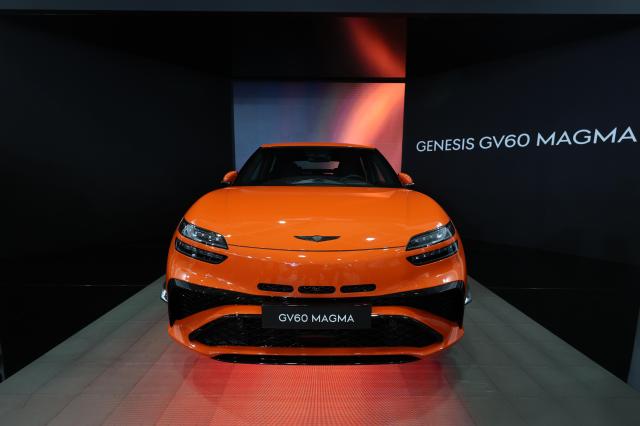
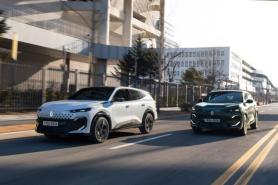
Gensis' GV60 Magma on display at the InterBattery 2026 held in COEX, March. 12, 2026. AJP Han Jun-gu
SK On made perhaps the most vivid statement of that strategy by placing a Genesis GV60 Magma electric SUV at the center of its booth. The performance-focused vehicle carries an 84-kilowatt-hour battery pack built with SK On's high-nickel NCM pouch cells and offers a driving range of about 346 kilometers on a single charge.
The company also unveiled a "Hyper Fast" battery capable of charging from 10 percent to 80 percent in just seven minutes, alongside its cell-to-pack architecture and immersion-cooling battery system. SK On further showcased its first sulfide-based all-solid-state battery, targeting mass production by 2029.
Across the hall, LG Energy Solution occupied the largest exhibition space at 540 square meters. Its centerpiece was the JF2 DC LINK 5.0, a grid-scale energy storage system that won the InterBattery Awards 2026 and represents the company's first use of LFP chemistry in an ESS product.
A Renault Scenic fitted with LG's mid-nickel battery — containing about 70 percent nickel — illustrated a different strategic approach. The configuration aims to balance the performance of high-nickel batteries with a cost profile that sits between premium cells and low-cost LFP alternatives.
Robotics also made an appearance on the show floor, though demonstrations were limited. LG Electronics displayed its home robot CLOiD, first introduced at CES 2026, which greeted visitors with a heart-hand gesture while remaining largely static.
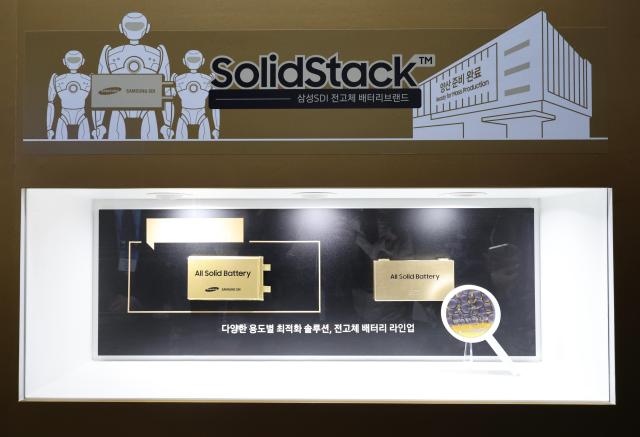
Meanwhile, Samsung SDI drew heavy crowds with the first public unveiling of a pouch-type all-solid-state battery sample designed for robotics and other "physical AI" applications. The company aims to begin mass production in the second half of 2027.
Samsung SDI's pouch type all-solid-state battery for robotics on display at the InterBattery 2026 held in COEX, March. 12, 2026. AJP Han Jun-gu
Samsung selected the pouch format for its lighter weight — a crucial advantage for robots that require high energy density and burst power in compact spaces.
While the company declined to identify potential humanoid-robot clients, its booth slogan — "AI thinks, Battery enables" — left little doubt about its intended market.
Samsung SDI also displayed a high-energy prismatic cell with a volumetric energy density of 700 watt-hours per liter, capable of powering an EV for roughly 800 kilometers on a single charge.
Among cathode material suppliers, the emphasis on performance over cost was equally clear.
POSCO Future M presented ultra-high-nickel cathodes with nickel content above 95 percent, along with newly developed steel battery cans. Rival suppliers L&F and EcoPro also attracted steady traffic.
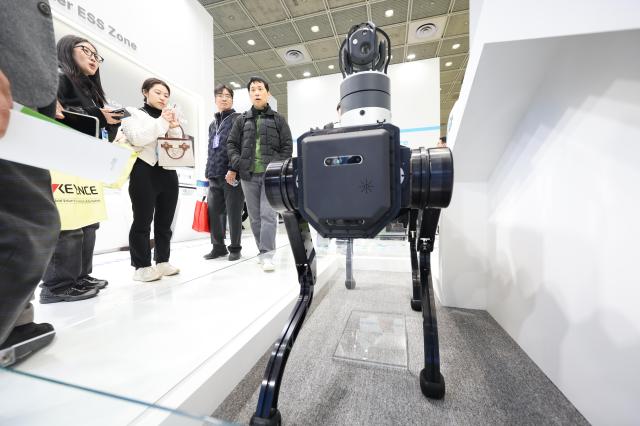
POSCO's four-legged robot on display at the InterBattery 2026 held in COEX, March. 12, 2026. AJP Han Jun-gu
The premium-focused posture reflects a broader strategic calculation. With Chinese competitors dominating much of the mid-tier battery market, Korean manufacturers are betting that advanced chemistries, all-solid-state technology and sophisticated cell engineering will secure territory where margins remain higher and technological barriers harder to replicate.
"The robot battery market is expanding very rapidly, with different technical requirements depending on the type of robot," said Jung Ji-sub, team leader at LG Energy Solution's small-size battery division on the sidelines of the exhibition.
"While many robots rely on GPUs or CPUs for intelligence, their actuators and operating time create very different battery demands."
Safety, however, remains the overriding concern.
"One client at the vice-president level told us directly that they lose sleep over the prospect of a robot catching fire near people," Jung said.
"Energy density and battery life are important, but for robots to coexist safely with humans, safety is the most critical requirement."