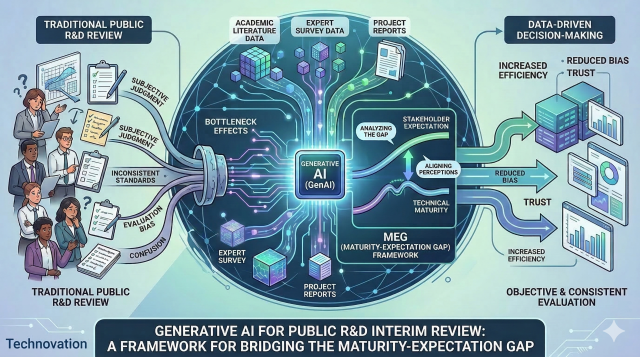
SEOUL, March 18 (AJP) - A research team led by Professor Kim Do-hyung of the KMU International Business School (KIBS) at Kookmin University (KMU) has developed a generative artificial intelligence framework to enhance decision-making in public research and development (R&D) evaluations, the university said Tuesday. The study introduces a systematic approach to bridging the gap between technical capabilities and stakeholder expectations.
The research paper, titled "Bridging the maturity-expectation gap: Generative AI in strategic decision-making for public R&D interim review," was published in the international journal Technovation. It addresses the limitations of current public R&D interim reviews, which often depend on the subjective judgment of experts. These traditional methods frequently face criticism for lacking consistency and being prone to evaluation bias.
To resolve these issues, the team proposed the Maturity-Expectation Gap (MEG) framework. This model analyzes the difference between the actual maturity of generative AI technology and the performance levels expected by stakeholders. By combining survey data from experts with machine learning-based literature analysis, the researchers quantified how perceptions of AI vary across different groups.
The findings revealed that significant discrepancies between expectations and technical maturity can reduce trust and the willingness to adopt AI tools. The study also categorized evaluation areas where generative AI could be easily integrated, as well as those that require additional preparation. This provides a clear roadmap for public sectors to build data-driven decision-making systems.
"Generative AI has the potential to increase efficiency and consistency in the public R&D evaluation process," said Professor Kim Do-hyung. "However, if the gap between expectations and actual technical maturity is not managed, it can lead to distrust and resistance during implementation. The MEG framework proposed in this study can be used to diagnose these gaps and establish phased introduction strategies."
The project was a collaboration between lead author Professor Kim Do-hyung, co-author Professor Kang Song-hee of the Tech University of Korea, and corresponding author Professor Hong Ah-reum of Kyung Hee University. The researchers expect the framework to contribute to more consistent and objective R&D management in the future.
(Reference Information)
Journal/Source: Technovation
Title: Bridging the maturity-expectation gap: Generative AI in strategic decision-making for public R&D interim review
Link/DOI: https://doi.org/10.1016/j.technovation.2024.103110
Copyright ⓒ Aju Press All rights reserved.