

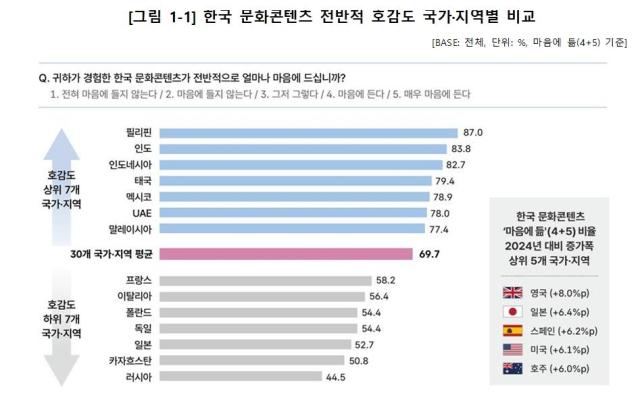
Foreigners’ favorability toward K-content is nearing 70%, a survey found, underscoring the growing reach of K-culture, including its positive influence on purchases of Korean products and services.
According to the Ministry of Culture, Sports and Tourism and the Korean Foundation for International Cultural Exchange, 69.7% of respondents said they had a favorable view of K-content in the “2026 Overseas Hallyu Survey (based on 2025),” released Monday.
The survey targeted people in 30 overseas markets who had experienced Korean cultural content. Compared with the previous year, it added countries including Singapore, Chile and Poland and expanded the sample to 27,400.
By country, favorability was highest in Southeast Asia, including the Philippines (87.0%), India (83.8%), Indonesia (82.7%) and Thailand (79.4%). Favorability also rose from a year earlier in the Americas and Europe, where it had been relatively lower. The biggest increases were in the United Kingdom (up 8 percentage points), Japan (up 6.4), Spain (up 6.2), the United States (up 6.1) and Australia (up 6.0).
As the Korean Wave has spread, negative perceptions have also grown. The share agreeing with negative views of Hallyu was unchanged from last year at 37.5%, but that was up 6.8 percentage points from five years earlier, in 2021.
By content category, popularity was led by food (55.1%), music (54.0%), beauty (52.6%), dramas (51.3%) and films (48.9%). Experience rates were highest for food (78.0%), films (77.9%), dramas (72.9%), music (71.9%) and beauty (61.8%). The results, as in the previous year, suggest that food and beauty have become core areas of Korean culture alongside traditional industries such as music, dramas and films.
For characters, domestic popularity in respondents’ countries was 38.9% and the experience rate was 52.6%, similar to other categories. For live performances excluding K-pop, popularity was 34.4% and the experience rate was 35.1%, indicating an early stage of diffusion.
For the ninth straight year, K-pop ranked first as the image most associated with South Korea at 17.5%, followed by food (12.1%), dramas (9.5%), beauty (6.2%) and films (5.9%). By contrast, “the Korean War” and “North Korea’s nuclear threat/war risk,” which previously ranked high, fell out of the top 10.
Asked what matters most in recognizing content as Korean cultural content, respondents most often chose “content reflecting Korean cultural elements” (23.3%), followed by “many Korean people appear” (21.8%) and “Korea is the setting” (19.1%). “Content produced by Korean directors and production companies” ranked fourth at 18.0%, suggesting respondents place more weight on identity in the content than on whether it was made in Korea.
Preferences for specific dramas and films largely held steady. Netflix’s “Squid Game” (12.4%), which ended with Season 3, ranked No. 1 among dramas for the fifth consecutive year. “Parasite” (8.4%) was selected as the most popular film for the sixth straight year.
In a newly added question on the “most influential Hallyu star,” BTS ranked first at 6.9%. E-sports player Faker entered the rankings at 1.9%, pointing to the Korean Wave’s diversification into gaming.
Average monthly time spent consuming Korean cultural content was 14.7 hours, and average spending per category was $16.6, up 0.7 hours and $1.2 from a year earlier. The most cited reason for buying Korean products and services was “quality” (61.8%), followed by “price” (43.0%) and “ease of use” (33.4%), largely unchanged from last year.
As for how people access Korean cultural content, dramas, films, animation and music were most often consumed through “OTT and video platforms,” while variety shows were most often accessed through social media and short-form video platforms.
* This article has been translated by AI.
Copyright ⓒ Aju Press All rights reserved.