

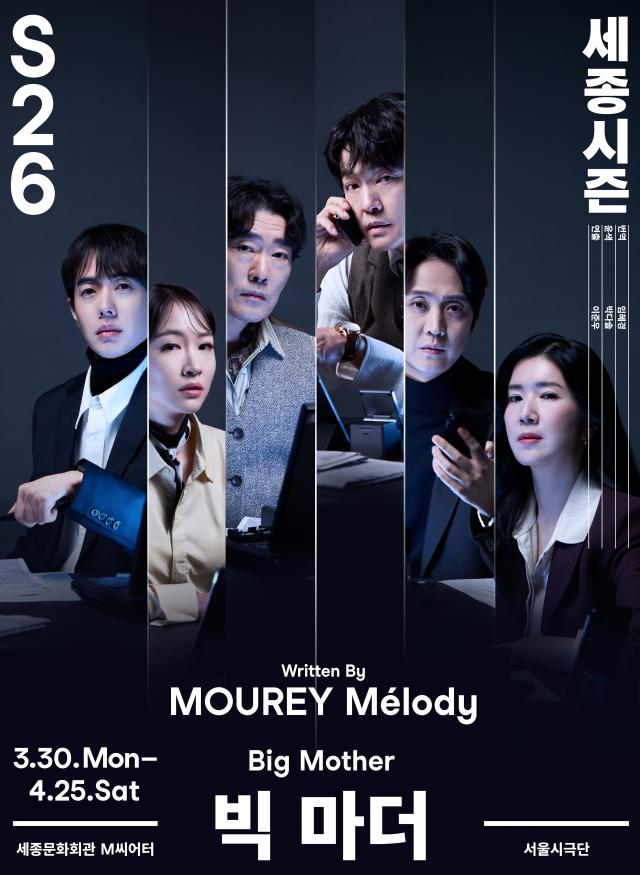
"In a society where everything is transparently exposed, you gain things, but don’t you also lose things?"
The Seoul Theater Company’s production “Big Mother” is staged with screens and transparent glass. The audience can see not only the actors’ gestures and voices, but also real-time projections of political developments. With nothing hidden, the play pushes viewers to consider what “transparency” means, from private backstories to power brokers who dream of creating a “Big Mother.”
Director Lee Jun-woo said after a press call on the 30th that he wanted audiences “to sense and experience the media environment around us and the algorithms of the data age.”
“Big Mother,” a widely discussed work by French playwright Melodie Mourey, presents a thriller about a modern society where politics, media and big data are intertwined. Through journalists fighting to expose a powerful conspiracy, it tracks how truth functions in a world where control disguised as transparency, data surveillance and manipulation of public opinion have become routine.
Lee said he reduced the original’s French-style humor and sharpened its focus on algorithms. “What we search for and buy gets recommended back to us, and I felt like even our desires could be pulled along,” he said. He added that what people see, think and dream “may not be what we truly want, but what an algorithm has led us to,” and warned that algorithm-driven media can leave people believing only what they want and make it harder to encounter those with different views.
The play includes scenes that evoke U.S. President Donald Trump, Elon Musk and Jeffrey Epstein. Lee said he did not set out to deliberately unpack politics, but pointed to characters absorbed in dramas with plots stranger than political news and others who appeal to tears over reason. He said he hopes audiences examine why emotion-driven media can feel more persuasive than truth.
As the story progresses, the focus shifts from algorithms to journalism. Lee said that was unavoidable. He described four reporters: Owen, a pragmatic editor-in-chief; Cook, who writes to win his father’s approval; Julia, who works like a machine after losing her boyfriend; and Kate, who is more focused on the climate crisis than politics. “They flounder in their family ties and personal stories,” he said, adding that only after the midpoint do they confront the case and begin their work. “I thought it had to end as a story about journalism.”
The production runs March 30 to April 25 at Sejong Center’s M Theater.
* This article has been translated by AI.
Copyright ⓒ Aju Press All rights reserved.