

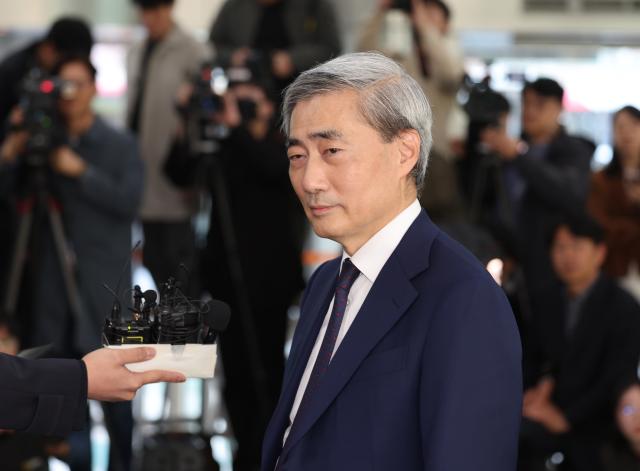
“What matters more than the level itself is whether the financial system can accommodate it,” Shin told reporters as he arrived at his temporary office ahead of his confirmation hearing. “From that perspective, it should not be a concern.”
Shin, a veteran economist from the Bank for International Settlements (BIS), stressed that exchange rate levels alone should not be interpreted as a trigger for financial instability.
“The level itself should not be given too much meaning,” he said. “The exchange rate is one indicator of how much risk the financial system can absorb, and in that sense, there is no major concern.”
He added that dollar liquidity remains ample, pushing back against fears that the sharp depreciation of the won could lead to capital flight or funding stress.
“There is no need to directly link the exchange rate to financial instability,” Shin said.
On external risks, Shin pointed to the ongoing Middle East conflict as the most immediate concern for the Korean economy.
“In the short term, it is clearly the situation in the Middle East,” he said. “Rising oil prices will put upward pressure on inflation while posing downside risks to growth.”
Still, he cautioned that the uncertainty surrounding the scale and duration of the conflict makes it difficult to draw firm conclusions at this stage.
Shin also noted that South Korea’s external financial structure has improved significantly compared to past crises, particularly in terms of capital flows and dollar funding.
He highlighted structural changes in the market, where foreign investors increasingly access Korea’s bond market through foreign exchange swaps — lending dollars while borrowing won — which in turn helps ensure stable dollar funding.
“That structure actually supports dollar liquidity,” he said. On monetary policy stance, he also dismissed labels such as “hawk” or “dove” as overly simplistic.
“I don’t think it is desirable to view policy through a binary lens,” he said. “What matters is reading the economic flow, understanding the interaction between the financial and real sectors, and responding flexibly depending on the situation.”
Shin's remarks however failed to improve market confidence. The dollar was trading at 1,525 against the dollar as of 11:30 a.m. and the main KOSPI and secondary KOSDAQ both fell more than 2 percent. The bond yields rose, finding Shin less hawkish than expected. The three-year government bond yield fell 1.3 basis points to 3.529 percent, while the 10-year yield dropped 2.7 basis points to 3.864 percent.

Copyright ⓒ Aju Press All rights reserved.
