

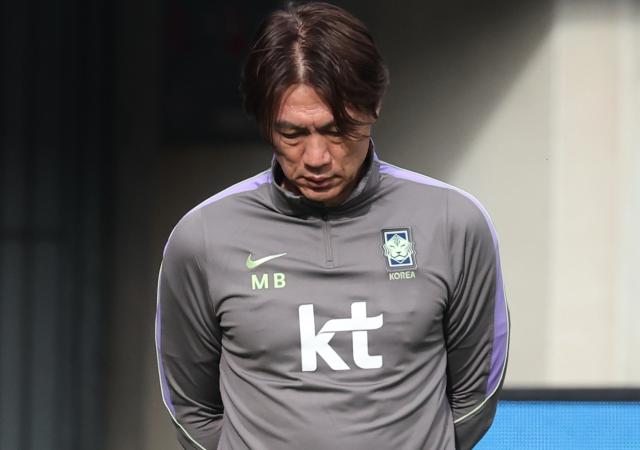
South Korea coach Hong Myung-bo watches training at Ernst Happel Stadium in Vienna on March 30, local time, a day before the match against Austria. (Yonhap)
South Korea coach Hong Myung-bo’s three-back system unraveled in the team’s last friendly, raising fresh doubts about whether it can hold up on the World Cup stage. The upcoming match against Austria is widely seen as the final proving ground for keeping the setup for the 2026 FIFA World Cup.
South Korea lost 4-0 to Ivory Coast on March 28 (Korea time) in a friendly at Stadium MK in Milton Keynes, England. The match was intended as a tune-up against a team modeled on South Africa, a group-stage opponent at the 2026 World Cup, but South Korea struggled throughout against intense pressure and quick transitions.
The biggest concern was the collapse of the three-center-back line of Kim Tae-hyeon (Kashima Antlers), Kim Min-jae (Bayern Munich) and Cho Yu-min (Sharjah). Ivory Coast repeatedly attacked down the flanks. Even when wingbacks Seol Young-woo (Crvena Zvezda) and Kim Moon-hwan (Daejeon Hana Citizen) dropped to form a five-man back line, South Korea showed costly problems with spacing and covering. The team allowed nine shots from inside the penalty area and, with passing lanes into midfield cut off, often resorted to aimless long balls from the goalkeeper that quickly surrendered possession.
Individual strengths were also blunted. Cho appeared burdened by wide defensive cover and made a series of mistakes, while Kim Min-jae — known for dominant one-on-one defending — was repeatedly forced into reactive cover after the flanks had already been breached. The performance echoed issues exposed in last October’s 5-0 loss to Brazil, when South Korea’s three-back struggled against speed and dribbling.
After the match, captain Son Heung-min (Los Angeles FC) told reporters the team must improve its use of space and off-the-ball movement. “If I have to play uncomfortably, the opponent also becomes uncomfortable,” Son said. “I need to position myself in places where it’s difficult to receive the ball.”
Hong pointed instead to shortcomings in individual duels. “We were lacking in one-on-one battles,” he said. “We’ll look for ways to grow further.”
South Korea lost 4-0 to Ivory Coast on March 28 (Korea time) in a friendly at Stadium MK in Milton Keynes, England. The match was intended as a tune-up against a team modeled on South Africa, a group-stage opponent at the 2026 World Cup, but South Korea struggled throughout against intense pressure and quick transitions.
The biggest concern was the collapse of the three-center-back line of Kim Tae-hyeon (Kashima Antlers), Kim Min-jae (Bayern Munich) and Cho Yu-min (Sharjah). Ivory Coast repeatedly attacked down the flanks. Even when wingbacks Seol Young-woo (Crvena Zvezda) and Kim Moon-hwan (Daejeon Hana Citizen) dropped to form a five-man back line, South Korea showed costly problems with spacing and covering. The team allowed nine shots from inside the penalty area and, with passing lanes into midfield cut off, often resorted to aimless long balls from the goalkeeper that quickly surrendered possession.
Individual strengths were also blunted. Cho appeared burdened by wide defensive cover and made a series of mistakes, while Kim Min-jae — known for dominant one-on-one defending — was repeatedly forced into reactive cover after the flanks had already been breached. The performance echoed issues exposed in last October’s 5-0 loss to Brazil, when South Korea’s three-back struggled against speed and dribbling.
After the match, captain Son Heung-min (Los Angeles FC) told reporters the team must improve its use of space and off-the-ball movement. “If I have to play uncomfortably, the opponent also becomes uncomfortable,” Son said. “I need to position myself in places where it’s difficult to receive the ball.”
Hong pointed instead to shortcomings in individual duels. “We were lacking in one-on-one battles,” he said. “We’ll look for ways to grow further.”
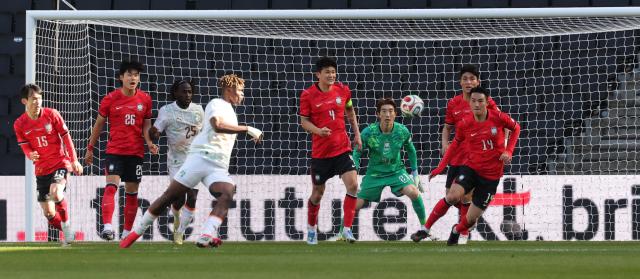
South Korea players face Ivory Coast in a friendly at Stadium MK in Milton Keynes, England, on March 28, local time. (Yonhap)
South Korea now must find answers to the defensive flaws and buildup problems exposed against Ivory Coast in its next test, a friendly against Austria scheduled for 3:45 a.m. April 1 in Vienna at Ernst Happel Stadium. It is the team’s final warmup before the World Cup final roster is announced in May.
With the tournament approaching, a major tactical overhaul appears unlikely. South Korea used a three-back in five of six friendlies in the second half of last year, investing heavily in it as the team’s primary system. The broad framework is expected to remain in place against Austria.
At an official news conference on March 30 (local time), Hong said there was little time to introduce something new. “We don’t have the room to prepare something new in two days,” he said. “The most important thing is where we lost the ball. We need to prepare a style of play that allows us to press immediately when we lose it.”
Hong also called for a quick response, citing last year’s rebound after the heavy loss to Brazil. “After the big defeat to Brazil last year, the players handled it wisely and won the next match (against Paraguay),” he said. “Playing again after a short rest in a difficult situation will help us grow mentally as a team.”
With the tournament approaching, a major tactical overhaul appears unlikely. South Korea used a three-back in five of six friendlies in the second half of last year, investing heavily in it as the team’s primary system. The broad framework is expected to remain in place against Austria.
At an official news conference on March 30 (local time), Hong said there was little time to introduce something new. “We don’t have the room to prepare something new in two days,” he said. “The most important thing is where we lost the ball. We need to prepare a style of play that allows us to press immediately when we lose it.”
Hong also called for a quick response, citing last year’s rebound after the heavy loss to Brazil. “After the big defeat to Brazil last year, the players handled it wisely and won the next match (against Paraguay),” he said. “Playing again after a short rest in a difficult situation will help us grow mentally as a team.”
* This article has been translated by AI.
Copyright ⓒ Aju Press All rights reserved.