

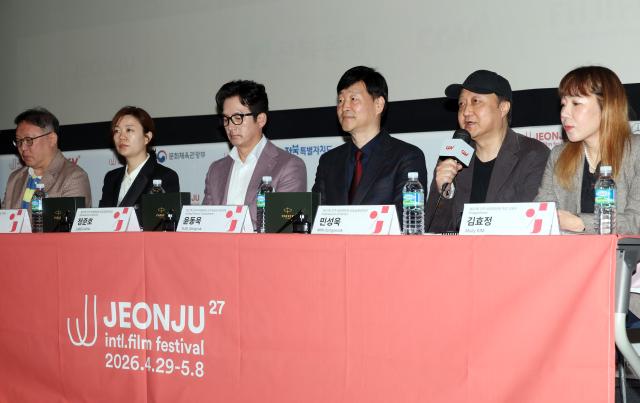
The 27th Jeonju International Film Festival. [Photo = Yonhap]
The Jeonju International Film Festival, a major showcase for independent and art-house cinema, has launched its 27th edition with a theme of pushing beyond traditional boundaries. Organizers named Kent Jones’ “My Private Artist” as the opening film, signaling what they described as a distinctly Jeonju-style program.
A news conference announcing the lineup was held Monday afternoon at CGV Yongsan I’Park Mall in Seoul. Attendees included acting organizing committee chair Yoon Dong-wook; co-festival directors Min Sung-wook and Jung Joon-ho; programmers Moon Seok, Moon Sung-kyung and Kim Hyo-jung; and director Byun Young-joo, selected as this year’s “programmer of the year.”
This year’s slogan is “We Always Cross the Line” (Beyond the Frame). Organizers said it reflects Jeonju’s efforts to expand its programs and venues beyond conventional film formats, while refocusing on human sensibility and the essentials of cinema amid rapidly advancing technology.
“Jeonju International Film Festival has established itself as a valuable platform where creative filmmakers from around the world communicate with audiences, and as a leading film festival in Asia,” Yoon said.
Jung, who secured another term as co-festival director, said, “The past three years went by so fast I don’t know where they went,” adding, “Now that I’ve been reappointed after addressing what was lacking, I will prepare for a better three years.” He added, “After spending three years in Jeonju, I realized there are many fun and thrilling works, like hidden local restaurants. I will take responsibility so the festival can shine even more.”
Min said he would help create a richer festival through “Jeonju-like” films and programs.
The opening film, Jones’ “My Private Artist,” was first unveiled at the Venice International Film Festival. It portrays an artist’s life in allegorical form, depicting a warm world that coexists with everyday pain, organizers said. The closing film is director Kim Hyun-ji’s documentary “Namtaeryeong,” which centers on an incident in Namtaeryeong in December 2024 and examines changes among women and farmers and the broader social impact.
Special screenings will include “New York Underground — The Mavericks,” introduced by newly appointed programmer Kim Hyo-jung, focusing on New York underground artists of the 1960s and 1970s and tracing currents in experimental film. The festival will also present “Meeting Ahn Sung-ki, Slightly Anew,” honoring the late actor Ahn Sung-ki and revisiting lesser-seen aspects of his work in independent and art films. “Ahn Sung-ki is another name for Korean cinema,” programmer Moon Seok said.
Byun, selected for “J Special: Programmer of the Year,” attended in person and said it was “a great joy and honor” to return as a programmer 27 years after attending the first Jeonju festival. “I will watch films diligently in Jeonju,” she said, introducing titles she curated.
Organizers said the “Possible Cinema” program, which drew positive response last year, has been expanded into an official section. Audience-participation events, including alley screenings and urban camping-style screenings, will also be strengthened.
The 27th Jeonju International Film Festival will run for 10 days from April 29 to May 8 at five theaters with 21 screens, including Moak Hall at the Sori Arts Center of Jeollabuk-do and venues around Jeonju’s Film Street.
A news conference announcing the lineup was held Monday afternoon at CGV Yongsan I’Park Mall in Seoul. Attendees included acting organizing committee chair Yoon Dong-wook; co-festival directors Min Sung-wook and Jung Joon-ho; programmers Moon Seok, Moon Sung-kyung and Kim Hyo-jung; and director Byun Young-joo, selected as this year’s “programmer of the year.”
This year’s slogan is “We Always Cross the Line” (Beyond the Frame). Organizers said it reflects Jeonju’s efforts to expand its programs and venues beyond conventional film formats, while refocusing on human sensibility and the essentials of cinema amid rapidly advancing technology.
“Jeonju International Film Festival has established itself as a valuable platform where creative filmmakers from around the world communicate with audiences, and as a leading film festival in Asia,” Yoon said.
Jung, who secured another term as co-festival director, said, “The past three years went by so fast I don’t know where they went,” adding, “Now that I’ve been reappointed after addressing what was lacking, I will prepare for a better three years.” He added, “After spending three years in Jeonju, I realized there are many fun and thrilling works, like hidden local restaurants. I will take responsibility so the festival can shine even more.”
Min said he would help create a richer festival through “Jeonju-like” films and programs.
The opening film, Jones’ “My Private Artist,” was first unveiled at the Venice International Film Festival. It portrays an artist’s life in allegorical form, depicting a warm world that coexists with everyday pain, organizers said. The closing film is director Kim Hyun-ji’s documentary “Namtaeryeong,” which centers on an incident in Namtaeryeong in December 2024 and examines changes among women and farmers and the broader social impact.
Special screenings will include “New York Underground — The Mavericks,” introduced by newly appointed programmer Kim Hyo-jung, focusing on New York underground artists of the 1960s and 1970s and tracing currents in experimental film. The festival will also present “Meeting Ahn Sung-ki, Slightly Anew,” honoring the late actor Ahn Sung-ki and revisiting lesser-seen aspects of his work in independent and art films. “Ahn Sung-ki is another name for Korean cinema,” programmer Moon Seok said.
Byun, selected for “J Special: Programmer of the Year,” attended in person and said it was “a great joy and honor” to return as a programmer 27 years after attending the first Jeonju festival. “I will watch films diligently in Jeonju,” she said, introducing titles she curated.
Organizers said the “Possible Cinema” program, which drew positive response last year, has been expanded into an official section. Audience-participation events, including alley screenings and urban camping-style screenings, will also be strengthened.
The 27th Jeonju International Film Festival will run for 10 days from April 29 to May 8 at five theaters with 21 screens, including Moak Hall at the Sori Arts Center of Jeollabuk-do and venues around Jeonju’s Film Street.
* This article has been translated by AI.
Copyright ⓒ Aju Press All rights reserved.