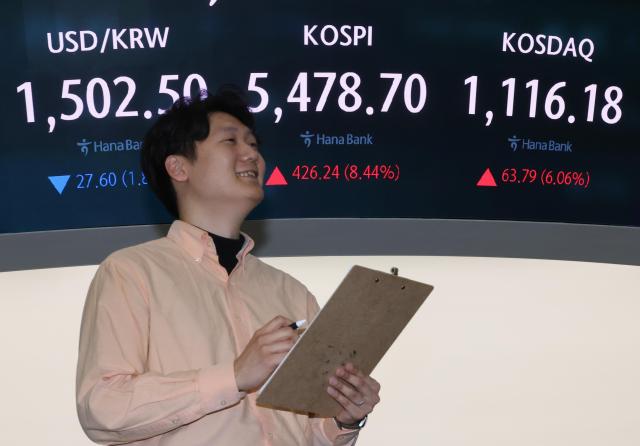
SEOUL, April 1 (AJP) — South Korea's war-beleaguered capital markets roared back with all three assets — stocks, the won and bond prices — strengthening sharply Wednesday, helped by talk of a Gulf war endgame and a rush of foreign capital into the debt market on the first day of Korea’s inclusion in the World Government Bond Index.
But since much of the rally hinges on Gulf developments, the sustainability of the gains remains in question.
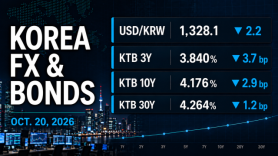
The dollar tumbled below 1,500 won Wednesday, a stunning retreat from above 1,530 in the previous session. Bond yields also retreated, showing a rare moment of strength, with the three-year government bond yield falling 17.7 basis points to around 3.38 percent and the 10-year yield dropping 19.1 basis points to 3.691 percent. The KOSPI ended 8.4 percent higher.
While expectations of a war exit in the Gulf fueled equities, the primary boost to the currency and debt markets came from WGBI inclusion, while the passage of the "Exchange Rate Stability Act" played only a small supporting role.
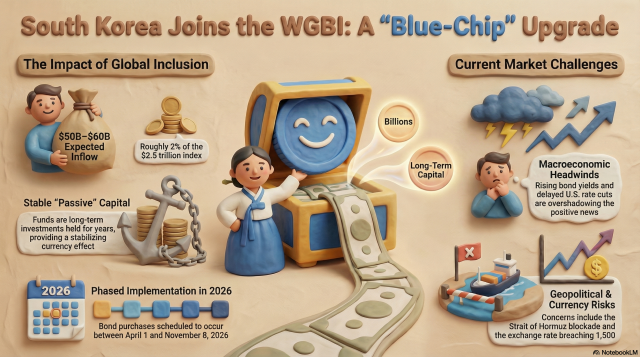
After a year’s delay, FTSE Russell, a subsidiary of the London Stock Exchange, finalized South Korea’s inclusion in the WGBI, with phased purchases of Korean government bonds set from April 1 to Nov. 8, 2026.
Inclusion in the WGBI is often likened to a "blue-chip" certification for a country’s sovereign debt. At least 2 percent of the $2.5 trillion index — equivalent to roughly $50 billion — is expected to be allocated to Korean government bonds, triggering an influx of foreign capital.
Unlike typical emerging market debt flows, WGBI-related funds are primarily "passive" capital aimed at long-term investment. While emerging market debt is often traded within months, WGBI funds tend to be held for several years, providing a stabilizing effect on the currency market.
"Foreign financial institutions and primary dealers forecast an inflow of $50 billion to $60 billion following the WGBI inclusion, and we have confirmed capital inflows starting this week," wrote Goo Yun-cheol, Deputy Prime Minister and Minister of Economy and Finance, on his X account, echoing the optimistic outlook.
Traders are not as optimistic.
"While we saw strength today, it is still insufficient considering that bond yields have surged by 40 to 60 basis points this year alone," said a bond trader at a commercial bank on condition of anonymity. "Since the blockade of the Strait of Hormuz remains the dominant issue, we are treating the WGBI news as a short-term factor."
Yoon Yeo-sam, a researcher at Meritz Securities, also noted that "macro uncertainties, such as delayed U.S. rate cuts and the exchange rate breaching the 1,500 level, are overshadowing the positive impact of the index inclusion."

The so-called reshoring incentive as part of the FX Stability Act drew even more cynicism.
Brokerages have been selling Reshoring Investment Accounts since March 23, offering various tax incentives for those who reinvest dollar-based assets into Korean ones.
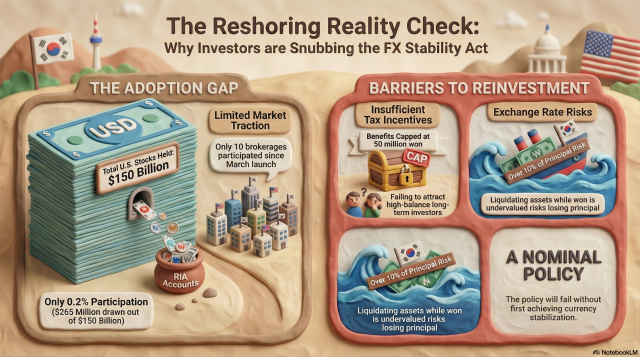
The accounts sold by 10 brokerages have so far drawn 400 billion won ($265 million), about 0.2 percent of the roughly $150 billion in U.S. stocks held by South Koreans.
Investors scoffed at the limited incentives, with tax benefits capped at 50 million won.
"After investing in U.S. stocks for over a decade, my balance is well into the hundreds of millions of won," said one investor. "Unless the tax benefits are significantly expanded for larger and longer-term investments, I have no reason to return."
For others, there is little reason to cash out of U.S. dollar assets, as no tax benefit is enough to offset exchange losses.
"I entered the U.S. market a year ago when the rate was around 1,300 won," said another investor. "With the rate now near 1,500, returning to the domestic market and then trying to re-enter U.S. stocks later would cost me more than 10 percent of my principal."
Experts agree that RIAs will struggle to attract investors without addressing fundamental issues.
"Asking investors to liquidate overseas assets and bring them back in won when the currency is undervalued essentially damages their expected returns," said Kang Hyun-joo, a senior research fellow at the Korea Capital Market Institute.
"Unless currency stabilization comes first, the RIA will remain little more than a nominal policy."

Copyright ⓒ Aju Press All rights reserved.